
 Google
 Yelp
 Facebook
 Twitter
 ChEnected
341197 Thermal Decomposition of Nitrosamines in Amine Scrubbing
Thermal Decomposition of Nitrosamines in Amine Scrubbing
Unlike other carbon capture processes, amine scrubbing is a chemical absorption process which directly contacts the contaminated flue gas with a solvent. The contaminants in the flue gas can react with the solvent, forming dangerous byproducts under the high temperatures in the stripper. Nitrosamines, a family of organic compounds that form from secondary amines reacting with nitrosating agents, are one of the largest environmental issues associated with amine scrubbing. Over 80% of nitrosamines are carcinogenic to humans at low concentrations so it is important to understand and then control their accumulation in amine scrubbing. This work will describe thermal decomposition, the most straightforward techniques for controlling nitrosamine accumulation Thermal Decomposition Kinetics
Recent research
has shown that N-nitrosopiperazine (MNPZ) will decompose under stripper
conditions (Fine & Rochelle, 2013).
Decomposition is first order in MNPZ and half-order in the amine
concentration. This work has been
expanded to include the thermal decomposition of n‑nitrosodiethanolamine
(NDELA), nitrosopiperidine (NPIP), and nitrosomorpholine (NMOR) to understand how nitrosamine
structure effects thermal degradation.
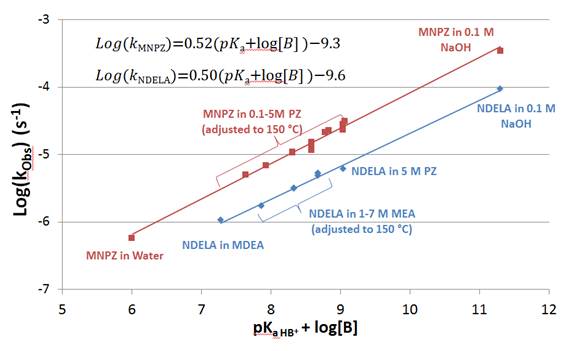
Furthermore, the role of the solvent has been tested on both MNPZ and
NDELA. Nitrosamine decomposition was
found to be base catalyzed with a Bronsted slope of
0.5 (Figure 1). Base catalysis may be
useful in amine scrubbing since reclaiming often runs under strong basic
conditions. Nitrosamine decomposition
was also found to be highly temperature dependent with an
activation energy of approximately 100 kJ/mol across several
nitrosamines. Thus, it is important to
have a thermally stable solvent so that the stripper can run at higher
temperature to increase nitrosamine decomposition.
Figure 1: Base Catalysis
in Nitrosamine Thermal Decomposition Thermal Decomposition Products
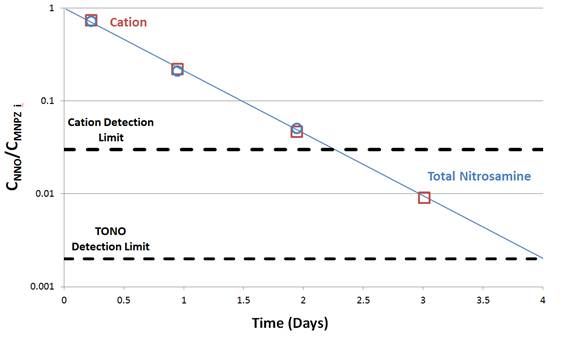
Samples of
thermally decomposed MNPZ were analyzed using a previous HPLC method (Fine,
Goldman, Nielsen, & Rochelle, 2013) as well as a group analysis method for
total nitrosamines. (Dreshcer &
Frank, 1978; Walters & Smith, 1983).
Both methods agreed within the precision of the instruments, proving
that MNPZ does not transnitrosate into another
nitrosamine (Figure 2). In another
experiment the decomposed nitrosamine was analyzed for total aldehydes. Aldehyde concentration increased
stoichiometrically as the nitrosamine decomposed; the final sample was analyzed
using high resolution mass spectrometry and the aldehyde was determined to be
piperazin-2-ol (Figure 3).
Figure 2: MNPZ
Decomposition into Non-nitrosamine species
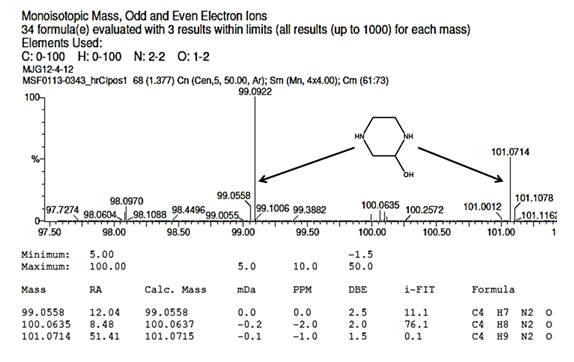
High Resolution Mass Spectrometry of Piperazin-2-ol in Decomposed MNPZ Sample Thermal Decomposition Mechanism
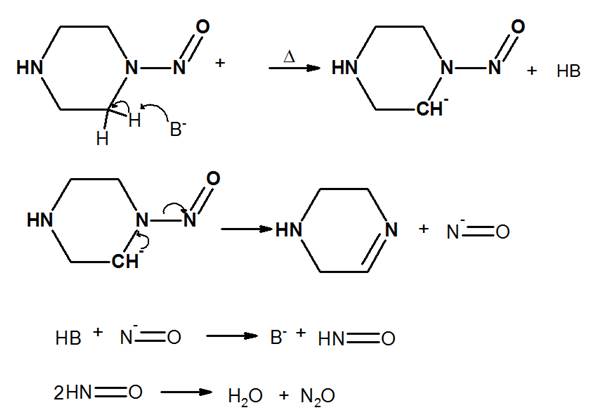
We have now proposed a mechanism for nitrosamine thermal decomposition using the empirical kinetics and decomposition products found (Figure 4). The hypothesized formation of nitrous oxide will be studied using a cycling reactor. The piperazine imine form is readily hydrolyzed to form the piperazin-2-ol seen on the high resolution mass spectrometry.
See more of this Group/Topical: Topical Conference: CO2 Capture