
 Google
 Yelp
 Facebook
 Twitter
 ChEnected
341215 Building a 3D Graphene/Graphene Oxide Matrix for Cooperative Catalysis
Reduced graphene oxide and graphene oxide (GO) based materials have many unique properties that make them intriguing candidates for catalyst supports. These materials have high surface areas, high adsorption capacities, can transfer π-electron density to supported catalytic metal particles, can have high electron mobility which can facilitate electron transfer during catalytic reactions, and also can be chemically transformed through the large number of oxygenate groups on the surfaces. One of the challenges encountered when utilizing graphene oxide materials for catalyst supports is the regraphitization and reduction in surface area when the catalyst is dried to a powder. The reduced graphene oxide layers restack via the strong π-π interactions between layers. This leads to a reduction in access to active sites on the interior basal planes of the catalyst. A number of methods have been explored to reduce this restacking interaction, for example, by creating 3D structures such as graphene-organic-frameworks (GOFs), graphene aerogels, and graphene hydrogels.
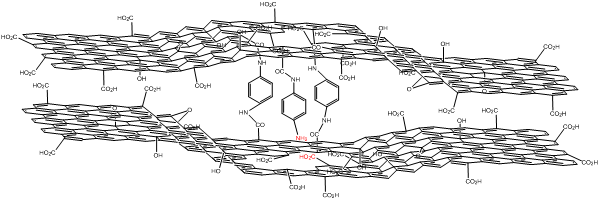
We have explored using 3-D graphene/graphene oxide based framework to create catalytic “pockets” in which we can engineer a micro- or nano- environment that can influence catalytic performance. These ‘pockets' are designed to create a partially nanoconfined or sterically hindered environment in which functional groups are placed near each other to work cooperatively and influence the catalytic active site or the reaction mechanism pathways. We made use of graphene oxides synthesized with nanosized in-plane defects or ‘holes' that also have a high density of carboxylic acid groups and that allows for quicker diffusion of reactants and products to the interior areas of the 3-D structure. By reacting the GO support with compounds such as the diamine compound, 4-aminobenzylamine, the reaction of the two primary amine groups with the carboxylic acid or epoxy groups on the surface of the graphene oxide support would form a bridge between two separate graphene oxide sheets. The phenyl ring of this compound provides enough rigidity to increase the d-spacing of the material, forming pockets, and thus preventing re-graphitization. The introduction of catalytically relevant amine functional groups is accomplished by the utilization of another diamine complex, N-Boc-p-phenylenediamine or N-Boc-ethylenediamine, in which one of the amine functional groups is temporarily protected to prevent it from also becoming a bridging species. The protecting N-Boc group is then chemically or thermally removed which then result in a catalyst with a free primary amine can be located near residual surface carboxylic acid groups. The synthesis and characterization of 3-D structures prepared by this and similar methods will be described, including their structural, chemical and catalytic properties.
See more of this Group/Topical: Nanoscale Science and Engineering Forum