
 Google
 Yelp
 Facebook
 Twitter
 ChEnected
341237 Novel Schemes for CO2 Utilization Using Methane Bi-Reforming and Carbon Formation Reactions
Production of synthesis gas (CO and H2) can be derived from methane via CO2 (dry) or steam reforming. Typical applications of the reformate product gas are the production of methanol, or synthetic fuels via Fischer-Tropsch synthesis. Since a 2:1 ratio of H2 to CO is optimal for these processes; and since CO2 is a pollutant, the two reforming pathways can ideally run in concert (bi-reforming). The net result is utilization of an undesirable gas (CO2), a favorable H2/CO ratio, and coke suppression due to the presence of steam. Therefore, process schemes are explored, which utilize CO2 for the conversion of CH4 to synthesis gas and finally the production of methanol or Fischer-Tropsch liquids. The carbon footprint of CH4 steam reforming (owed to the CO2 produced during combustion of CH4 for generation of the heat required for the endothermic reforming reactions) can be partially offset by employing bi-reforming and/or reverse water gas shift schemes. However, offsetting sequestered CO2 streams (e.g., from coal power plants) requires additional reactions.
The objective of this work is to valorize carbon dioxide by producing liquid fuels and solid carbon. The concept explored is an indirect chemical recycling of CO2 as a valuable carbon source. The overall objective is to explore sustainable carbon cycles of fuel production and consumption by focusing on concentrated CO2 conversion, instead of storage. Carbon formation can be recovered utilizing CO2 via the Boudouard and/or CO hydrogenation reactions. In streams deficient in H2, but rich in CO and CO2, the forward-Boudouard reaction is sought with purpose: the carbon sequestered safely as an inert solid. On an industrial scale, the Boudouard reaction can be staged; the first stage for bulk conversion to filamentous carbon using Fe/Fe2O3 (for sequestration) and CO2, and a second stage (at a now greatly reduced through-put) tailored for structured carbon formation using Fe-Mo/MoO2 (a valuable product). Therefore, CO2 can be utilized in a number processes involving bi-reforming and carbon formation reaction. This presentation will analyze CO2 utilization process flowsheets (such as this of Figure 1) and experimental results on the carbon formation conversion on Fe-based catalysts.
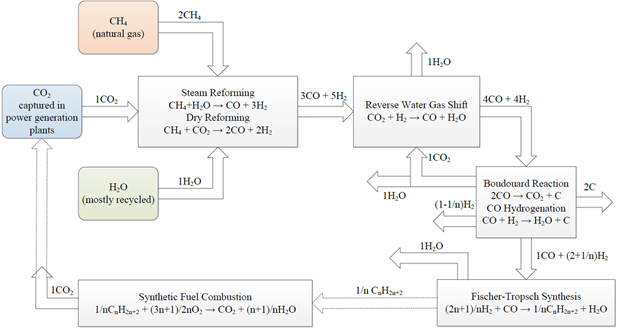
Figure 1: Coupling of DMR SMR, RWGS, C formation and FTS for CO2-neutral liquid fuels production.
See more of this Group/Topical: Catalysis and Reaction Engineering Division