
 Google
 Yelp
 Facebook
 Twitter
 ChEnected
341269 Pretreatment Effects On Charge Storage of Early Transition-Metal Carbides and Nitrides
Pretreatment Effects on Charge Storage of Early Transition-Metal Carbides and Nitrides
Abdoulaye Djirea, Priyanka Pandea , Aniruddha Debb, Alice E. S. Sleightholmea, Paul Rasmussenac, James Penner-Hahnb, Levi T Thompson*ac
a Department of Chemical Engineering
b Department of Chemistry
c Hydrogen Energy Technology Laboratory
University of Michigan, Ann Arbor, MI_- 48109-2130
E-mail: ltt@umich.edu
Early transition-metal carbides and nitrides are promising candidates for use in supercapacitor electrodes due to their high electronic conductivities, high surface areas (can exceed 200 m2/g), good electrochemical stabilities and high capacitance [1,2]. For example, the capacitance for VN has been reported to be as high as 1340 Fg-1 in aqueous KOH [3]. This high capacitance has been attributed to pseudocapacitive charge storage involving fast near-surface redox reactions. We observed that pretreatment of the surface to remove the passivation layer significantly improved the capacitances and electrochemical stabilities of early transition-metal carbides and nitrides in aqueous electrolytes. In this paper we present results from electrochemical characterization including cyclic voltammetry (CV), chronopotentiometry, and electrochemical impedance spectroscopy (EIS), and surface characterization using x-ray photoelectron spectroscopy (XPS) to explain changes in surface chemistry and electrochemical properties caused by pretreatment.
The early transition-metal carbides and nitrides of V, W and Mo were synthesized via temperature-programmed-reaction of their oxide precursors with 15% CH4/H2 or anhydrous NH3 followed by passivation in 1% O2/He at room temperature to form a oxygen-rich passivation layer preventing bulk oxidation on exposure to air [1]. Characterization of the structural properties was performed using nitrogen physisorption (BET surface area) and X-ray diffraction. Prior to the electrochemical characterization, the electrodes were pretreated in 0.3M NaOH aqueous solution for 1 min then rinsed with acetone, ethanol, and ultrapure water [4]. The CV was used to establish the stability windows and capacitances for these materials. The capacitance was deconvoluted into double-layer capacitance and pseudocapacitance by means of CV and EIS. Chronopotentiometry was used for further stability measurements and to determine changes in surface activities caused by pretreatment.
As shown in Figure 1, the specific capacitance for VN increased by 57% after pretreatment. This enhancement in performance suggests significant improvement in material electrochemical activities. We believe that pretreatment altered the charge storage for the carbides and nitrides. We also observed good electrochemical stability after successive cycling of the material for several thousand cycles. In general, the treated materials were more stable than the passivated materials.
Figure 2 shows the open circuit potential (OCP) or rest potentials for the passivated and treated VN in acidic medium. The OCP for the treated material is lower than that for the passivated material. We attributed this to changes in surface activities due to pretreatment. Using the Nernst equation, we found that the treated VN had a higher pseudocapacitance than the passivated VN. This pseudocapacitive charge-storage mechanism is being investigated using XPS and in-situ x-ray absorption spectroscopy.
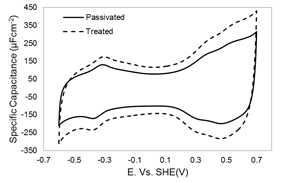
Figure 1: CV of passivated and treated VN in 0.1M H2SO4 at 50 mVs-1.
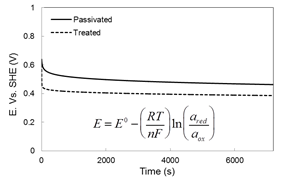
Figure 2: Rest potential of passivated and treated VN in 0.1M H2SO4
The physical and electrochemical properties will be described in terms of a proposed mechanism for psuedocapacitive charge storage.
References
(1) Cladridge, J. B.; York, A. P. E.; Brungs, A. J.; Green Malcolm L. H.; Chem. Mater. 2000, 12, 132.
(2) Wixom, M.R.; Tarnowski, D. J.; Parker, J. M.; Lee , J.Q.; Chen, P. –L.; Song, I.; Thompson, L. T.; Mat. Res. Soc. Symp. Proc. 1998, 496, 643.
(3) Choi, D.; Kumta, P. N.; Electrochem. Solid-State Lett. 2005, 8, 8, A418.
(4) Weidman, M.C.; Elposito, D.V.; Hsu, I. J.; Chen J. G.; J. Electrochem Soc.2010, 157, 12, F179
See more of this Group/Topical: Topical Conference: Nanomaterials for Energy Applications