
 Google
 Yelp
 Facebook
 Twitter
 ChEnected
341369 Adsorption, Structural Alteration and Elution of Peptides At Pendant PEO Layers
Adsorption, structural alteration and elution of poly-peptides at pendant PEO layers
Xiangming Wu, Matthew P Ryder, Joseph McGuire, Karl F Schilke*
A more quantitative understanding of peptide entrapment and elution from otherwise protein-repellent polyethylene oxide (PEO) brush layers will provide direction for development of new strategies for drug storage and delivery. In this work we recorded selected effects of peptide structure and amphiphilicity on peptide adsorption into PEO brush layers based on covalently stabilized Pluronic® F108. In particular we evaluated the adsorption of poly-L-arginine (PLR), and the cationic amphiphilic peptide WLBU2 to PEO brush layers. Each peptide is comprised of 24-30 amino acids with structure readily controllable between disordered and more ordered forms by varying solution conditions. Further, while WLBU2 is highly amphiphilic, PLR is not amphiphilic.
Self-assembled PEO brush layers were formed by suspension of hydrophobic silica nanoparticles in F108 solution. Uncoated and F108-coated nanoparticles were then incubated with PLR or WLBU2 under different solvent conditions for a desired period of time. Peptide structure in the presence or absence of nanoparticles was evaluated by circular dichroism (CD). In addition peptide-nanoparticle suspensions were washed by centrifugation, resuspended in different solvents, and CD spectra recorded again to detect changes in the amount of peptide remaining on the nanoparticles, and determine conformational changes associated with the washing step. Optical waveguide lightmode spectroscopy (OWLS) was used for direct determination of peptide adsorption and desorption kinetics on F108-coated sensors under selected solution conditions. In addition, pyrene fluorescence quenching was used to determine the existence of a hydrophobic inner region (favors peptide adsorption) of self-assembled PEO brush layers.
For both PLR and WLBU2 in their disordered states the CD spectra were similar, independent of the presence of F108-coated nanoparticles. Moreover, CD spectra indicated complete removal of the peptide from each sample after washing the F108-coated nanoparticle suspensions with water. On the other hand, when peptide is in a more ordered form (i.e., possessing α-helix content), CD spectra showed that considerable α-helical PLR remained on the F108-coated nanoparticle surface after washing the suspension with the helix-promoting solvent, while a completely removal of PLR was observed upon washing suspensions with the solvent favored the disordered form of the peptide, as shown in Figure 1. Interestingly, peptide α-helix content increased after location within the brush. Retention of the amphiphilic peptide in the brush was independent of whether the eluting solvent favored the structured or disordered form of the peptide. Complementary OWLS evaluation of adsorbed mass changes within the F108 layer upon washing was fully consistent with the CD results.
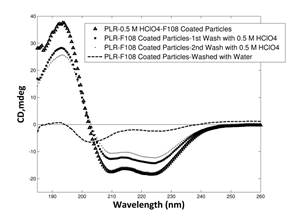
Figure 1. CD spectra of: Poly-L-arginine (PLR) in HClO4, and in suspension with F108-coated nanoparticles before and after washing with HClO4 or water. The non-amphiphilic peptide PLR entrapped in the PEO brush layer was partially elutable when the helix-promoting solvent (HClO4) was used for elution. However, in contact with water (which favors PLR's disordered, non-adsorbable conformation), the adsorbed PLR was entirely elutable.
In summary, an initially more ordered (α-helical) structure promotes peptide adsorption into the PEO layer. Further, a partially helical peptide undergoes a cooperative increase in helicity after entry, likely due to concomitant loss of capacity for peptide-solvent hydrogen bonding. Peptide interaction with the hydrophobic inner region of PEO chains resulted in entrapment and conformational change that was irreversible to elution with changing solution conditions in the case of the amphiphilic peptide. In contrast, the adsorption and conformational change of the non-amphiphilic peptide was reversible. These results indicate that responsive drug delivery systems based on peptide-loaded PEO layers can be controlled by modulation of solution conditions and peptide amphiphilicity.
See more of this Group/Topical: Engineering Sciences and Fundamentals