
 Google
 Yelp
 Facebook
 Twitter
 ChEnected
341427 Injectable, Thermoresponsive Hydrogels With Tunable Cross-Linking Kinetics Based On Ketone and Aldehyde-Functionalized Pre-Polymers
Injectable, thermoresponsive hydrogels with tunable cross-linking kinetics based on ketone and aldehyde-functionalized pre-polymers
Mathew Patenaude and Todd Hoare
Department of Chemical Engineering, McMaster University, Hamilton, Ontario, L8S 4L7
E-mail: patenamj@mcmaster.ca | hoaretr@mcmaster.ca
Introduction
Hydrogels have been widely investigated
for use in biomedical applications due to their physicochemical and
mechanical similarity to the mammalian extracellular matrix. Hydrogels
based on poly(N-isopropylacrylamide) (pNIPAM) are particularly attractive
for potential in vivo application as “smart” hydrogels because they
possess a volume phase transition temperature (VPTT) close to
physiological temperature. Below the VPTT, the polymer network is swollen; exceeding
this VPTT leads to a collapse of the hydrogel network and subsequent
expulsion of water, potentially facilitating entrapment and/or pulsatile
release of therapeutics in drug delivery applications as well as tunable
cell adhesion/release in tissue engineering applications.
Injectable, in situ-gelling hydrogels hold particular interest for in vivo applications given that they can easily be administered into the body without the need for surgical implantation. We have previously demonstrated the fabrication of the first injectable, degradable, and covalently-crosslinked pNIPAM hydrogels composed of hydrazide-functionalized pNIPAM and aldehyde functionalized pNIPAM precursor chains.1 Following their co-extrusion through a double barrel syringe, these precursors can form a covalently cross-linked hydrogel network via formation of hydrolysable hydrazone bonds between the precursor chains; by synthesizing the precursor polymers below the molecular weight of the renal glomerular membrane exclusion limit (i.e. below 40 kDa), the hydrogel can degrade over time and clear from the body.2 The ability of these gels to rapidly form in situ following the co-extrusion of complimentary precursor copolymers makes these systems attractive candidates as injectable biomaterials. However, the extremely rapid rate of gelation results in gel formation within seconds following extrusion, providing minimal time for self-diffusion of the mixed precursor chains within the pre-gel mixture and leading to hydrogels with nanoscale domains of un-crosslinked (unmixed) precursor solutions and/or highly heterogeneous gel structures. Furthermore, while gelation time can be slowed by reducing the functional group content and/or the functional polymer content to enable e.g. spreading of the pre-gel mixture on a surface or self-diffusion-driven mixing, this approach also results in a weaker hydrogel following gelation. As such, it is of interest to reduce the rate of gelation without significantly affecting the mechanical or physicochemical properties (in particular, the cross-link density) of the final hydrogel.
To this end, we have designed a synthetic strategy to control the rate of hydrazone hydrogel network formation by cross-linking hydrazide-functionalized pNIPAM with pNIPAM copolymers possessing a mixture of aldehydes (fast reacting) and ketones (slow reacting). In this way, we can generate injectable hydrogels with a range of formation and degradation kinetics as well as tunable internal morphologies.
Materials and Methods
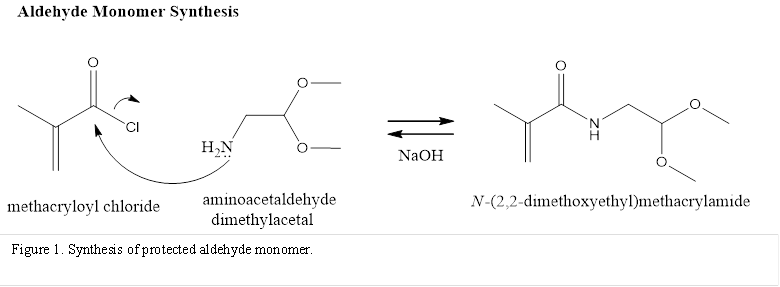
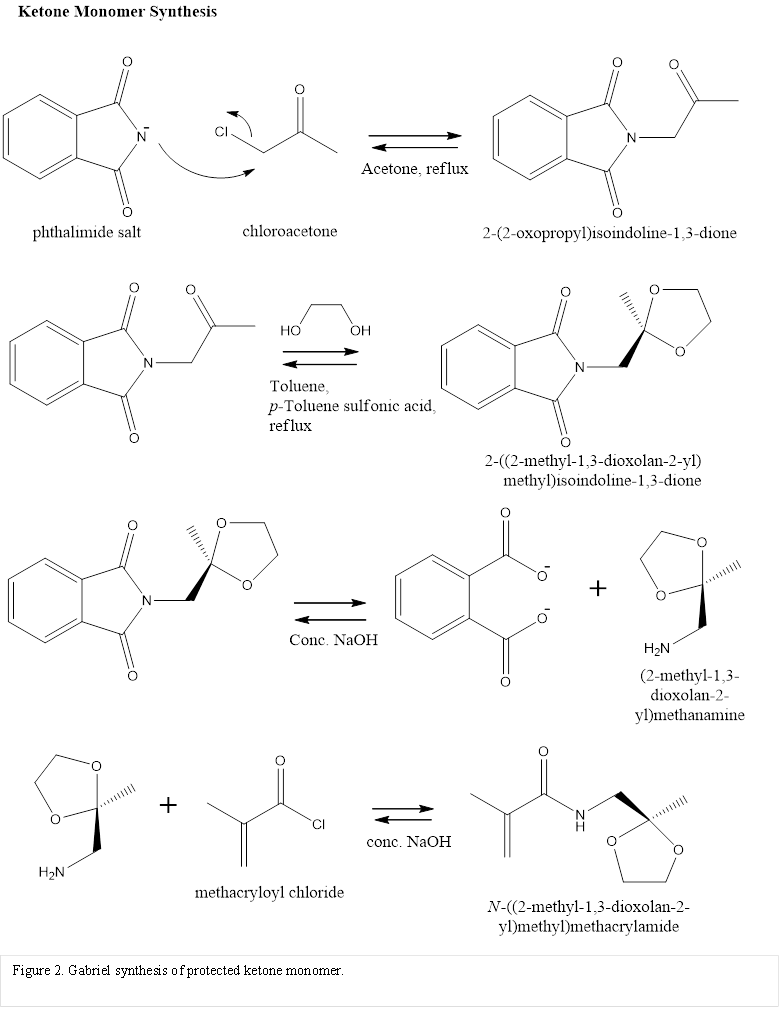
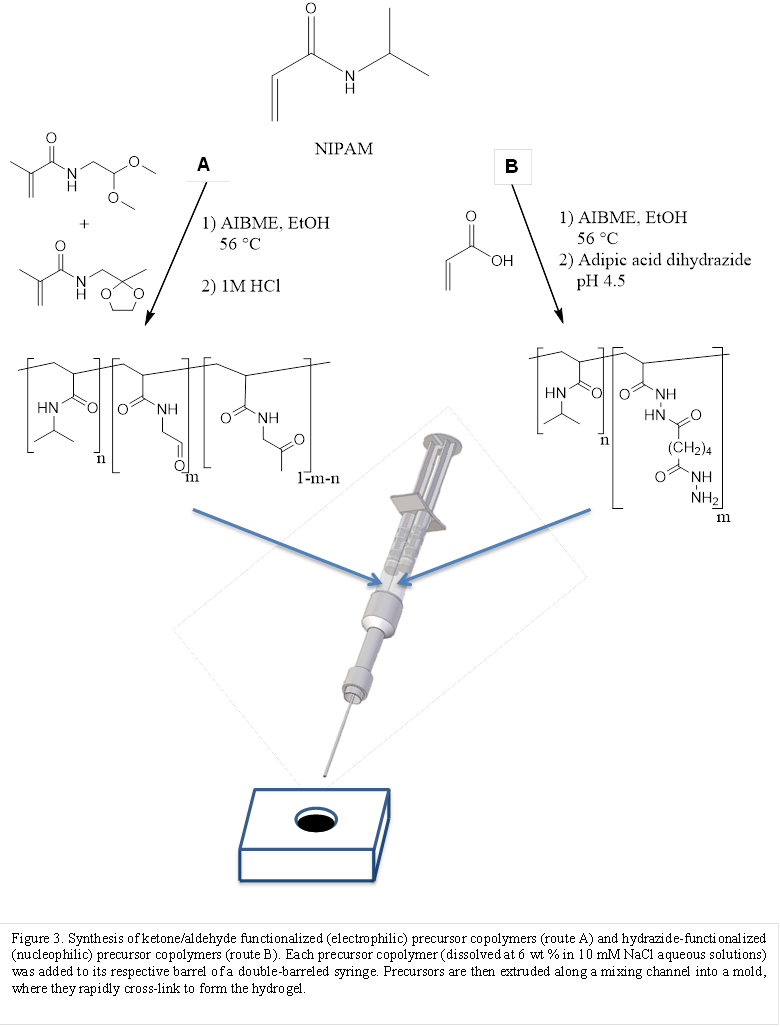
Protected aldehyde and ketone monomers were synthesized according to Figures 1 and 2, respectively. Precursor PNIPAM based copolymers were fabricated according to Figure 3, with hydrogels made from hydrazide-functionalized PNIPAM (nucleophilic precursor) and PNIPAM consisting of a range of aldehyde to ketone functionality (electrophilic precursor). The molecular weight of precursor PNIPAM copolymers was determined using gel permeation chromatography. The degree of hydrazide functionality in the hydrazide functionalized PNIPAM precursor chains was determined using conductometric titration. Aldehyde and ketone functionality were determined using proton NMR calibrated with a tetramethyl silane standard.
Nucleophilic and electrophilic precursors were mixed at constant polymer weight percent via co-injection through a double barrel syringe, as shown in Figure 3. The rate of gel formation for gels made from a range of ketone to aldehyde content was determined using infrared spectroscopy by monitoring the rate of hydrazone peak appearance around 1614-1602 cm-1 and 3344-3263 cm-1. Reversible thermoresponsiveness was determined gravimetrically by incubating the gels at alternating temperatures of 25 °C and 37 °C. The degradability of these gels was demonstrated by incubating them in different concentrations of hydrochloric acid and determining the percent of gel loss over a period of time gravimetrically. Gel heterogeneity was assessed using light transmission measurements and X-ray scattering.
Results and Discussion
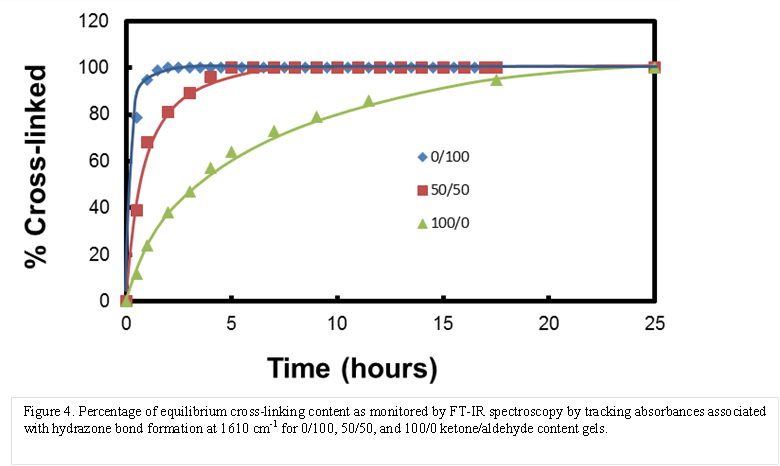
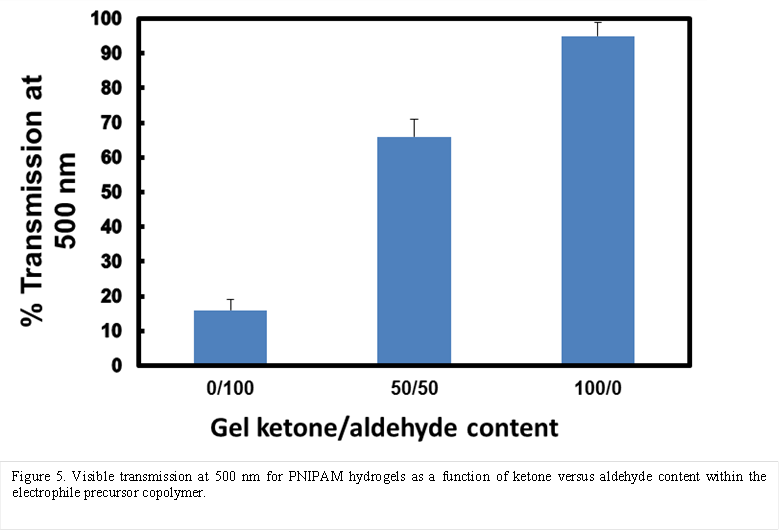
The rate of gel network formation was determined using Fourier transform infrared spectroscopy operating in reflectance mode. A significant decrease in gel cross-linking kinetics was observed as the fraction of the precursor ketone content was increased (Figure 4). Using this method, we have determined that complete gel cross-linking occurs in around 25 hours for gels composed of electrophilic chains possessing 100% ketone content and around 2 hours for gels possessing 100% aldehyde content, with functional gels passing the vial inversion test produced within ~3 minutes for aldehyde-only gels and ~30 minutes for ketone-only gels. Mixtures composed of electrophilic copolymer chains consisting of a 50/50 mix of aldehydes to ketones formed fully cross-linked solid gels at an intermediate time of around 5 hours, with functional gels being produced after ~10 minutes. Transmission studies conducted at 500 nm demonstrated that the degree of homogeneity increases as the precursor ketone content is increased and the cross-linking kinetics are slowed (Figure 5). X-ray scattering and atomic force microscopy results probing the homogeneity of the ketone versus aldehyde-functionalized hydrogels will be presented.
Conclusions
The rate of gel formation in hydrazone-crosslinked networks can be tuned by changing the ratio of aldehyde to ketone functional groups in the electrophilic precursor polymer mixture. Gelation times ranging from 3 to 30 minutes can be achieved, with slower cross-linked hydrogels exhibiting improved homogeneity without sacrificing mechanical strength. This approach can be used to make injectable hydrogels adaptable to a much wider range of potential biomedical applications (i.e. cell encapsulation, thin film formation, etc.).
Acknowledgements: Funding from the Natural Sciences Engineering Research Council of Canada (NSERC) is gratefully acknowledged
References
(1) Patenaude, M.; Hoare, T. ACS Macro Letters 2012, 1, 409–413.
(2) Patenaude, M.; Hoare, T. Biomacromolecules 2012, 13, 369–78.
See more of this Group/Topical: Materials Engineering and Sciences Division