
 Google
 Yelp
 Facebook
 Twitter
 ChEnected
341442 Evidence of a Hydrophobic Region in Pluronic Brush Layers Formed On Silica Surfaces
The action of pendant, polyethylene oxide (PEO) brush layers as nonfouling coatings for biomedical materials is well understood. However progress toward clinical application of stable, high density PEO coatings has historically been impeded by the lack of cost effective, non-invasive methods for their preparation. Triblock polymers featuring a hydrophobic, polypropylene oxide (PPO) or polybutadiene (PB) centerblock flanked by two PEO side chains can be used to coat the surfaces of hydrophobic biomedical materials, and in this way render them less prone to protein adsorption and bacterial adhesion. Optimal coating requires awarenesss of triblock aggregation properties, and for this purpose pyrene fluorescence quenching was used to determine the critical aggregation concentration of the triblocks used in this work. Coatings produced by radiolytic grafting of PEO-PB-PEO triblocks to polyacrylonitrile membranes used in hemodialysis were evaluated in relation to impact on urea permeability through the membrane. Neither the presence of PEO-PBD-PEO triblocks nor the irradiation process was observed to have any effect on membrane permeability to urea. Beyond issues surrounding biocompatibility, PEO coatings can potentially be used to entrap and later release bioactive peptides for short-term medical device applications. In this context, pyrene fluorescence quenching (Figure 1) was used to demonstrate the existence of a hydrophobic inner region of PEO layers based on PEO-PPO-PEO triblocks, substantially explaining the high affinity for entrapment previously recorded for amphiphilic peptides.
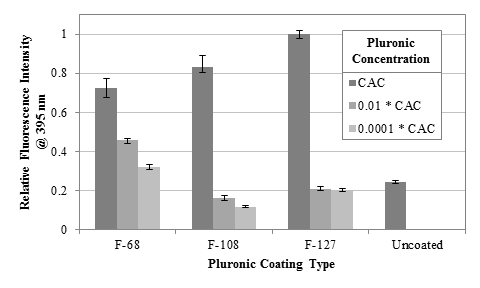
Figure 1: Plot of relative fluorescence intensity of pyrene at 395 nm for various Pluronic coatings on R816 nanoparticles. Coatings were made at different concentrations, denoted by the dilution factors. The dilution scheme is based on the CAC value for each Pluronic. The error bars show the minimum and maximum values for each data set of three samples.
See more of this Group/Topical: Engineering Sciences and Fundamentals