
 Google
 Yelp
 Facebook
 Twitter
 ChEnected
341733 Deactivation Model for Co Fischer-Tropsch Catalysts
One of the foremost technical barriers to the successful, economical practice of Fischer-Tropsch Synthesis (FTS) is uncertainty regarding catalyst life. Understanding the chemistry of deactivation pathways and modeling catalyst deactivation rates are imperatives to the design of more stable catalysts and the development of robust, realistic reactor models which facilitate FT reactor/process design and optimization. Carbon deposition on FT catalysts, however, is not sufficiently quantitatively understood to effectively enable its management. Our goal is to develop a deactivation rate model which predicts the deactivation of Co FT catalysts by carbon deposition as a function of reactant partial pressures and temperature.
The FTS reaction kinetics and deactivation kinetics can be linked by the activity of the catalyst. Activity (a) is a function of time, temperature, and concentrations and is defined as the CO depletion rate normalized by the initial rate. The rate of the main reaction (rm) and deactivation rate (rd) are defined as follows:
-rm = k(T) f1(T,C) a
-rd = -da/dt = kd(T) f2(T,C) ad
f1(T, C) and f2(T, C) are potentially functions of reactant and product concentrations and temperature which can lead to models with shifting reaction orders (e.g. Langmuir-Hinshelwood) which are more complex than models traditionally used such as power-law and generalized power-law models [1]. To verify and determine the constants for such a model, a wide range of rate data as a function of CO and H2 partial pressures is needed.
The proposed mechanism for carbon deposition is shown Figure 1. It consists of 1) dissociation of CO on the surface to atomic carbon (Cα), 2) transformation of Cα to polymeric carbon (Cβ), 3) formation of graphitic carbons (CC), 4) hydrogenation of Cα, 5) hydrogenation of Cβ. Reactions 1, 2, 4, and 5 are considered in this study.
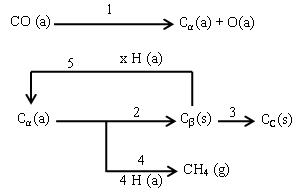
Figure 1. Formation, transformation, and hydrogenation of carbon on cobalt ((a), (g), (s) refer to adsorbed, gaseous, solid states, respectively).
Kinetic parameters of the first elementary step can be estimated by CO-TPD [2] and the other elementary steps can be found by temperature-programmed hydrogenation (TPH) [2]. CO-TPD and TPH spectra on a cobalt catalyst are shown in Figure 2.
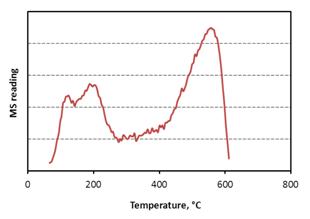
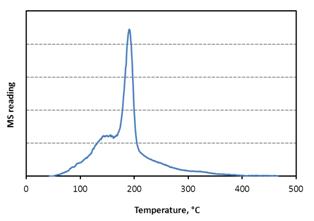
Figure 2. (a) CO-TPD spectra after CO adsorption at 150 °C, (b) TPH spectra after FTS for 1 h at 200 °C, H2/CO=1.
References:
1- Fuentes, G.A. Applied Catalysis, 15, 33 (1985).
2- Paul, U., Microkinetic model of Fischer-Tropsch synthesis on iron catalysts, in Chemical Engineering. 2008, Brigham Young University: Provo.
See more of this Group/Topical: Catalysis and Reaction Engineering Division