341814 Polycarboxybetaine Esters for Gene Delivery: Molecular Tuning, Controlled Degradation and Vaccine Applications
Thursday, November 7, 2013: 4:55 PM
Golden Gate 8 (Hilton)
Andrew Sinclair1, Tao Bai2, Lei Zhang3, Shaoyi Jiang1 and Ann Nowinski4, (1)Chemical Engineering, University of Washington, Seattle, WA, (2)ChemE, University of Washington, Seattle, WA, (3)Bioengineering, University of Washington, Seattle, WA, (4)nowinsk2@uw.edu, Seattle, WA
The safe and
controlled delivery of genes to targeted cells promises exceptional advancements
in clinical disease treatment, next-generation vaccines, and tissue
engineering. [1-3] An ideal polymeric vector would condense nucleic acids into
stable polyplexes that can successfully navigate the extracellular environment
and pass through the cell membrane, as well as protect genes from degradation
inside and outside the target cells and assist with escape from the endosome or
trafficking vesicle. We have developed a gene delivery platform based on
polycarboxybetaines (PCBs) modified with degradable esters, with the goal of
optimizing each function without detriment to the others.
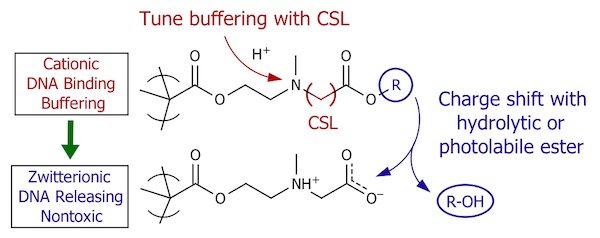
When the
anionic carboxylate groups in zwitterionic PCB side chains are esterified, the
polymer is rendered cationic and thus able to bind and condense nucleic acids.
[4,5] A tertiary amine can be introduced in place of the quaternary ammonium to
make the polymer pH-responsive, buffering pH changes during polyplex
trafficking and providing a mechanism via the "proton sponge" for endosomal or
phagosomal escape. Another key function of this platform is the hydrolytic
conversion of cationic PCB esters to zwitterionic PCB. The rate of this charge
shifting can be easily modified by the incorporation of different ester leaving
groups and different distances between the ester and the tertiary amine groups.
This appends a "smart" characteristic to this polymer; DNA is first strongly
complexed by cationic PCB-esters, but is efficiently released when ester
degradation reveals the anionic carboxylate groups, rendering PCB zwitterionic
and nontoxic.
In our
recent study [6], the side chain length was varied to include either one or two
alkyl spacers denoted between the amine and the carboxylate/ester groups.
Additionally, each chain length was synthesized with both an ethyl ester and a
tert-butyl ester hydrolytic group. These molecular modifications result in
monomers and resulting polymers with varying proton buffering capacities and
hydrolytic profiles. An alkyl spacer length of one brings the pKa of each amine
into the optimal range for endosomal buffering, and the hydrolytic ester can be
easily modified to speed or slow charge switching. An optimized polymer is able
to deliver plasmid DNA an order of magnitude more effectively than
polyethyleneimine, without demonstrating any cytotoxicity.
We have also
developed a novel photolabile o-nitrobenzyl ester of polycarboxybetaine
(PCB-NBE) to give this platform a UV- sensitive "switch" for active degradation
control, to study how the charge neutralization caused by ester degradation
directly catalyzes DNA release from a polyplex. Photoinitiated ester
degradation precipitates the rapid release of over 70% of complexed DNA from
PCB-NBE polyplexes. This molecule is promising for triggered release of nucleic
acid therapies in vitro.
Extending
the functionality of this polymer class, we have applied a similar platform to
the passively targeted delivery of DNA vaccines with polycarboxybetaine
micro-"gels". [7] These hydrogel microparticles target the phagocytosis pathway
of immunostimulating cell types to delivery nucleic acid vaccines adsorbed to
their surface. Tertiary amines and hydrolytic esters confer similar benefits of
attraction, buffering, and release as they do in nanosized polyplexes. A model
vaccine delivered to macrophage cells has resulted in over 10x higher
expression than that delivered from a cationic CTAB microparticle control. This
platform is also nontoxic and easily tunable.
References:
[1] Sheridan,
C. Nat. Biotechnol. 2011, 29, 121-128.
[2] Ferraro,
B.; Morrow, M. P.; Hutnick, N. A.; Shin, T. H.; Lucke, C. E.; Weiner, D. B. Clin. Infect. Dis. 2011, 53, 296-302.
[3] Vallet-Regi, M.; Ruiz-Hernandez, E.; Gonzalez, B.; Baeza, A. J. Biomater. Tissue Eng.
2011, 1, 6-29.
[4] Zhang,
Z.; Cheng, G.; Carr, L. R.; Vaisocherova,́ H.; Chen, S.; Jiang, S. Biomaterials 2008, 29,
4719-4725.
[5] Carr, L. R.; Jiang, S. Biomaterials
2010, 31, 4186-4193.
[6] Sinclair,
A.; Bai, T.; Carr, L. R.; Ella-Menye,
J-R.; Zhang, L.; Jiang, S. Biomacromolecules 2013 (DOI: 10.1021/bm400221r)
[7] Zhang,
L.; Sinclair, A.; Cao, Z.; Ella-Menye, J-R.; Xu, X.; Carr, L. R.; Pun, S.
H.; Jiang, S. Small 2013 (DOI: 10.1002/smll.201202727)
Extended Abstract: File Not Uploaded
 Google
 Yelp
 Facebook
 Twitter
 ChEnected
