
 Google
 Yelp
 Facebook
 Twitter
 ChEnected
341899 A Reduced Mechanism for the Prediction of Olefin Production and Coke Precursors During the Steam-Cracking of Ethane and Propane
A reduced mechanism for the prediction of olefin production and coke precursors during the steam-cracking of ethane and propane
L.C. López 1, A.Y. Ramírez1, M.Kraft2, J.C. Vivas3, A. Molina*,1
1 Universidad Nacional de Colombia – Sede Medellín, Facultad de Minas, Bioprocesos y Flujos reactivos, Medellín, Colombia
2 University of Cambridge, Department of Chemical Engineering and Biotechnology, Computational Modelling Group, Cambridge, England
3Instituto Colombiano del Petróleo, Piedecuesta, Colombia
*Corresponding author: amolinao@unal.edu.co
A reduced mechanism for the steam-cracking of ethane and propane was proposed. Thermal cracking of hydrocarbons is the main route for the production of valuable products such as ethylene and propylene from ethane, propane and naphtha. Recently Ramírez [1] proposed a model that represents coke formation during the steam-cracking of ethane and ethane-propane mixtures. The success of Ramirez's model depends on the ability of a gas-phase mechanism to predict the concentration of coke precursors such as benzene, hydrogen and acetylene. Among the numerous kinetic mechanisms developed to describe the combustion and pyrolysis of hydrocarbons, Ramirez recommended those developed by Frenklach et al. [2, 3] and Wang et al. [4, 5] that can represent the pyrolysis of light hydrocarbons.
The kinetic mechanism of Frenklach et al. (ABF mechanism) consists of 99 chemical species and 544 reactions [2, 3]. It includes the pyrolysis and oxidation of C1 and C2 species and considers pyrene as the heaviest aromatic compound. The kinetic mechanism described by Wang et al. (USC mechanism), with 352 species and 2083 reactions in its last published version, takes into account the combustion of H2/CO/C1-C4 and the description of pyrolysis and combustion at high temperature of normal alkenes up to n-dodecane. It has as the most complex aromatic compound benzene [4, 5]. These mechanisms involve a large number of chemical species and reactions and, therefore, imply a high computational cost. As the detail required in the simulation of cracking processes increases (e.g. in CFD analyses or in optimization processes), large mechanisms become impractical. A reduced mechanism that decreases the computational cost without losing information about the most important species and coke-precursors is, therefore, desirable.
In the referred literature several authors have worked on the simplified representation of reaction mechanisms [6-10]. Most authors agree that a strategy for reducing a kinetic mechanism could combine sensitivity and principal component analyses (PCA). This study proposes reduced versions of the ABF and USC mechanisms, keeping in mind its application to the simulation of coke deposition in a steam-cracking reactor operating with ethane and ethane/propane mixtures. The new versions were obtained after a PCA following the methodology described by Tomlin et al. [6]. A value of 10-6 was used as threshold for the eigenvalues and eigenvectors analysis to determine the redundant reactions and generate the reduced mechanism. To validate the reduced mechanism, simulations were carried out for a batch and a PFR reactors with the same temperature profile (approximating the time as space time for the batch reactor assuming a residence time of 0.5 s) of an industrial steam-cracking furnace operating at the conditions described by Ramirez [1]. Fig.1 shows the concentration profile of important species in a simulation carried out in the batch reactor. As the ethane concentration decreases, the concentration of ethylene and propylene increases.
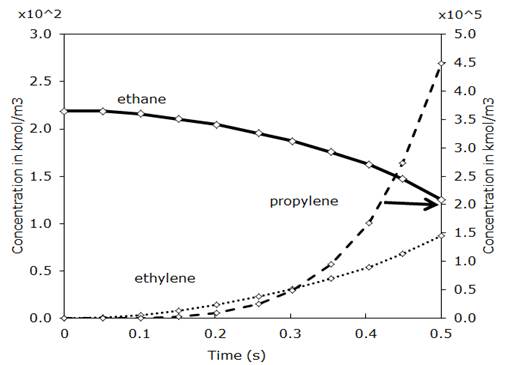
Fig 1. Concentration profiles of important species. Ethane, ethylene and propylene for the simulation using the reduced USC mechanism
After applying the PCA analysis the number of reactions for the ABF and USC mechanisms was reduced to 28% and 16% of the original value, respectively. Fig. 2 and Fig. 3 show, through a parity plot, that the predictions for benzene and acetylene perfectly agree between the original and reduced mechanisms for the batch simulations. Similar results were obtained for other species. Fig. 4 shows that the reduced ABF mechanism correctly represents the conversion of ethane along the industrial steam-cracking furnace. Similar profiles, obtained for other coke precursors, indicate that the reduced ABF mechanism, with only 153 reactions, guarantees a good representation of the process of steam-cracking of ethane.
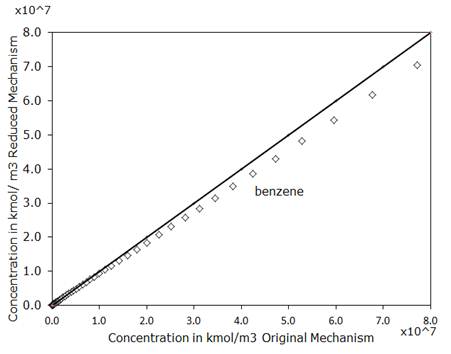
Fig 2. Comparison of predictions for benzene concentration during the steam-cracking of ethane in a batch reactor as obtained with the original and reduced USC mechanisms
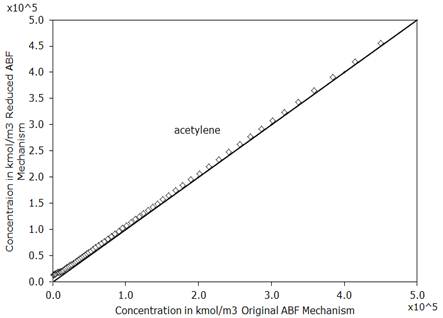
Fig 3. Comparison of predictions for acetylene concentration during the steam-cracking of ethane in a batch reactor as obtained with the original and reduced ABF mechanisms
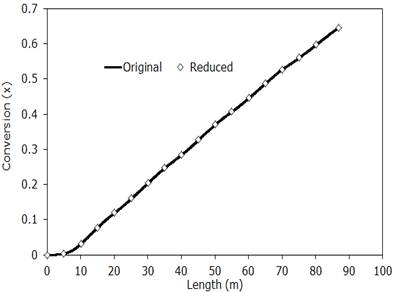
Fig. 4. Comparison of the predicted ethane conversion by the ABF original and reduced mechanisms along an industrial ethane steam-cracker.
REFERENCES
[1] A. Ramírez. “A model for the prediction of olefin production and coke deposition during thermal cracking of light hydrocarbons”. M.Sc. thesis, Universidad Nacional de Colombia, 2012. Available on http://www.bdigital.unal.edu.co/7360/1/1017125365.2012.pdf
[2] M. Frenklach, J. Appel, and H. Bockhorn, “ABF mechanism.” [Online]. Available: http://www.me.berkeley.edu/soot/mechanisms/abf.html.
[3] J. Appel, H. Bockhorn, and M. Frenklach, “Kinetic modeling of soot formation with detailed chemistry and physics: laminar premixed flames of C2 hydrocarbons,” Combustion and Flame, vol. 121, no. 1–2, pp. 122-136, 2000.
[4] H. Wang, X. You, A. V. Joshi, S. G. Davis, A. Laskin, and F. Egolfopoulos, “USC Mech Version II. High-Temperature Combustion Reaction Model of H2/CO/C1-C4 Compounds.” [Online]. Available: http://ignis.usc.edu/USC_Mech_II.htm.
[5] H. Wang and F. Egolfopoulos, “JetSurf-A Jet Surrogate Fuel Model.” [Online]. Available: http://melchior.usc.edu/JetSurF/.
[6] A. S. Tomlin, M. J. Pilling, J. H. Merkin, J. Brindley, N. Burgess, and A. Gough, “Reduced Mechanisms for Propane Pyrolysis”, Industrial & Engineering Chemistry Research, vol. 34, no. 11, pp. 3749-3760, 1995.
[7] T. Kovács, I. G. Zsély, A. Kramarics, and T. Turányi, “Kinetic analysis of mechanisms of complex pyrolytic reactions" Journal of Analytical and Applied Pyrolysis, vol. 79, no. 1-2, pp. 252-258, 2007.
[8] T. Turányi, “Sensitivity analysis of complex kinetic systems. Tools and applications," Journal of Mathematical Chemistry, vol. 5, no. 3, pp. 203-248, 1990.
[9] T. Turányi. “Reduction of large mechanisms”. New Journal of Chemistry. Vol. 14 no. 11. pp. 795-803. 1990.
[10] M. S. Okino and M. L. Mavrovouniotis, “Simplication of Mathematical Models of Chemical Reaction Systems" Chemical Reviews, vol. 98, no. 2, pp. 391-408, 1998.
See more of this Group/Topical: Catalysis and Reaction Engineering Division