
 Google
 Yelp
 Facebook
 Twitter
 ChEnected
341993 Chemotactic Live Autonomous Drug Delivery Agents With Different Body Geometries
Chemotactic live autonomous drug delivery agents with different body geometries
Ali Sahari1, Mahama A. Traore2, and Bahareh Behkam1, 2
1School of Biomedical Engineering and Sciences, Virginia Tech, Blacksburg, VA 24061
2Mechanical Engineering Department, Virginia Tech, Blacksburg, VA 24061
INTRODUCTION
Bacteria-based drug delivery carriers are envisioned to significantly improve the targeted delivery of drug molecules and imaging agents to the regions of interest. These autonomous drug carriers if directed by chemical cues, normally present in diseased areas such as tumors, can offer novel solutions for targeted drug delivery. DrugBots, the potential drug carriers developed by the authors, are constructed by interfacing various shapes micro/nano-particles with an ensemble of live engineered bacteria with the purpose of using the bacteria for actuation, sensing, communication and control. Non-spherical micro/nanoparticles are recognized to have advantages over their spherical counterparts such as higher margination and adhesion as well as prolonged circulation which make them attractive for drug delivery purposes. Gradients of chemical attractants (such as naturally occurring gradients of disease biomarkers) can be utilized to control the motion of the bacteria (and hence DrugBots with spherical and non-spherical body shapes) towards higher concentrations of chemo-effectors (i.e. disease site). In the work presented here, the chemotactic response of DrugBots is quantitatively characterized in the presence of a stable and well-controlled concentration gradient of a chemo-attractant, established within a flow-free hydrogel-based microfluidic device. This study focuses on investigating the role of body shape and chemotaxis in the motile behavior of DrugBots. We established a linear gradient of L-Aspartic acid for bacteria in a hydrogel-based microfluidic device in order to characterize the DrugBot transport for two different morphologies of the DrugBot, namely sphere and elliptical disk. Disks were fabricated here using a casting and mechanical stretching technique [1]. This non-spherical shape was selected as it has been shown to exhibit longer half-life circulation and higher targeting specificity in mouse models [2] which makes them a good candidate, along with their spherical counterparts, for chemotaxis experiments.
MATERIALS AND METHODS
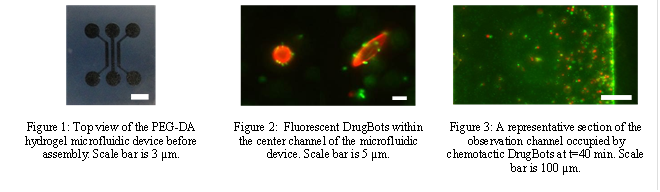
PEG-DA based Microfluidic device fabrication: A diffusion-based microfluidic device using 700 Da polyethylene glycol diacrylate (PEG-DA) hydrogel was fabricated through a one-step UV polymerization process. The three parallel channels separated by the two porous hydrogel walls enabled us to establish concentration gradients of chemo-effectors for bacteria (and DrugBots) (see Fig. 1). This was accomplished by continuous flowing of a chemo-attractant and a buffer solution in the two outer channels and lateral diffusion of the chemo-attractant through the hydrogel wall and into the flow-free buffer filled center channel after assembling the device. The quasi-steady linear gradient in the center channel was maintained throughout the entire experiment.
DrugBot Construction: Elliptical disk-shaped (ED) polystyrene (PS) particles were fabricated using a high throughput particle casting and stretching technique [1]. Motile sub-populations of Escherichia coli (E. coli) MG1655 transformed with pHC60 (GFP-expressing plasmid) were grown in Tryptone Broth to OD600=0.5 at 32 ˚C and incubated with goat polyclonal anti-lipid A LPS antibody labeled with biotin (10 μg/ml). The two collections of 6 µm microparticles (spheres and EDs) were coated with Cy3-streptavidin and were added to the bacterial solution which produced the DrugBots (see Fig. 2) through self-assembly by utilizing the high affinity between biotin and streptavidin.
L-Aspartic acid, a known chemoattractant for E. coli bacteria, was selected to control the movement of the DrugBots in the device. Spherical and ED-shaped DrugBots were injected into the chemotaxis observation channel (see Fig. 3) after a concentration gradient of the chemo-effector (0.1 mM/mm) was established. Motile DrugBots were observed using a Zeiss AxioObserver D1 inverted microscope equipped with a motorized stage and an AxioCam HSm camera plus a 20× objective and the captured videos were analyzed using the ImageJ software (NIH, Bethesda, MD). For data, analysis, the width of the observation channel is divided into two partitions and the spatial distribution of DrugBots is calculated across the width of the channels in order to quantify the migration profile of the DrugBots.
RESULTS AND DISCUSSION
CONCLUSIONS
Bacteria-based cargo carriers with spherical and ED shapes along with E. coli strain MG1655 were constructed here. Chemotaxis was exploited to control the movement of these autonomous drug delivery vehicles introduced into a PEG-DA hydrogel based microfluidic device. Both types of these carriers, called DrugBots, have shown a biased movement towards higher concentrations of L-Aspartic acid. These controllable DrugBots have a great potential to autonomously navigate and carry/deploy a wide variety of cargos such as therapeutics and contrast agents to hard-to-reach diseased areas.
 |
REFERENCES
[1] Champion, J.A. et al., Making polymeric micro- and nanoparticles of complex shapes, Proceedings of the National Academy of Sciences, 104:11901 (2007).
[2] Muro, S. et al. Control of endothelial targeting and intracellular delivery of therapeutic enzymes by modulating the size and shape of ICAM-1-targeted carriers. Molecular Therapy, 16:1450–1458 (2008).
See more of this Group/Topical: Nanoscale Science and Engineering Forum