
 Google
 Yelp
 Facebook
 Twitter
 ChEnected
342295 Lithium Bromide-Water Absorption Heat Pump System for Heating Up Air From Waste Heat
The efforts for energy conservation are requested because of the limitation of fossil fuel and the environmental issue of global warming. Enormous amount of heat at lower temperatures than 100 °C is wasted daily from industrial plants in the world-wide. The petrochemical and steel industries are especially the largest energy-consuming manufacturing industries. Waste hot water in the range of 60-90 °C is drained from these industrial processes in large quantities. Absorption heat pump (AHP) is known as one of the refrigeration techniques working by heat without using compressor, but have been recently applied to steam generation or heating up higher temperature by recovering waste heat as well.
In this study, an innovative AHP system is suggested to heat up the temperature from waste heat in a level of 80 °C and to produce hot air over 120 °C available for drying. Air is heated up directly by heat exchange in the absorber working in the heating mode of AHP. The main structure of the present AHP systemwas composed of an evaporator, an absorber, a regenerator, a condenser, a solution heat exchanger, solution pumps, and water pumps. The evaporator, the absorber and the regenerator consisted of 74, 46 and 42 vertical spiral tubes made of copper with 23 mm in inner diameter, respectively. Their length was 4848mm, 4940mm and 4352mm. In the condenser, a bundle of 91 U-shaped bare- copper tubes of 16.6 mm inner diameter was installed, and the total length was about 5500mm. The absorbent used in the AHP was an aqueous solution of lithium bromide (LiBr) and the additives were added for corrosion resistance. All operation process proceeded in a closed system under sealed evacuated atmosphere.
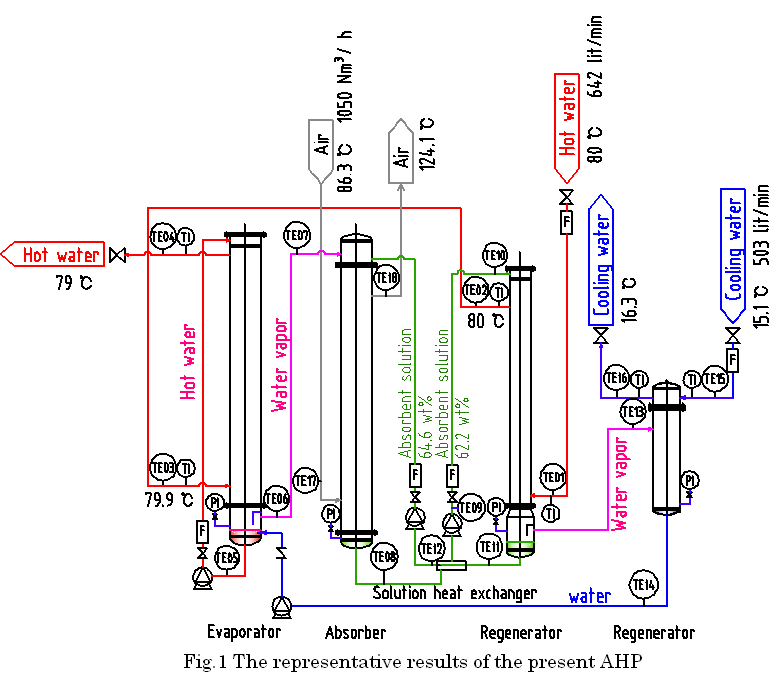
The absorbent solution condensed in the regenerator was fed to the absorber by solution pump through solution heat exchanger. A film of the solution flowing down along the inside wall of the vertical tubes was formed in the absorber, to absorb water vapor, which was evaporated from a pure water film flowing on the inside wall of the tubes heated by hot water at 80 °C , which flowed around the tube in the evaporator. Then the solution was heated up during flowing down due to gaining exothermic dilution heat of the solution and the latent heat by water vapor absorption. Air streamed in counter flow around the tubes in the absorber and heat exchange took place to heat up the air through the tubes from the solution. The diluted absorbent solution by absorbing water vapor was returned into the regenerator through the solution heat exchanger. In the regenerator, the absorbent solution flowed down forming a film on the inside wall of the tubes, and was heated by hot water at 80 °C, which flowed around the tubes. The solution was condensed during flowing down by evaporation of water vapor. The evaporated water vapor transferred into the condenser, and was condensed on the surface of the tubes which was cooled by water fed into the inside. The water in the condenser was moved to the evaporator.
The examination was performed continuously on the performance of the AHP. When it was confirmed that the operation achieved sufficiently a steady state, temperatures of the fluids were measured at the inlet and outlet of each device. The absorbent solution was sampled at the inlet and outlet of the absorber and the regenerator to determine the concentration of LiBr using the infrared moisture analyzer (Shimadzu MOC-120H).
The representative results of the present AHP performance were indicated in Fig. 1. It was resulted in that the temperature of hot air at the outlet of the absorber achieved at above 120 °C by recovering heat of hot water at 80 °C. The coefficient of performance, which is defined by the ratio of heat generated to the power consumed for pumps of fluid flow, exceeds 20.
The present authors acknowledge that this work was supported financially by Research and Development Program for Innovative Energy Efficiency Technology under the New Energy and Industrial Technology Development Organization (NEDO) project based on a grant from METI.
See more of this Group/Topical: Computing and Systems Technology Division