
 Google
 Yelp
 Facebook
 Twitter
 ChEnected
343131 Understanding Carbon Dioxide Adsorption On Alkali Metal Exchanged Zeolite SSZ-13
Understanding Carbon Dioxide Adsorption on Alkali Metal Exchanged Zeolite SSZ-13
Trong D.Pham1, Matthew R. Hudson2, Craig M. Brown2, Raul F.Lobo1*
1Center for Catalytic Science and Technology, University of Delaware, Department of Chemical and Biomolecular Engineering, USA, lobo@udel.edu.
2Center for Neutron Research, National Institute of Standards and Technology, Gaithersburg, Maryland 20899-6102, USA.
Keywords: CO2, SSZ-13, adsorption, neutron diffraction
Introduction
The emission of anthropogenic carbon dioxide into the atmosphere due to the combustion of fossil fuels is one of the main causes of climate change. Low silica zeolites (types A, 13X, zeolite Y) are among the most commonly used CO2 adsorbents in industrial gas separations[1,2], but are generally strong adsorbents, making regeneration difficult [3]. Because of lower Al content, high silica zeolites with a less hydrophilic pore environment are an interesting option with respect to the regeneration and the tolerance to polar impurities in the gas such as water vapor and sulfur compounds[4]. Here we report an investigation of CO2 adsorption on high-silica zeolites SSZ-13 (CHA framework-type, Si/Al=6 and 12), examining the effects of framework Si/Al ratio and extra-framework cations (Li+, Na+, K+) on CO2 adsorption isotherms and heats of adsorption. The interaction of CO2 with the SSZ-13 is investigated at the molecular level using Rietveld refinement of neutron diffraction patterns of adsorbed CO2 in the host zeolite.
Experimental
SSZ-13 samples (Si/Al=6 and 12) were prepared by hydrothermal methods using N,N,N-Trimethyl-1-adamantanammonium ion as a structure-directing agent. Element compositions of synthesized and ion-exchanged samples were determined by Energy-dispersive X-ray spectroscopy (EDX). CO2 adsorption isotherms of the SSZ-13 samples at various temperatures (273, 303 and 343 K) were measured on a Micromeritics ASAP 2020 device up to ambient pressure. Neutron powder diffraction (NPD) measurements were conducted on the high-resolution diffractometer BT1 at NIST, using a Ge(311) monochromator, λ = 2.0787(2) Å for bare and CO2 gas-dosed alkali-exchanged SSZ-13.
Results and Discussion
Na-SSZ-13/6 is remarkable because it shows comparable equilibrium CO2 capacity to 13X and Y, and higher capacity than NaA, three zeolites with much higher aluminum content (Table 1). This is because all the cations in the smaller cages of SSZ-13 are accessible to CO2, and despite the fact that SSZ-13 has a lower cation concentration compared to other zeolite frameworks. Na-SSZ-13/12 adsorbed less CO2 than the lower Si/Al samples under the same conditions, as expected, but shows much higher adsorption capacity than FER and STI with similar Si/Al ratio. This difference is attributed to the higher microporous volume of the SSZ-13 sample.
Table 1. Adsorption capacity of CO2 on various sodium-exchanged zeolites at 303 K and 1atm.
Samples | Na-13X | NaY | NaA | Na-FER[6] | Na-STI [6] | Na-SSZ-13/6 | Na-SSZ-13/12 | |||||||
Si/Al ratio | 1.25 | 2.47 | 1 | 9 | 15 | 6 | 12 |
| ||||||
Uptake (mmol/g) | 5.23 | 5.03 | 4.13 | 2.6 | 2.5 | 5 | 3.96 |
| ||||||
*ref [6]: The experiment was carried out at 298K and 750torr
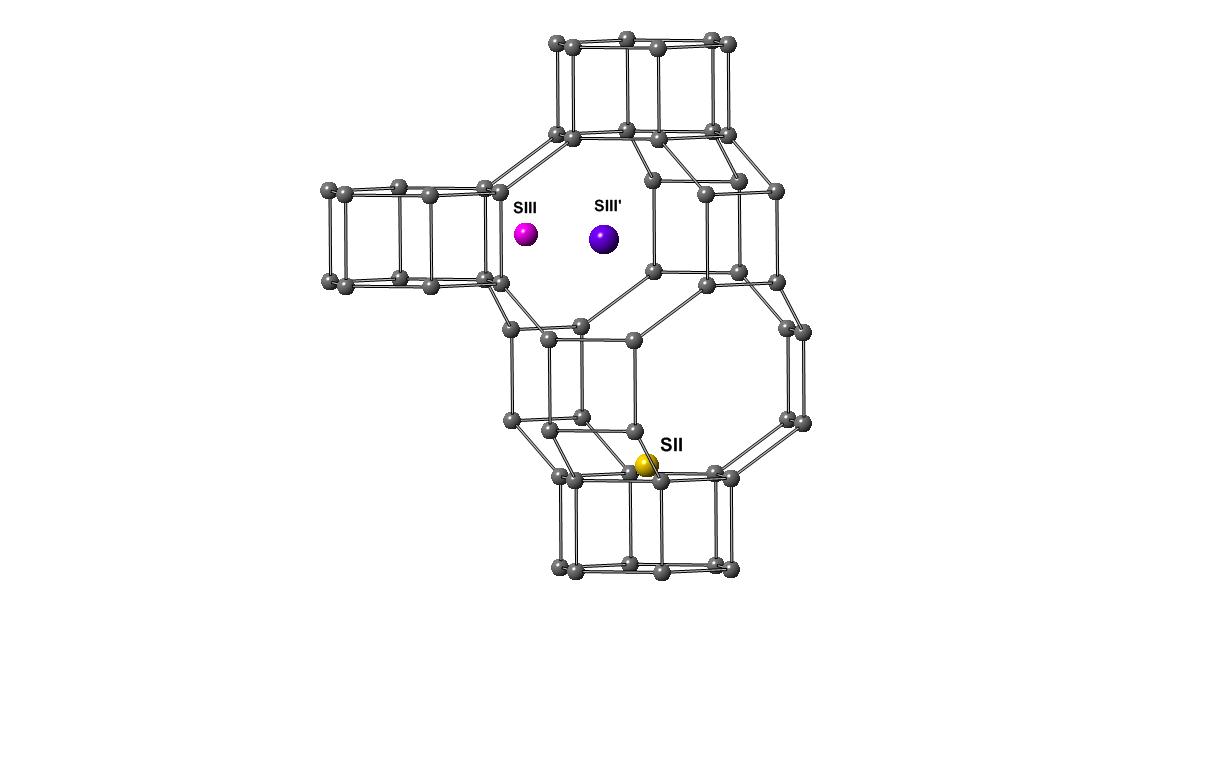
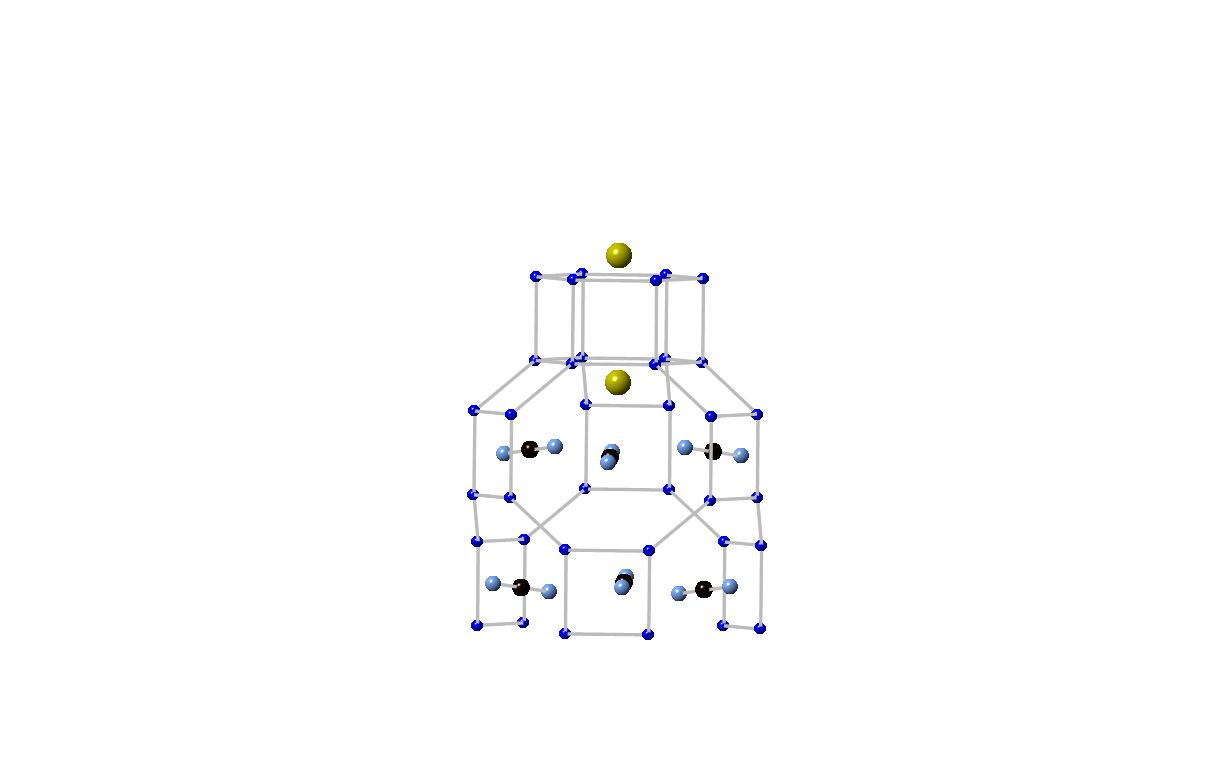
Figure 1: Schematic view of cation positions in SSZ-13 framework (left) and CO2 positions in Na-SSZ-13 (Si/Al~12) (right)
Rietveld refinement of neutron diffraction on bare adsorbent SSZ-13/12 shows that Li+, Na+ is located right above the center of the hexagonal prism (site SII), and the larger cation K+ is in the middle of 8-membered rings. With 4 K+ cations/cage in K-SSZ-13/6, K+ could reduce the effective adsorption capacity of the zeolite by blocking access to some of the SSZ-13 cavities. Difference Fourier maps were used to locate the positions of CO2 molecules in the zeolite. At a loading of 0.66 molecules CO2 per 8-ring window on Na-SSZ-13/12, we found that CO2 is located in the center of the 8-membered ring window instead of directly interacting with extra-framework cations, which is similar to the results reported by Hudson et al[5] for Cu-SSZ-13. Na+ is bound to 3 oxygen atoms of the 6-ring with a bond length of 2.35 Å, and the closest distance of O(CO2)-Na is 3.71 Å. This distance is too long for efficient interaction coupling of the CO2 and the cations suggesting that adsorption is driven by the electrostatic interactions of the framework oxygen atoms in the 8-ring and the carbon atom in CO2.
Conclusions
SSZ-13 has a high potential for CO2 capture, reaching an adsorption capacity of 5.1 mmol CO2 per gram of zeolite at ambient temperature and pressure, a value comparable with the best-known zeolite adsorbents (X, Y). The adsorption characteristics of SSZ-13 are strongly dependent upon the cation concentration, the cation-type, and the CO2 loading amount.
Acknowledgements
This work was supported by the National Science Foundation through grant CBET-940768 and National Institute of Standards and Technology Center for Neutron Research (NCNR). Trong Pham acknowledges support from Vietnam Education Foundation (VEF). MRH acknowledges support from the NRC Postdoctoral Research Fellowship.
References
[1] Yang, H.; Xu, Z.; Fan, M.; Gupta, R.; Slimane, R. B.; Bland, A. E.; Wright, I., Journal of Environmental Sciences-China 2008, 20 (1), 14-27.
[2] Walton, K. S.; Abney, M. B.; LeVan, M. D., Microporous Mesoporous Mater. 2006, 91 (1-3), 78-84.
[3] Harlick, P. J. E.; Tezel, F. H., Microporous Mesoporous Mater. 2004, 76 (1-3), 71-79.
[4] Bao, Z.; Yu, L.; Dou, T.; Gong, Y.; Zhang, Q.; Ren, Q.; Lu, X.; Deng, S., J. Chem. Eng. Data, 2011, 56 (11), 4017-4023.
[5] Hudson, M. R.; Queen, W. L.; Mason, J. A.; Fickel, D. W.; Lobo, R. F.; Brown, C. M., J. Am. Chem. Soc. 2012, 134 (4), 1970-1973.
[6] Zukal, A.; Zones, S. I.; Kubu, M.; Davis, T. M.; Cejka, J., Chempluschem 2012, 77 (8), 675-681. ADDIN EN.REFLIST
See more of this Group/Topical: Separations Division