
 Google
 Yelp
 Facebook
 Twitter
 ChEnected
343240 Effect of External Vibrations On Non-Isothermal Ice-Nucleation Rates
Effect of External Vibrations on Non-isothermal Ice-Nucleation Rates
T.J. Dursch,1,2 G.J. Trigub,1 J.F Liu,1 C.J. Radke,1,3 A.Z. Weber2
1 Chemical and Biomolecular Engineering Department, University of California, Berkeley, CA
2 Environmental Energy Technology Division, Lawrence Berkeley National Laboratory, Berkeley, CA
3 Earth Sciences Division, Lawrence Berkeley National Laboratory, Berkeley, CA
AICHE 2013: Session 01C02 Fundamentals of Interfacial Phenomena I
Nucleation stochastically generates aggregates of a new and more stable phase within a metastable mother phase, capable of growing rapidly into macroscopic crystallites. Controlled nucleation is critical to the success of numerous applications, including: manufacturing of bioactive drugs, thermal energy storage in phase-change materials, zeolite synthesis, and freeze drying. Our particular focus lies in ice crystallization during cold-start of a proton-exchange-membrane fuel cell1. Commonly, nucleation rates are obtained from induction-time measurements1. In many cases, especially in ice crystallization, large driving forces (e.g., subcoolings of 10-30 °C) are required for sufficiently large nucleation rates and short induction times. In this work, we examine the effect of an external driving force, specifically, applied vibrations, on ice-nucleation rates and induction times.
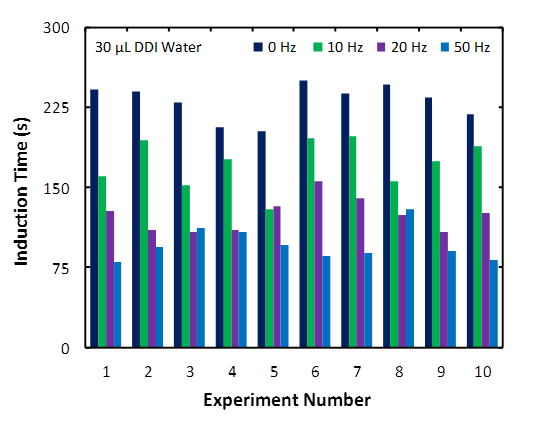
Distilled/deionized (DDI) water, placed in a plexiglass (PMMA) cylinder, is cooled from beneath by a copper heat exchanger positioned on a vibration generator. Induction times are obtained using both infrared thermography and thermocouples as a function of vibration frequency (0 to 50 Hz) and amplitude (1 to 10 mm). Figure 2 plots 10 repeated induction-time measurements for 30-µL of DDI water at frequencies of 0 (blue), 10 (green), 20 (purple), and 50- Hz (light blue). Induction times decrease with increasing vibration frequency (i.e., a factor of 3 from 0 to 50 Hz). Additionally, induction-time Poisson distributions1 narrow with increasing vibration frequency, yielding well-controlled nucleation rates. No theory is currently available to predict the role of vibrations in ice nucleation. We find that accounting for work input by mechanical vibrations in classical nucleation theory provides qualitative agreement with the new results.
 |
References
[1] T.J. Dursch, M.A. Ciontea, C.J. Radke, A.Z. Weber, Isothermal ice-crystallization kinetics in the gas-diffusion layer of a proton-exchange-membrane fuel cell, Langmuir 28 (2012) 1222-1234.
See more of this Group/Topical: Engineering Sciences and Fundamentals