
 Google
 Yelp
 Facebook
 Twitter
 ChEnected
343440 A Simulation Of Weathering Of Colombian Crude Oils In The Colombian Caribbean Sea
A SIMULATION OF WEATHERING OF COLOMBIAN CRUDE OILS IN THE COLOMBIAN CARIBBEAN SEA
Juan Ramírez1, Aura Merlano1, Juan Guerrero-Gallego2, Daniel Peláez2, Juan Hernández2, Andrés Osorio2, Alejandro Molina1,*
1Universidad Nacional de Colombia – Sede Medellín, Facultad de Minas, Bioprocesos y Flujos reactivos, Medellín, Colombia
2Universidad Nacional de Colombia – Sede Medellín, Facultad de Minas, Grupo de investigación en Oceanografía e Ingeniería Costera - OCEANICOS, Medellín, Colombia
*Corresponding author: amolinao@unal.edu.co
A module, MEUN (Módulo de Envejecimiento Universidad Nacional), that describes the processes that occur due to the interaction, also known as weathering, of the crude in an oil spill with the atmosphere and the ocean, was developed. This module, programmed in FORTRAN, couples individual sub-models available in the literature to describe the evaporation, emulsification, dispersion and spreading processes that characterize the first week after an oil spill in the ocean. MEUN predicts as well the variation in density and viscosity over time as a result of the weathering processes.
In MEUN the evaporation submodel considered the pseudocomponent approach proposed by Jones, (1997). Knowledge of the True Boiling Point (TBP) curve and API gravity of the crude oil of interest, allowed the estimation, with Aspen Plus V7.2, of the thermodynamic properties (vapor pressure, mole fraction and mole volume) for each pseudocomponent. The weathering module includes the first-order kinetic expression proposed by Mackay et al., (1980) to model the rate of the emulsification process. The kind of emulsions formed (stable, mesostable, unstable or entrained water), the maximum water content of the emulsion and the evaporative thresholds to have a change in the type of the emulsion formed were interpolated from the experimental work developed by Fingas and Fieldhouse, (2004). MEUN couples the dispersion expression, developed by Delvigne and Sweeney, (1988), that takes into account the significant wave height and wave period to predict the amount of crude oil dispersed in the water column by the wave action. To predict the spreading rate of the oil slick, MEUN uses the equation developed by Lehr et al., (1984) based on observations in controlled oil spills. This expression considers the imbalance of forces acting on the oil slick and the effect of wind velocity to predict the spreading rate. The models developed by Lehr et al., (2002) and by Mackay et al., (1980), included in MEUN, predict the increase in density and viscosity, respectively, that results from the evaporation and emulsification processes.
All sub-model's constants were adapted to the specific requirements of Colombian crudes, particularly to Cusiana (°API 44.1) and Vasconia (°API 24.5). While the first one represents light crudes, the second one is an example of heavy oil. These two crudes have high production and require marine transport. The simulations results of the atmospheric model WRF (Weather Research and Forecasting Model), the wave model SWAN (Simulating WAve Nearshore) and the ocean model ROMS (Regional Ocean Modeling System) gave a typical ocean and atmospheric data of Golfo de Morrosquillo (latitude 09°29' N and longitude 75°46' W). Two scenarios, for high (4 m/s - 12 m/s) and low (0 m/s - 4 m/s) wind velocity, and the effect of time-averaging wind velocity, significant wave height and sea surface temperature were studied.
As an example of MEUN's predictions, Figure 1 shows the variation of the evaporated volume fraction with time after the spill for Cusiana and Vasconia oils. As expected, the lighter oil yields a higher evaporation fraction. Figure 1 also suggests that, while an average wind (discontinuous lines in Figure 1) yields reasonable predictions for a high wind condition, it significantly overestimate evaporation when the wind velocity (continuous lines in Figure 1) is low.
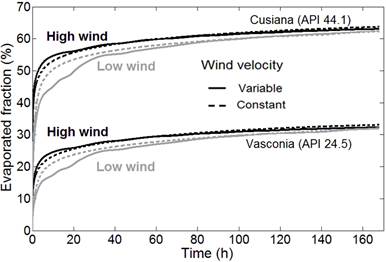
Figure 1. Predicted variation of the evaporated fraction for Cusiana and Vasconia crude oils after a spill in the Caribbean Sea under high and low wind velocity scenarios and variable and constant wind velocity.
Figure 2 summarizes MEUN's predictions as a plot of the volume fraction evaporated, dispersed and remaining on the sea surface. Because of differences in the physicochemical properties of the Colombian crude oils, Cusiana is more affected by evaporation and dispersion than Vasconia. According to MEUN, under high-wind conditions, a combination of evaporation and dispersion causes in Cusiana a decrease in the fraction of crude oil remaining on the ocean surface that is more than twice the decrease for Vasconia crude oil. While the results in Figure 1 and 2, as well as the fact that MEUN predicts an increase in viscosity of two to three orders of magnitude as the slick evaporates and the water makes an emulsion with the oil, agree with previous observations of weathering of oils in the ocean, a more complete validation of MEUN with experiments is currently under way using a wind tunnel and a rotating cylinder for evaporation and emulsion, respectively, at conditions typical of the Colombian Caribbean Sea.
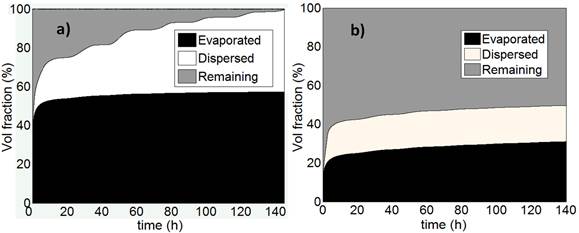
Figure 2. Distribution of the spilled crude oil between evaporated, dispersed and remaining on the ocean fractions for a) Cusiana and b) Vasconia oils. Predictions according to MEUN.
REFERENCES
Delvigne, G. A. L., & Sweeney, C. E. (1988). Natural dispersion of oil. Oil and Chemical Pollution, 4(4), 281–310.
Fingas, M., & Fieldhouse, B. (2004). Formation of water-in-oil emulsions and application to oil spill modelling. Journal of hazardous materials, 107(1-2), 37–50.
Jones, R. K. (1997). A simplified pseudocomponent oil evaporation model. 20th Arctic Marine Oilspill Program Technical Seminar. (pp. 43–61). Ottawa, Ontario: Environment Canada.
Lehr, W. J., Fraga, R. J., Belen, M. S., & Cekirge, H. M. (1984). A new technique to estimate initial spill size using a modified fay-type spreading formula. Marine Pollution Bulletin, 15(9), 326–329.
Lehr, W., Jones, R., Evans, M., Simecek-Beatty, D., & Overstreet, R. (2002). Revisions of the ADIOS oil spill model. Environmental Modelling & Software, 17(2), 189–197.
Mackay, D., Buist, I., Mascarenhas, R., & Patterson, S. (1980). Oil Spill Processes and Models. Report No. EE/8. Environment Canada (p. 192). Ottawa, Ontario.
See more of this Group/Topical: Environmental Division