
 Google
 Yelp
 Facebook
 Twitter
 ChEnected
343676 Impedance Behavior and Analysis of Binder-Free Ni-Mo Composite Cathode for Li-O2 Batteries
AIChE Annual Meeting Abstract – Materials for Energy Storage; Electronics & Photonics
Title
Impedance Behavior and Analysis of Binder-free Ni-Mo Composite Cathode for Li-O2 Batteries
Authors
Ruben Nelson, Mark H. Weatherspoon, Joyce Kosivi, Eric E. Kalu, Jim P. Zheng
Abstract
Lithium oxygen (Li-O2) batteries have significant promise for energy storage, with a high theoretical energy density above 10 KW/kg. However, their many shortcomings from a cyclability and efficiency perspective leave the technology in the research stage. It is generally understood that significant electrochemical activity occurs at the cathode side; hence, there is much work in the area of cathode design. Specifically, cathodes with metal oxide deposits have provided improved capacity and efficiency, leading to enhanced performance over cells with bare carbon cathodes.
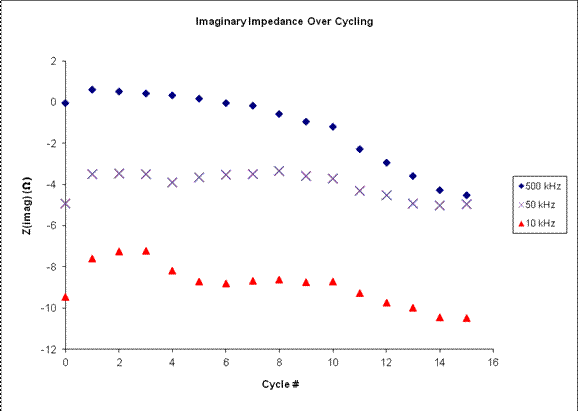
We present a porous carbon cathode with an electroless deposited nickel and molybdenum composite that was also electrolytically oxidized for use in Li-O2 batteries promising a specific capacity of approximately 1 Ah/g in the fist discharge. However, scanning electron microscope images show several changes in surface composition before and after 15 charge-discharge cycles indicating several sources. To follow up, impedance spectroscopy measurements are performed to gather frequency dependent impedance behavior. Equivalent circuit models are developed to associate intrinsic cell phenomena to physical models. Cathode influence on ohmic resistance, charge-transfer resistance, and double layer capacitance, and constant phase element behavior trends are investigated. We expect that throughout cell cycling, there is greater polarization from product buildup. This would increase the various physical resistances of the cell and lead to a decrease in capacity. Also unique to our study, we include the impedance response of the cell to high frequency voltage signals greater than at least 10 kHz, where capacitive behavior is recessive. Other previous studies attribute behavior at these frequencies to be inductive behavior from instrumentation, cathode design, or other factors. We aim to gain more insight on the relationship and significance between high frequency and inductive behavior to decreasing cell capacitance response in efforts to associate physical cell changes with electric circuit principles.
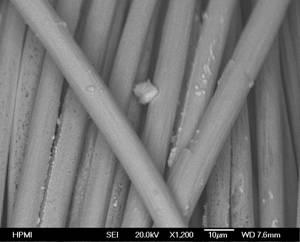
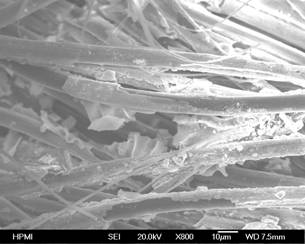
Ni-Mo Composite Oxide Catalyst Cathode Prior to Discharge (left) and After 15 Discharge/Charge Cycles (right)
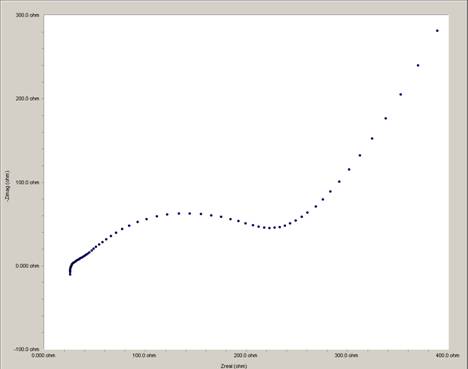
Predischarged Li-O2 cell with Ni-Mo Composite Oxide Catalyst Impedance Spectrum
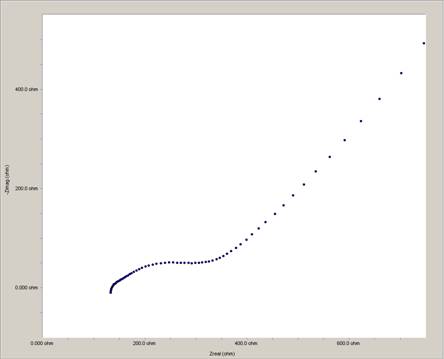
Impedance Spectrum of Li-O2 Cell with Ni-Mo Composite Oxide Catalyst Discharged 15 Times
See more of this Group/Topical: Materials Engineering and Sciences Division