
 Google
 Yelp
 Facebook
 Twitter
 ChEnected
343789 Optimization of Si/Al Ratio, Fe and P Loadings for Higher Stability of P-Fe/HZSM-5 in Steam Catalytic Cracking
Light olefins such as ethylene and propylene are the backbone of chemical industries. Steam cracking because of emission of large amount of CO2 and energy consumption [1] is not the appropriate way to produce light olefins. So, thermal catalytic cracking attracted attention. Among catalysts, HZSM-5 due to acidity, hydrothermal stability and shape selectivity [2] is a suitable catalyst. However, high acidity of HZSM-5 which results in secondary reactions and consequently reduction of products yield is a serious problem. Modification of HZSM-5 with various elements such as transition metals [3] and rare earth elements [4] is an effective way to adjust the acidity in order to obtain high light olefins yield.
On the other hand, dealumination of HZSM-5 in the presence of steam in high temperature of reaction is a serious drawbacks. Modification of HZSM-5 with phosphorous is an appropriate alternative to overcome this problem [5].
In this study, we aim to increase light olefins yield and improve hydrothermal stability of HZSM-5 by considering three factors including Fe, P and Si/Al ratio. Therefore, a series of P-Fe/ZSM-5 was designed by statistical design using Box-Behnken and impregnated by co-impregnation method. The effect of each factor and their interactions were studied by response surface methodology.
Thermal catalytic cracking of naphtha was carried out for 20 h. The experimental results demonstrated that steam cracking is the main reaction for ethylene production [3] whereas thermal catalytic cracking is the major mechanism for propylene production. So, initial propylene yield and reduction of propylene during reaction time (the difference of propylene yield between the initial time and after 20 h) were subjected to analysis of variance (ANOVA). According to ANOVA analysis and their F values, factors A (Si/Al), B (Fe) and C (P) and their interactions A×B, A×C and B×C affected both initial propylene yield and propylene reduction, significantly. Fig.1 (a) and (b) shows the contour plots of interactions of Fe and P on propylene yield and propylene reduction. According to Fig. 1 (a), propylene yield increases with the simultaneous movements of Fe and P up to a maximum point in which propylene yield is 32.62 wt.%. The seame trend is observed for propylene reduction up to a maximum point (propylene reduction=10.2 wt.%)
| |
|
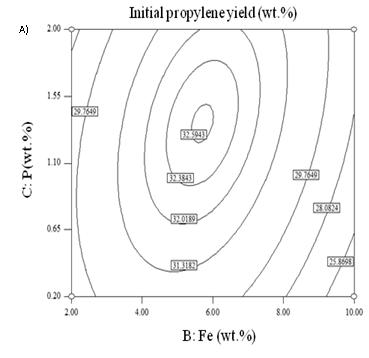
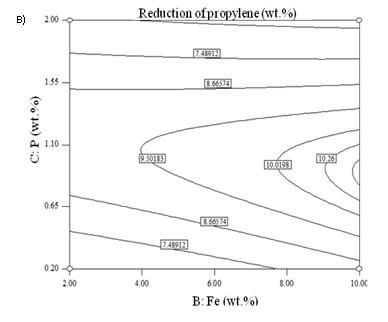
Figure 1. Contour plots of A) initial propylene yield, B) Propylene reduction as function of B (Fe wt.%) and C (P wt.%) at Si/Al=137.
Fig. 2 presents the NH3-TPD of some catalysts. According to Fig. 2 and experimental results, more strong acid sites causes more initial propylene yield. According to TPR analysis, the redox properties of catalysts improve by adding P and increasing Si/Al which results in the speed of electron transfer and eventually increasing propylene yield. According to NH3-TPD and TPO, more number of weak acid sites results in more amount of coke formation. According to TPO and XRD, dealumination has a remarkable effect on catalytic instability. Fe(6)-P(2)/HZSM-5 with 1.86 wt.% of propylene reduction showed the highest catalytic stability.
|
|
|
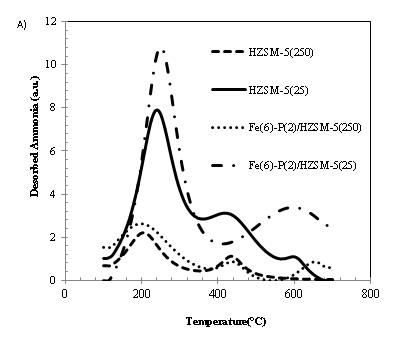
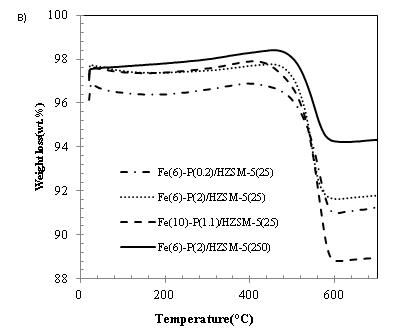
Figure 2. A) NH3-TPD of some catalysts, B) Weight loss with temperature of some catalysts after 20 h.
References
1. Yoshimura, Y., Kijima, N., Hayakawa, T., Murata, K., Suzuki, K., Mizukami, F.,
Matano, K., Konishi, T., Oikawa, T., Saito, M., Shiojima, T., Shiozawa, K., Wakui, K.,
Sawada, G., Sato, K., Matsuo, S., and Yamaoka, N. Catalysis Surveys from Japan. 4,
157 (2000).
2. Zhao, G., Teng, J., Xie, Z., Jin, W., Yang, W., Chen, Q., and Tang, Y. J. Catal. 248, 29 (2007).
3. Lu, J., Zhao, Z., Xu, C., Zhang, P., Duan, A. J. Catal. Commun. 199–203, 7 (2006)
4. Xiaoning, W., Zhen, Z., Chunming, X., Aijun, D., Li, Z., Guiyuan. J. J. Rare Earths. 321–328, 25 (2007).
5. Blasco, T., Corma, A., Martínez-Triguero, J. J. Catal. 267–277, 237 (2006)
6. Teimouri Sendesi, S.M., Towfighi, J., Keyvanloo, K. J. Catal. Commun. 114-118, 27 (2012).
See more of this Group/Topical: Catalysis and Reaction Engineering Division