
 Google
 Yelp
 Facebook
 Twitter
 ChEnected
343849 Multifunctional Reactor Engineering for Galacturonic Acid (GA) Production: Enzymatic De-Polymerization of Pectin-Rich Biomass With Simultaneous Adsorption of GA Onto Anion Exchange Resins
Multifunctional Reactor Engineering for Galacturonic Acid (GA) Production: Enzymatic De-polymerization of pectin-rich biomass with simultaneous adsorption of GA onto Anion Exchange Resins
Galacturonic acid (GA) is one of the main compounds produced after the enzymatic hydrolysis of pectin-rich biomass generated as waste from the processing of citrus fruits, apples, and sugar beet. Production statistics for the last five years indicate that several million (MM) tons of these wastes annually accumulate in USA at an approximate range of 3.0 to 3.5 MM tons for citrus processing waste (CPW), 2.0 to 2.5 MM tons (dry weight) for sugar beet processing waste (SBPW), and 0.20-0.25 MM of dry apple processing waste (APW) (NASS, 2011 and 2013).GA has the potential to be considered as a renewable platform for the synthesis of relevant products or it may be used in direct applications as is shown in Figure 1. A novel process in a multifunctional reaction system has been developed to produce GA from the enzymatic hydrolysis of citrus pectin with its simultaneous separation from the reaction media by adsorption onto weakly basic anion exchange resins (WBAER). This study is based on the following experimental steps at laboratory scale: 1) adsorption of pure GA onto WBAER in a batch reactor to determine the adsorption kinetic parameters; 2) determination of the kinetic parameters for the de-polymerization of citrus pectin by enzymatic hydrolysis to produce GA in a self-buffered reaction media by the formation of sodium galacturonate (NaGA); 3) development and evaluation of a multifunctional reaction system for the enzymatic hydrolysis of citrus pectin to produce GA with its simultaneous adsorption onto WBAER. Some preliminary results are shown in Figures 2, 3, 4, and 5 for the kinetics of GA adsorption, self-buffered enzymatic hydrolysis of pectin, and the integrated process for the enzymatic hydrolysis of pectin with simultaneous adsorption of GA respectively in a multifunctional batch reactor. All the data generated in these experimental steps are being utilized to calculate the engineering parameters needed for process design and scale-up for the conversion of grapefruit processing waste (GPW) into sugars, GA, and other value-added products (flavonoids).
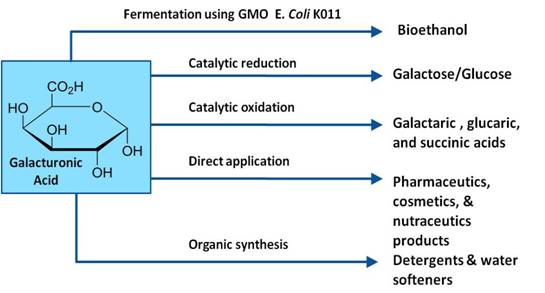
Figure 1. Potential utility of Galacturonic acid as a platform feedstock for green specialty chemicals
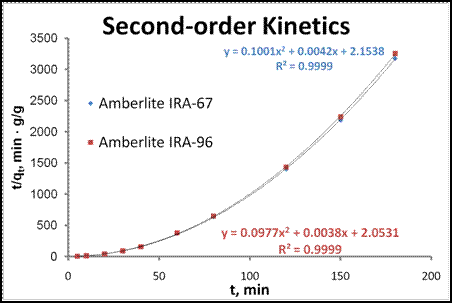
Figure 2. The graph shows the graphical determination of kinetics order for the adsorption of GA onto two commercial WBAER. The graph shows that the adsorption process follows second-order kinetics; such behavior means that there is more than one parameter that affects the kinetics of the adsorption process.
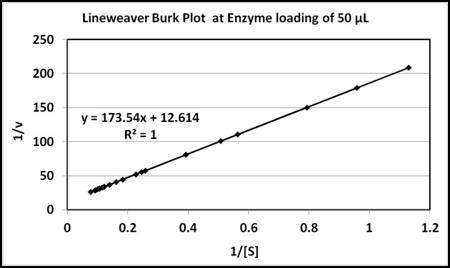
Figure 3. Linearization of Michaelis-Menten kinetic model for the enzymatic hydrolysis of citrus pectin in a self-buffered reaction media at an enzyme loading of 50 μL/100 mL of a 0.5 wt% pectin solution. Based on this graph a values for Km= 14.27 mmol/L and Vm = 0.0822 were calculated using 50 μL of Pectinex Ultra SPL combined with 20 μL of Accellerase XY. The substrate concentration [S] was defined and calculated as the monomer concentration of homogalacturonan.
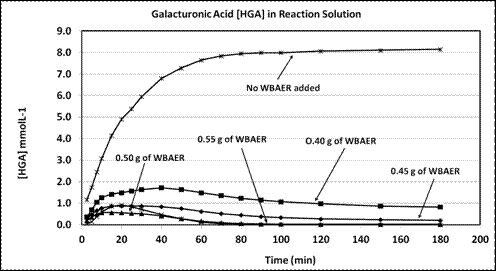
Figure 4. Graph of galacturonic acid concentration (here described as [HGA]) leaved in the reaction media during the enzymatic hydrolysis of pectin and simultaneous adsorption onto WBAER (Amberlite IRA-67) at various resin loadings (0, 0.4g, 0.45g, 0.5g, and 0.55g). The concentrations were calculated applying the equation of Henderson-Hasselbalch for the determination of dissociated carboxylic acids in a buffer solution, and based on the monitoring of the changes in pH during the reaction time.
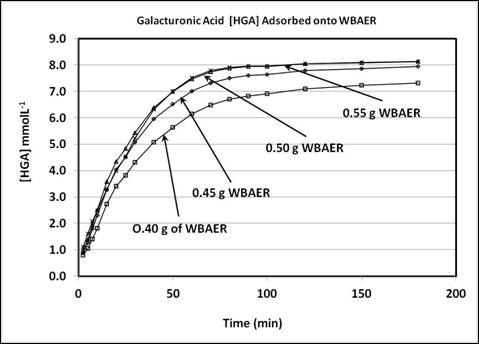
Figure 5. Graph of galacturonic acid concentration (here described as [HGA]) adsorbed onto WBAER (Amberlite IRA-67) during the enzymatic hydrolysis of pectin and simultaneous adsorption at various resin loadings ( 0.4g, 0.45g, 0.5g, and 0.55g). The concentrations were calculated applying the equation of Henderson-Hasselbalch for the determination of dissociated carboxylic acids in a buffer solution, and based on the monitoring of the changes in pH during the reaction time.
Bibliographic References
National Agricultural Statistics Service (NASS) (eds.) (2011). Citrus Fruit 2011 Summary. United States Dept. of Agriculture (USDA).On http://usda01.library.cornell.edu/usda/ current/CitrFrui/CitrFrui-09-22-2011.pdf. Last date accessed on 02.15.2013.
National Agricultural Statistics Service (NASS) (eds.) (2013). Noncitrus Fruits and Nuts 2012 Preliminary Summary, January 2013. United States Dept. of Agriculture (USDA). On http://usda01.library.cornell.edu/ usda/current/ NoncFruiNu/NoncFruiNu-01-25-2013.pdf. Last date accessed on 02.26.2013.
See more of this Group/Topical: Catalysis and Reaction Engineering Division