
 Google
 Yelp
 Facebook
 Twitter
 ChEnected
344140 Synthesis and Characterization of LaCrAl11O19 (Magnetoplumbite) Through Solid State Reaction
LaCrAl1O19 powders, having the magnetoplumbite crystal structure (Fig. 1a), were prepared by solid state synthesis in a reducing environment. Powders were synthesized using a multi-step process in which starting nitrate precursors (La(NO3)3-6H2O, Cr(NO3)3-9H2O and Al(NO3)3 -9H2O were first heat treated to cause evaporation of water and pyrolysis of the nitrate groups. Thermogravimetric analysis of precursors revealed complete water evaporation did not occur until 300°C. A subsequent high temperature heat treatment under a 4%H2-Ar flow promoted the reduction of Cr3+ to Cr2+ that stabilizes the magnetoplumbite structure, allowing for the formation of LaCrAl1O19. X-ray diffraction analysis verifies LaCrAl1O19 formation at temperatures as low as 1200°C, although there is the presence of Al2O3 and LaCrO3 phases indicating that the reaction may not have gone to completion. Scanning electron microscopy (Fig. 1b) shows LaCrAl1O19 to have a porous plate-like morphology with a high surface area. This morphology may be ideal for catalytic combustion applications where a large surface area is necessary for high efficiency.
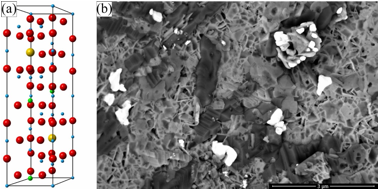
Figure 1. (a) Magnetoplumbite crystal structure with blue spheres representing oxygen, red aluminum, purple lanthanum and green chromium, and (b) scanning electron microscopy image of synthesized powders; light phase - LaCrO3, gray phase - LaCrAl1O19 and dark phase - Al2O3.
See more of this Group/Topical: Materials Engineering and Sciences Division