
 Google
 Yelp
 Facebook
 Twitter
 ChEnected
344193 Analysis of Transport-Kinetics Interactions in Complex Commercial Catalyst Shapes for SO2 Oxidation Using Different Flux Models
Introduction. Development of next-generation chemical processes that have zero emissions is a key environmental objective for sustainable development. The manufacture of H2SO4 by the air oxidation of SO2 to SO3 is an important technology where an opportunity exists for new catalyst development and process innovation by reducing emissions of unconverted SO2 in process reactor tail gases owing to the sheer number (> 1500) and scale (ca. 500 to 4500 metric tons/day) of typical plants. The global supply of H2SO4 is projected to grow from 200 MM tonnes in 2006 to more than 258 MM tonnes in 2015 with a value of > $10 MMM (British Sulphur Consultants, 2012). Hence, an opportunity exists to develop new innovations in environmental catalysis and reaction engineering for an important technology that has a rich and long history with solid projected growth.
Sulfuric acid catalyst manufacturers offer a variety of catalyst shapes for the air oxidation of SO2 to SO3 using adiabatic multi-stage reactor systems. These shapes include solid and hollow cylinders as well as various those involving hollow multi-lobe ribs, such as 5-lobe and 6-lobed shapes. However, the a priori technological bases for specifying a specific catalyst shape over another are generally lacking other than the obvious macroscopic requirements to maximize catalyst activity and life while minimizing pressure drop. From a catalyst design perspective, specification of catalyst size, catalyst shape and internal pore structure are interlinked parameters that have received notable attention by catalyst scientists and engineers since these properties affect the catalyst effectiveness factor, bed pressure drop, rate of catalyst attrition, catalyst mechanical integrity, catalyst life, amongst other key measures of performance. It is evident that determination of preferred catalyst design parameters requires careful optimization since tradeoffs exist in how the observed reaction rate and other measures of performance may be affected by altering one or both of these parameters.
The primary objective of this presentation is twofold: (1) to develop a rigorous modeling framework that accounts for non-ideal diffusion and non-isothermal reaction in various realistic 3-D commercial catalyst shapes for the oxidation of SO2 to SO3, such as hollow cylinders and multi-lobe particles; Several different flux models, such as the Wilke model and Dusty Gas model are deployed using COMSOL Multiphysics as the modeling tool; and (2) to employ this framework to compare the performance of these various catalyst shapes under typical multi-pass convertor operation.
Methods. Some catalyst shapes that have been proposed for SO2 oxidation to SO3 are illustrated in Figure 1. The ones shown here are not exhaustive, but provide a perspective of shapes that have been proposed in patents and the open literature. In the case of catalyst shapes involving multiple lobes, the shape parameters include the number and shape of the lobes, the characteristic dimension of a given lobe, the distance from the lobe center to true particle center, and the diameter of the hollow region. The lobes for these shapes are based upon either circle functions, trigonometric functions, or a triangle, although this is not a restriction and other shape functions will be discussed.
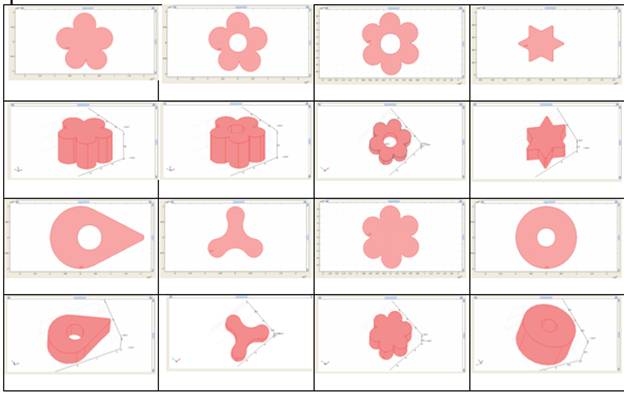
Figure 1. Illustration of Various Catalyst Shapes.
The above catalyst shapes and others not shown for brevity were constructed using either the drawing tools provided in COMSOL Multiphysics, or imported as a .dwg file created using a special-purpose program that generates the exterior particle coordinates that can be imported in AutoCAD. Both the 2-D and 3-D shapes are provided to show that the analysis requires a consideration of all three spatial dimensions.
Preliminary Results and Discussion. COMSOL Multiphysics is used to model non-isothermal diffusion and reaction with compositional and temperature dependence of all model parameters. The reaction kinetic model is based upon the work of Collina et al. (1971). Both the Wilke model and Dusty Gas model are used to describe diffusional fluxes, and comparisons are made between the concentration and temperature profiles as well as calculated values for particle effectiveness factor.
Typical SO2 concentration profiles for a multi-lobe particle shape whose lobes are described by a rounded step function are shown in Figure 2. In this case, the Wilke model is used to describe the diffusional fluxes. Here, the particle surface is exposed to a constant bulk concentration and temperature. A cross section of the temperature profiles inside the particle at the particle mid-section is shown in Figure 3. The particle model provides the starting basis for coupling local particle behavior to the external particle field equations, which is an essential component of SO2 oxidation reactor modeling.
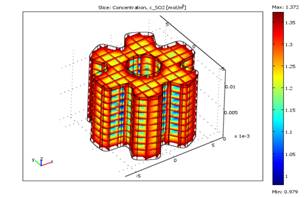
Figure 2. SO2 Concentration Profiles for a Novel Shape.
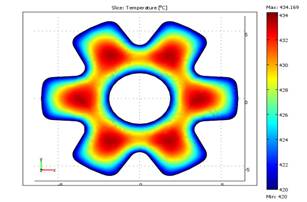
Figure 3. Catalyst Temperature Profiles at the Mid-Section.
Summary. Identification of optimal catalyst shapes can be approached on various degrees of complexity. COMSOL Multiphysics provides a platform where emphasis can be placed on exploring models versus creating computer codes. Detailed knowledge of transport principles and insight into the numerical methods used is required to obtain results.
References
British Sulphur Consultants, Sulphuric Acid : Global Supply and Demand in the Next Decade, Topsøe Catalysis Forum – Denmark, August 23rd to 24th 2007, http://www.topsoe.com/sitecore/shell/Applications/~/media/PDF%20files/Topsoe_Catalysis_Forum/2007/Peacock.ashx, Last accessed on Nov 12, 2012.
Collina, A., Corbetta. D. and Cappelli, A. Eur. Syrnp. "Use of Computers in the Design of Chemical Plants," Firenze (1971).
See more of this Group/Topical: Catalysis and Reaction Engineering Division