
 Google
 Yelp
 Facebook
 Twitter
 ChEnected
344313 A Highly Selective Sn-Doped PMO Catalyst for the Isomerization of Glucose to Fructose
Title: A Highly Selective Sn-Doped PMO Catalyst for the Isomerization of Glucose to Fructose
Anthony J. Crisci*, Ricardo Alamillo, Daniel H. Coller, Alessandro Gallo, Susannah L. Scott, and James A. Dumesic
The potential platform chemical, 5-hydroxymethylfurfural (HMF), can be produced selectively from fructose by acid-catalyzed dehydration. Fructose itself is produced by isomerization of glucose. Some efforts to convert glucose directly to HMF using a combination of a high-boiling solvent (e.g., DMSO, ionic liquids) and a metal chloride catalyst (e.g., CrCl2, PrCl3, NdCl3, DyCl3, YbCl3) have resulted in high HMF yields, but product isolation remains a challenge, adding to potential production costs. To produce HMF efficiently, the catalyst(s) must isomerize glucose to fructose, then dehydrate the fructose to HMF, all in a reaction medium from which the products and unconverted reactants are easily separated.
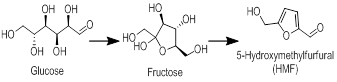
Figure 1. Reaction pathway for the direct production of HMF from glucose by first, glucose isomerization to fructose, followed by fructose dehydration to HMF.
Heterogeneous Lewis acid catalysts may provide an efficient pathway to HMF. These catalysts can be easily coupled with additional catalysts for use in a single pot reaction or in a packed bed reactor for the continuous production of HMF from glucose (to ease catalyst separation). A small number of solid Lewis acid catalysts have shown activity for glucose isomerization in an aqueous solution. Recently, Sn-β zeolite was reported to isomerize glucose to similar fructose yields as the enzyme used industrially. Sn-β zeolite has also been applied in tandem with HCl (dehydration catalyst) for the direct conversion of glucose to HMF. However, the process required a biphasic solvent system to achieve a moderate selectivity (6% single phase and 72% bi-phasic).
In addition to being difficult and time consuming to synthesize, post-synthesis functionalization of crystalline Sn-β zeolite with organosilanes (e.g., MPTMS, APTMS) is limited to silanols generated by surface defects. Similar to Sn-β, Lewis acidity can be incorporated into ordered mesoporous silicas through the addition of metal chlorides during the sol-gel synthesis. These Sn-modified (PMOs) are quick to synthesize (2 days), easily modified with additional functionalities, and potentially scalable. A series of phenylene-bridged periodic mesoporous organosilicas (PMOs) were synthesized and doped with various amounts of Sn (from ca. 0.5 to 6 wt%). A Sn-PMO (0.5 wt%) containing alkylsulfonic acid groups was also functionalized. The materials were extensively characterized (elemental analysis. XRD, TEM/STEM, N2 physisorption, solid-state NMR, IR, EXAFS and TGA) and glucose isomerization reaction studies were conducted. Reaction studies were also performed using Sn-β zeolite, and a Sn-SBA-15 for comparison.
Each reaction was ran for 2 hours in a 2 wt% glucose solution in a mono-phasic low boiling 4:1 THF:water (w:w) solvent at 413 K. Both the Sn:glucose molar ratio (1:100) and the total catalyst mass (diluted with Sn-free PMO) were held constant. PMO with isolated Sn sites (0.4 wt%) converted 28 % of the glucose to fructose with a selectivity of 47 %. However, as the Sn-loading increased, both glucose conversion and selectivity to fructose decreased, compared to the 0.4 wt% Sn-PMO. Sn-β zeolite under these conditions fully converted glucose, but did not yield any fructose and possessed a low selectivity to HMF (7%). The reaction time was reduced to compare results at the same conversion levels to that of the Sn-PMOs. Between 80 and 90% glucose conversion, the selectivity to fructose is 30-50%. Once glucose is completely consumed, the desired products (fructose and HMF) react and the corresponding selectivity drops significantly and rapidly. In contrast, the 0.4 % Sn-PMO maintains its selectivity to desired products around 40% even at higher conversions (> 85%). Sn-PMOs are capable of selectively isomerizing glucose to fructose in THF/Water without rapidly consuming glucose. The bifunctional PMO (with Lewis and Brønsted acid sites) at 30 % conversion had a selectivity to fructose and HMF of 27 and 14 %, respectively. With double the reaction time, the HMF selectivity improved to 37 % while fructose selectivity decreased to 4 % at 52 % conversion. HMF selectivity is expected to improve with the optimization of the Lewis: Brønsted acid ratio and the reaction conditions. Sn-PMOs are capable of selectively isomerizing glucose to fructose in THF/Water without rapidly consuming glucose. Through the incorporation of alkylsulfonic acid sites, reasonable selectivity to HMF from glucose is achieved without the use of costly and/or separation unfriendly solvents.
See more of this Group/Topical: Catalysis and Reaction Engineering Division