
 Google
 Yelp
 Facebook
 Twitter
 ChEnected
344513 Bubble Volume Fraction Using Electrical Capacitance Tomography and High Speed Photography
A two-phase flow is one of the most
common flows in nature as well as in industrial applications; it covers gas-solid,
liquid-liquid, solid-liquid and gas-liquid flows. Among these, the gas-liquid
flows can be encountered in wide variety of industrial applications including
boilers, distillation towers, chemical reactors, oil pipelines, nuclear
reactors, etc. The measurement of two-phase flow parameters such as flow regime
and void fraction is considerably important and plays an important role in
operational safety, process control and reliability of variety of processes
(Dong, F. et al., 2003). In process industries, void fraction is one of
the most important parameter to characterize the hydrodynamic behavior of two
phase dispersion system in a bubble column. The void fraction is a
dimensionless quantity and is often termed as “holdup or fraction” in two-phase
flows. It is defined as the ratio of the volume of that phase to the total
volume of the pipe (Corneliussen, S. et al., 2005) or can be defined as
the fraction occupied by the gas phase in the total volume of a two or three phase
mixture in a bubble column (Tang, C., 2006). Electrical Capacitance Tomography
(ECT) technique is new and upcoming technology in the area of measurement of
phase hold up distribution. ECT technique gives qualitative data for phase hold
up distribution not the quantitative information. Therefore, it was thought
desirable to validate this new technique with conventional photography
technique for void fraction measurement. Therefore, an attempt was made here to
design and construct an experimental test rig of laboratory scale bubble column
for two-phase air-water bubble flow by using in-house facilities. This
laboratory scale equipment is used to generate the phenomenon of void fraction
in an ECT sensor (i.e. co-current bubble column) and its subsequent measurements.
Series of experiments will be performed for the analysis of physical parameters
of two-phase flow. Experimental
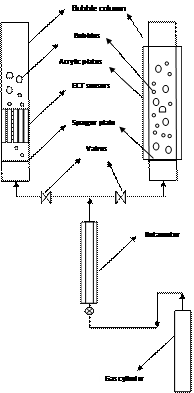
set up and techniques Bubble column experimental set up was
made up of Perspex of ID-48mm and height 1.2m. Two exactly similar set up
assembled on test rig where (i) one is for ECT sensor/electrodes mounted on
Perspex section (0.4m in length) (ii) similar transparent Perspex section fabricated for flow visualization (for high
speed photography). Both the columns were connected to each other by
Electrical Capacitance
Tomography Tomography by definition refers to
the process of exploring various characteristics of multi-component systems
using measurement of change in internal properties of fluid and solid;
depending on electrical properties of the components that is being analyzed and
background conditions during measurement. Electrical
capacitance tomography makes the use of capacitance measurements, section by
section, using pairs of electrodes from an 8 or 12 electrode ring assembly. It
provides subsequent reconstruction of the obtained data in the form of
concentration profile images by various image reconstruction techniques. It can be used to investigate the internal
dynamic behavior by presenting cross-sectional distribution of materials, i.e.
tomographic images. The overall voidage of the contents of ECT sensor
can be calculated by using the normalized pixel values in the reconstructed ECT
image (Donthi, S.S., 2004). High speed photography
Figure 1: A schematic of an experimental test setup The comparative study
of tomography and photography would be useful to get quantitative information
regarding void fraction in two phase flow. It will also be useful for two phase
flow boiling applications where boiling tubes are opaque and there ECT technique
will play a promising technology in order to get bubble volume fraction/vapor
quality.
References:

 High speed NR4-S1 camera was used for
the current experiments with resolution 1024×1024 @1000fps and pixel size not
more than 14µm. Bubble volume fraction will be measured for different sieve
plate sparger designs as well as different gas flow rates. Based on the
knowledge of volumetric void fraction, this current study also calculate the
void fraction by using the photographic technique
See more of this Group/Topical: Particle Technology Forum