
 Google
 Yelp
 Facebook
 Twitter
 ChEnected
344784 Hysteresis in Solid-Liquid Suspensions in Optimax®: Using CFD Simulations and Experiments With FBRM
Title: Hysteresis in solid-liquid suspensions in OPTIMAX®: Using CFD simulations and experiments with FBRM
Authors: Vedantam, S., Ranade, V.V.*
Affiliation: Industrial Flow Modeling Group (iFMg), CEPD Division, National Chemical Laboratory (NCL), Pune, INDIA
*corresponding author: vv.ranade@ncl.res.in
ABSTRACT
Introduction:
Crystallization is the most widely used separation and purification process employed throughout the chemical and pharmaceutical industry for chemical products that are solids at room temperature and pressure. Today, crystallization modeling tools are limited by the availability of methods to reliably predict solubility and super saturation for chemical systems of industrial importance. There is also limited capability for describing nucleation and crystal growth, and mixing and design scale-up for industrial crystallizers. Tools are needed to model and optimize crystallizer process performance with respect to product quality, throughput and efficiency. It is essential to understand and relate key thermodynamic, kinetic and hydrodynamic aspects to crystallizer performance not just in terms of yield but also in terms of product quality (characterized by particle size distribution, morphology, polymorphism and the amount of strain as well as the uptake of solvent or impurities in the crystal lattice). Process Analytical Technology (PAT) tools are also on the rise in these applications and published in the literature (Daneau and Steele., 2005; Samad et al., 2013).
Hydrodynamic modeling, one of the key aspects, is the focus of the work presented in this abstract. In literature, Joshi et al (2011), presented a comprehensive review on CFD modeling studies in stirred tanks, stating that it is worth noting that dense suspensions require a correct modeling of both solid–liquid and particle– particle interactions. However, as an initial step, an automated reactor called OPTIMAX® (launched by Mettler-Toledo Ltd.,) is being used for the study of various aspects of crystallization and the quantitative effect of all key aspects on the process. OPTIMAX® (OM), a synthesis workstation provides a platform for product and process development and is coming into use in bio-pharmaceutical synthesis applications. OM is typically an automated reactor, offering heating electrically and cooling on the basis of Peltier technology. Crystallization is one of the wide hopes of applications to be carried out in this particular workstation. In this particular set-up, OM is designed to accommodate internals such as Focused Beam Reflectance Measurement (FBRM) probe (used for estimating the Chord Length Distributions (CLD) and thus, Crystal Size Distributions (CSD)); Temperature probe (Tr probe), Fourier-Transform Infra Red (FTIR) spectroscopy probe; turbidity probe; pH probe; impeller and baffles as well. However, as for this study, the internals used are FBRM probe; Tr probe and 4-bladed down-pumping PBT as impeller are used. It is understandable that the reactor geometry, operating conditions and the flow characteristics govern the hydrodynamic aspects of the crystallization process thus subsequently also affecting the kinetic aspects. Solid-liquid suspension studies on solids distribution and the effect of operating conditions has been simulated and experimentally verified.
Methodology, flow characterization and mixing time:
Commercial software Ansys Fluent (14.0) has been used for all CFD simulations. Multiple Reference Frame (MRF) approach is used for modeling the impeller. Multiple phases have been simulated using Eulerian approach. 1000 mL reactor volume has been used as the domain for simulations and experiments, with an inner diameter of 0.101 m, and a height of 0.137 m. The impeller used is a 450, four-bladed, down pumping PBT. A mesh size of 4, 60,000 cells has been used for the entire domain. Simulations are carried out for impeller speed ranging from 100 to 1000 rpm, and varying solids hold-up of the particles used. The geometry indicating the internals, tank and inner and outer regions of the domain, clearly demarked for MRF approach are shown in the Figure 1. The commonly used validation check points such as Power number (NP, from turbulent energy dissipation rate and moments), Pumping number (NQ) are estimated from the CFD predictions, and satisfactory validation has been obtained, which gives a go ahead for further studies on crystallization in this reactor.
Experiments are carried out using FBRM to estimate the distribution of particles, and verify the hysteresis likely to occur with the variation in impeller speed. Neutrally buoyant particles of 350 micron are used as solid particles. Hold-up has been varied from 1 % to 10 % in the reactor. Impeller speeds are varied from 100 rpm to 1000 rpm and the particle size distribution has been tracked using FBRM. Similar conditions have been simulated using CFD.
Conclusions:
Solid-liquid suspension studies in OPTIMAX® are carried out using simulations as well as experiments. The CFD study is validated with the established parameters such as NP (from estimated turbulent energy dissipation rate and the torque), NQ from the CFD predictions. Possibility of hysteresis has been verified using FBRM and CFD simulations.
References:
Samad, N.A.F.B.A., Sin, G., Gernaey, K.V., Gani., R. 2013, “A systematic framework for design of process monitoring and control (PAT) systems for crystallization processes”, Computers & Chemical Engineering, 54, 8-23. http://dx.doi.org/10.1016/j.compchemeng.2013.03.003
Buwa, V. V. and Ranade, V. V., 2003a Characterization of dynamics of gas-liquid flows in rectangular bubble columns, AIChEJ, 50, 2394.
Deneau, E., Steele, G, 2005, An in-line study of oiling out and crystallization, Org. Proc. Res. Dev., 9, 943-950.
Joshi, J.B., Nere, N.K., Rane, C.V., Murthy, B.N., Mathpati, C.S., Patwardhan, A.W., Ranade, V.V., 2011, CFD Simulation of Stirred Tanks: Comparison of turbulence models (Part II: Axial Flow Impellers, Multiple Impellers and Multiphase Dispersions), The Canad. J. of Chem. Eng., 89, 754-816.
Ranade, V. V., Bourne, J. R. and Joshi, J. B., 1991. Fluid mechanics and blending in agitated tanks. Chem. Eng. Sci., 46, 1883.
Figures:
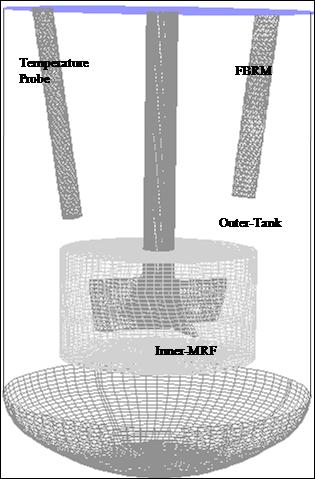
Figure 1. Computational domain showing inner and outer regions of MRF approach
See more of this Group/Topical: Separations Division