
 Google
 Yelp
 Facebook
 Twitter
 ChEnected
344943 Wetting Efficiency in Tubular Reactors With Solid Foam Packing
Wetting Efficiency in Tubular Reactors with Solid Foam Packings
Iman Mohammed1,*, Tobias Bauer1, Markus Schubert2, Rüdiger Lange1
1 Technische Universität Dresden, Institute of Process Engineering and Environmental Technology, 01062 Dresden, Germany
2 Helmholtz-Zentrum Dresden-Rossendorf, Institute of Fluid Dynamics, P.O Box 510519, 01314 Dresden, Germany
Introduction
In the recent years, the performance of gas-liquid-solid fixed bed reactors with structured catalysts instead of catalyst particles has been intensively discussed. Structured catalysts based on solid foams with an open cell structure are in particular very promising. Such porous structures combine high specific surface area up to 2000 m2/m3, low single-phase and two-phase pressure drop due to bed porosities between 75 and 95 %, and interconnected pores for enhanced heat and mass transfer (Stemmet et al., 2005; Grosse and Kind, 2011). The performance of fixed bed reactors with structured catalysts depends heavily on the gas-liquid-solid contacting pattern. For a broad range of flow conditions, the liquid phase does not cover the solid surface homogeneously, which is known as partial wetting.
The externally wetted fraction, which is defined as fraction of the external solid foam area covered by the liquid phase to the total external solid foam area, is directly linked to the liquid-solid and gas-solid mass transfer and thus, to the overall rate of reaction. The wetting fraction is a function of the superficial gas and liquid velocity and depends also on the physical properties of the liquid phase as well as catalyst shape, surface, porosity, etc. (Nigam and Larachi, 2005). However, studies on the wetting efficiency in trickle bed reactors also indicated the impact of the pre-wetting mode (Joubert and Nicol, 2012).
The aim of this work was to adopt an electrochemical method for: (a) measuring the wetting fraction in tubular reactors with solid foam packings and (b) to study the effect of pre-wetting.
Method and experimental setup
To solve the aforementioned tasks, a known electrochemical method has been modified to investigate the external wetting fraction in a tubular reactor packed with solid foam. The idea is based on the application of the kinetically-limited regime of the electrochemical polarization curve (Hanaratty and Campbell, 1983).
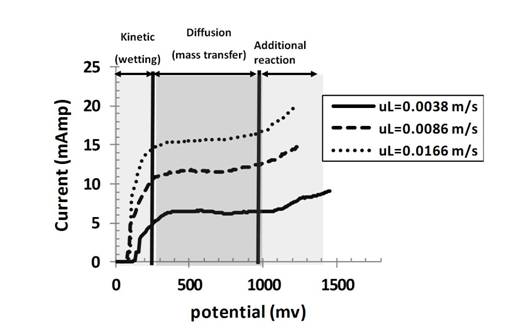
Figure 1: Effect of liquid superficial velocity (uL) on the shape of the polarization curves (25 ppi polyurethane foam, uG = 0.1 m/s).
The polarization curves for different flow conditions are depicted in Figure 1. The first part of the curve represents the region where the kinetics of the reduction reaction determines the rate of reaction at the wetted area of the electrode. Here, the slope of the line is a function of the area available for the electrochemical reaction, i.e. wetted fraction of the electrode. The polarization curve is determined by measuring the current at low voltage. Measurements under flooding condition represent 100% wetting (under negligible mass transfer condition). In order to calibrate the wetted area, cathodes with different cathode sizes were applied (Figure 2), which mimic different wetted areas at flooding condition.
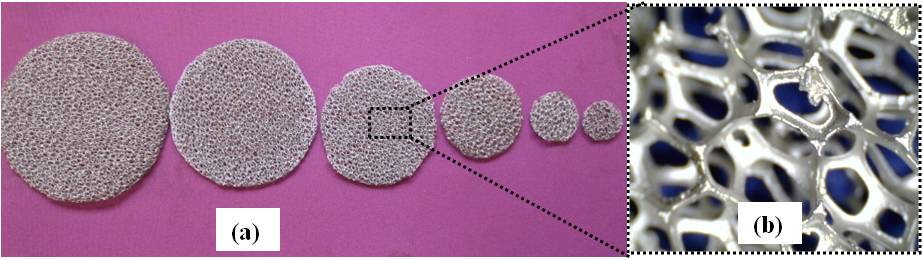
Figure 2: (a) Different Ni foam sizes used for the calibration (b) zoom into the Ni foam.
Gas (N2) and liquid phase (electrolyte solution of K4Fe(CN)6 K3Fe(CN)6 and NaOH) were fed co-currently in downflow mode of operation. Polyurethane foam cylinders of 10 cm diameter with different foam densities (10, 20 and 25) were used as packing. The nickel foam discs in between were acting as cathode and anode. The nickel foam (Ni, 99% purity, from Alantum Europe) was of the same foam density as the polyurethane foam cylinders. The total height of the packing was 1.0 m. The wetting measurements were performed at two axial positions of the packing (27 and 108 cm) downstream the distributor. The pre-wetting of the foam packings were based on LEVEC and KAN-LIQUID modes (Levec et al., 1986). Furthermore three liquid distributors (spray nozzle, single point and multipoint) were used to study the effect of the initial liquid distribution on the wetting.
Result and discussion
Figure 3 shows the wetting fraction for 10 ppi foam at the upper part of the packing (27 cm below the distributor). The wetting fraction increases with increasing liquid velocity. A negligible effect of the gas velocity was found. The phenomena of multiplicity of the wetting fraction were not observed. This indicates equivalent liquid distribution in the upper part of the packing in the both pre-wetting mode.
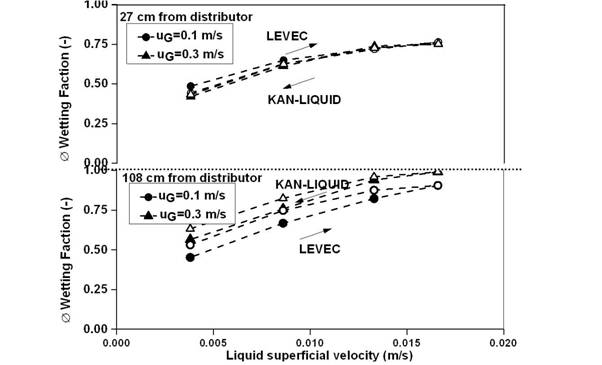
Figure 3: Wetting fraction for 10 ppi solid foam using spray nozzle distributor at two axial positions (filled symbol LEVEC pre-wetting mode, open symbol KAN-LIQUID pre-wetting mode).
At the lower part of the packing (108 cm) higher values of the wetting fraction were measured, which can be related to evolving liquid spreading on the foam surface. The effect of multiplicity was clearly observed depending on the pre-wetting mode. The wetting fraction is higher in KAN-LIQUID pre-wetting mode in comparison to the film flow characteristic at KAN-LIQUID pre-wetting mode. At LEVEC pre-wetting mode, the liquid phase is characterized by rivulet flow.
Conclusion
Wetting fraction measurements were performed in solid foams with different pre-wetting history using a modified electrochemical measurement method. The study shows the effect of operating conditions and pre-wetting modes on the wetting fraction at different axial position in the solid foam packing. Additional results for different foam densities will also be presented in the poster. The data will be used to calculate liquid-solid mass transfer coefficients as well.
References
J. Grosse, M. Kind, Hydrodynamics of ceramic sponges in countercurrent flow, Ind. Eng. Chem. Res. 50(8) (2011) 4631-4640.
C.P Stemmet, J.N. Jongmans, J. van der Schaaf, B.F.M. Kuster, J.C. Schouten, Hydrodynamics of gas-liquid counter-current flow in solid foam packings, Chem. Eng. Sci. 60(22) (2005) 6422-6429.
K.D.P. Nigam, F. Larachi, Process intensification in trickle-bed reactors, Chem. Eng. Sci. 60 (2005) 5880-5894.
Joubert, R. and W. Nicol Trickle flow liquid–solid mass transfer and wetting efficiency in small diameter columns. Canad. J. Chem. Eng. 91(3) (2013) 441-447.
See more of this Group/Topical: Catalysis and Reaction Engineering Division