
 Google
 Yelp
 Facebook
 Twitter
 ChEnected
345140 Scale-Up and Influence of the Process Variables in the Preparation of Highly-Concentrated Emulsions
Scale-up from experimental laboratory equipment to industrial plant size is one of the crucial issues in the field of process design. The processes working with low-viscosity Newtonian fluids are, usually, directly scalable. However, the scaling-up of processes involving high-viscosity non-Newtonian fluids is far more complicated, since fluid properties, like viscosity, and flow conditions can vary drastically during the process [1]. This is the case of emulsion manufacturing. Moreover, the final quality and properties of an emulsion are very dependent on the process variables, so a little change in the way of adding the components or in the vessel size can result in changes in the product quality, apart from a raw material, time and economical loss. The scale-up analysis of these processes and the study of the effect of process variables on the emulsion quality are necessary in order to predict what will happen at industrial scale and to optimize the process, saving money and time in unproductive tests.
In this study, preparation of highly-concentrated emulsions is used to investigate how the process variables and the scale-up influence emulsion properties, like droplet size, viscosity, yield stress, viscoelasticity and stability.
The w/o highly-concentrated emulsions (90 wt % dispersed phase) are prepared in batch mode following a two-step process: the first step consists in the addition of dispersed phase at a given flow rate (Q) while maintaining a constant stirring rate (N), the second step consists in the homogenization of the emulsion at the same stirring rate. Influence of composition variable surfactant/oil ratio (S/O) is also studied, using Span 80 as surfactant and dodecane as oil. Three different vessel sizes are used, with geometric similarity (1:2:4) and keeping the total emulsification time constant.
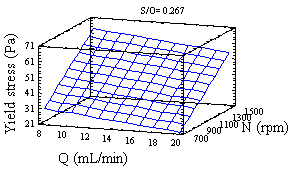
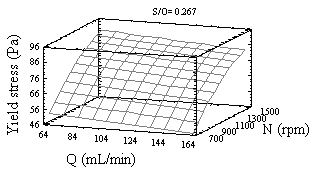
We use experimental design tools in order to minimize the number of experiments needed to obtain empirical models and response surfaces (Figure 1) that describe the influence of the variables on the emulsion properties and that can be used to predict further experiments. Additional experiments are performed to validate these empirical models obtained from few experiments. Similar response surfaces as function of the three input variables studied are obtained for each of the output variables. Empirical equations permit to predict corresponding emulsion property as a function of the input variables.
|
|
Experimentations at the three scales studied permit to obtain the scale invariants of the process, variables which have to remain invariants with scale in order to obtain emulsions with the same properties independently of the scale at which had been prepared.
From our results can be deduced that S/O is one of the invariants. Invariant related with flow rate is time of water addition, volume of reactor divided by flow rate. Finally, invariant related with stirring rate is not the Reynolds number, equivalent to ND2, as occur for other processes. For preparation of highly concentrated emulsions, we obtained that the invariant have the form NDa, where exponent a is between 0 and 1, and close to 0.5 for all the response variables chosen (including droplet size and rheological parameters).
For scaling up, we have empirical equations for each of the response variables as a function of the found invariants, and these empirical equations are valid for the three scales studied scales and, may be, it would be an extrapolation of empirical results, valid for any scale of magnufacturing that could be used.
[1] R. J. Wilkens, C. Henry, and L. E. Gates, “How to scale-up mixing processes in non-Newtonian fluids,” Chemical Engineering Progress, vol. 99, no. 5, pp. 44–52, 2003.
See more of this Group/Topical: Engineering Sciences and Fundamentals