
 Google
 Yelp
 Facebook
 Twitter
 ChEnected
345326 Preparation of Mesoporous Materials: Approaching to Industrial Viability
Since the discovery of the ordered mesoporous materials [1-2] many papers have been published about preparation of these kind of materials, but most of the proposed methods are very far of being applicable at industrial scale due to cost of precursors, catalysts, structure directing surfactants, and complex processes which are proposed.
In most of the processes alcoxides of the corresponding metal are proposed as precursors, acid or basic catalysts are used, and surfactants used as structure directing agents are not normally recovered.
In this work, meso and meso-macroporous materials are prepared using metasilicate as precursor, experiments using acid resins as acidifying agent are presented, and experiments using recovered surfactant are also presented. Influence of concentration of precursor and surfactant on properties of obtained materials is presented.
In case of using acid resin the preparation method is the following. First, water and surfactant are and kept under stirring at 50ºC to ease the melt of the surfactant until a clear solution was obtained. Then ion exchange resin is added to the water and surfactant solution. Later on, a sodium silicate solution is added drop by drop. The resulting slurry is stirred, so the Na+ of the sodium silicate solution substituted the H+ on the exchange sites of cation resin. The filtered liquid, which did not have condensed silica yet, is placed in an oven at 100 ºC during 24 h in order to allow the silicate condensation producing a white precipitate that corresponds to the ordered mesoporous material. In case of using macroemulsions as templates for macroporous materials, HCl is used as catalysts.
Surfactant is extracted from material by ethanol in a soxhlet, and recovered by evaporating the ethanol in a rotavapor.
The material is finally dried and calcined in order to eliminate the residual surfactant
Materials are characterized by Small-angle X-ray diffraction scattering (SAXS), Scanning electron microscopy (SEM), Transmission electron microscopy (TEM), Hg intrusion porosimetry and N2-sorption analysis.
In figure 1, examples of macromesoporous material and the ordered mesoporous structure are presented.
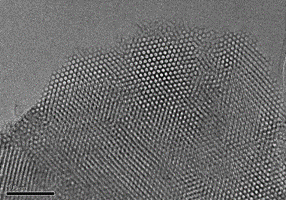
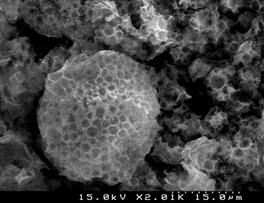
Figure 1. SEM and TEM images showing macroporous and mesoporous structures obtained
Mesostructure was confirmed by SAXS. High specific surfaces were obtained depending on the values of variables studied, the less silicate or surfactant concentration the more specific surface. No significant differences in specific surface were observed when recovered surfactant is used.
As main conclusion of this work, remark that very good materials with high specific surfaces and ordered mesostructure can be obtained using inorganic precursor, acid resin as catalyst, and recovered surfactant, which can make much less expensive the fabrication of this kind of materials.
[1] C.T. Kresge, M.E. Leonowicz, W.J. Roth, J.S. Beck. Ordered mesoporous molecular sieves synthetized by a liquid-crystal template mechanism. Nature 359, 1992, 710
[2] J.S. Beck, J.C. Vartuli, W.J. Roth, M.E. Leonowicz, C.T. Kresge,, K.D Schmitt, C.T.W Chu, D.H. Olson, E.W. Sheppard, S.B. McCulle, J.B. Higgins, J.L. Schlender. Anew family of mesoporous molecular sieves prepared with liquid crystal templates, J.Am. Chem. Soc. 114, 1992, 10834
Keywords: Silica, emulsion, meso-macroporous, ordered mesopores, cooperative templating mechanism
See more of this Group/Topical: Materials Engineering and Sciences Division