
 Google
 Yelp
 Facebook
 Twitter
 ChEnected
345518 Kinetics of Self-Buffering Hydrolysis of Pectin in Batch Reactor
Kinetic study for a self-buffering hydrolysis of pectin in batch reactor
Heman P. Asher, Raul Rivas-Cantu, Patrick L. Mills
Processing of citrus waste generates large amount of wastes. From 2008-2011, the USA generated almost 10.5 million tons of Citrus Processing Waste (CPW) from processing of grapefruits and oranges. The CPW is dried and then used as a low cost feed for livestock. Due to low nutritional values of feedstock and high energy consumption during drying, this operation is not economical and is used as a remedial process for waste disposal. The unused CPW is sent to landfills, which incurs environmental hazards and high economical costs. Grapefruit Processing Waste (GPW) is the primary source of CPW in Texas. GPW can be used as a renewable source of pectin-rich biomass, which on hydrolysis gives Galacturonic Acid (GA) and other value added products for biorefinery applications. GA on catalytic reduction may produce hexoses (glucose, galactose), which can be used to produce bio-ethanol.
The objective of this work was to obtain kinetic parameters for self-buffered enzymatic hydrolysis of pectin in a batch reactor to determine the reaction kinetics with an emphasis on its conversion into galacturonic acid (GA). Lab scale experiments were performed in bottom- baffled Erlenmeyer flasks submerged in water bath shaker at pH 4.8, temperature 45 °C and 175 rpm.
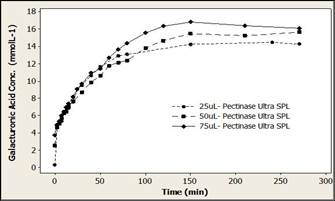
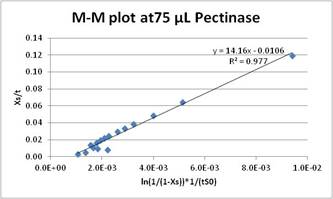
The first step was to evaluate the experimental results of total hydrolysis of various concentrations of pectin solutions in 75 mM sodium acetate (NaOAc) buffer solution and in a self-buffering solution of sodium galacturonate (NaGA) produced during enzymatic hydrolysis and formed due to addition of sodium hydroxide (NaOH) to raise the initial pH to 4.8. Experiments for determination of kinetic parameters were performed for three different enzyme loadings for 0.5 wt% pectin solutions monitored at periodic time intervals for 5 hours. Commercially available enzyme complexes, such as PectinexR Ultra-SPL and AcceleraseR XY, were used as biocatalyst. The initial results showed that the self-buffering system behaved similar to externally buffered system. Subsequently, the kinetic parameters for a self-buffered system were determined based on experimental data using the Michaelis-Menten model. Additional experiments at pH 6.0 are being evaluated for improving enzymatic activity and to increase the reaction yield. The determined kinetic parameters are shown in table 1. Fig. 1 shows the behavior of GA concentration with time during the enzymatic hydrolysis of pectin and Fig. 2 shows the normalized M-M plot for enzymatic hydrolysis.
These and other results, including the utility of the kinetic modeling for reaction scale-up by a volume factor of more than 150, will also be discussed
Table 1 – Determined kinetic parameters for various enzyme loading
Kinetic Parameters
| 25 µL Pectinex, 10 µL Accelerase XY
| 50 µL Pectinex, 20 µL Accelerase XY
| 75 µL Pectinex, 30 µL Accelerase XY
| ||||||
| Lineweaver
| Eadie-Hofstee
| Hanes-Woolf
| Lineweaver
| Eadie-Hofstee
| Hanes-Woolf
| Lineweaver
| Eadie-Hofstee
| Hanes-Woolf
|
Michaelis-Menten Constant (Km, mmol/L)
| 13.47
| 13.47
| 13.47
| 14.27
| 13.76
| 13.76
| 14.26
| 14.16
| 14.16
|
Max. forward velocity (Vm, mmol/L-min)
| 0.093
| 0.093
| 0.093
| 0.082
| 0.079
| 0.079
| 0.16
| 0.16
| 0.16
|
|
|
See more of this Group/Topical: Catalysis and Reaction Engineering Division