
 Google
 Yelp
 Facebook
 Twitter
 ChEnected
346618 Study on Pyrolysis Properties of Agriculture Residues by Using FTIR and DRIFT Technique
Study on pyrolysis properties of agriculture residues by using FTIR and DRIFT technique
Peng Fu, Weiming Yi*, Zhihe Li*, Xueyuan Bai, Yanmei Li, Jing Wang
School of Agricultural and Food Engineering, Shandong University of Technology, Zibo 255049, China
*Corresponding author. Tel.: +86 533 2786308; Fax: +86 533 2786158
Abstract
The gas release properties and char structural evolution during pyrolysis of agricultural residues (maize stalk, rice straw and cotton straw) was studied with Fourier transform infrared spectroscopy (FTIR) and diffuse reflectance infrared Fourier transform spectroscopy (DRIFT).
The results showed that the pyrolysis processes underwent three consecutive stages, corresponding to the evaporation of water, the formation of primary volatiles and the subsequent release of small molecular gases. Fig. 1 showed that the major pyrolysis gases for the three materials were similar, including CO2, CO, methane, ethane, and some organics such as methanol, formaldehyde, formic acid, acetic acid and acetone. HCN was the major nitrogen containing product. The release of CO2 mostly focused in the temperature range of 250–450 oC. It was mainly released out with the cracking and reforming of carbonyl and carboxyl groups. The evolution of CO started at ≈ 230 oC, increased significantly with rising temperature, and reached a maximum at 337, 301 and 339 oC for maize stalk, rice straw and cotton straw respectively. The formation of CO below 400 oC was mainly caused by the cracking and reforming of thermolabile carbonyl and ether groups. The release of CO above 450 oC was probably due to the scissions of diaryl ether groups and secondary reactions of decomposition of the char. Compared with CO and CO2, CH4 evolution covered over a wider temperature range of 300–600 oC, with a maximum at about 420 oC. The formation of methane below 500 oC was mainly attributed to the cracking of the methoxyl groups. Moreover, the breaking of methylene groups in the temperature range could also contribute to the formation of CH4. The release of methane at higher temperatures might be ascribed to the rupture of aromatic rings. The aliphatic –CH2OH groups in –γ position of the alkyl side chains and aromatic methoxyl groups were the main source of methanol. The reforming of free hydroxyl groups and C–O groups could also generate methanol. The formation of formaldehyde at lower temperatures indicated that the aliphatic –CH2OH groups might be easily removed by alkyl C–C fragmentation.
To investigate the changes in the surface chemistry of chars formed during biomass pyrolysis, information on the surface chemistry of raw samples and chars has been provided by DRIFT spectroscopy. The DRIFT spectra of rice straw and chars given in Fig. 2 showed that the amount of hydroxyl (3200–3700 cm-1), aliphatic C-H groups (2800–3000 cm-1) and olefinic C=C bonds (1610–1680 cm-1) in the chars decreased significantly when the temperature exceeded 250 oC. The amount of C=O (1650–1770 cm-1) and ether structures in the chars first gradually decreases and then increases with the temperature rising. The aromatic structure develops when the temperature was higher than 350 oC. Aromatization was also evidenced by the shift to lower frequencies of the bands due to ν(C=O) and olefinic ν(C=C) vibrations. This behavior was consistent with the increase in conjugation of C=O groups and C=C bonds. At 500 oC, the char contained large amounts of aromatic and ether type structures. With the further increase of temperature, the amount of ether groups in the char decreases and the char became increasingly polyaromatic. The loss of ether groups led to a more ordered carbon structure at high temperature. The DRIFT analysis showed that the hydroxyl, aliphatic C-H, carbonyl and olefinic C=C functional groups were lost at high temperatures. The aromatization process started at ≈ 400 oC and continued to higher temperatures.
Keywords: Agricultural residues; Pyrolysis; FTIR; DRIFT
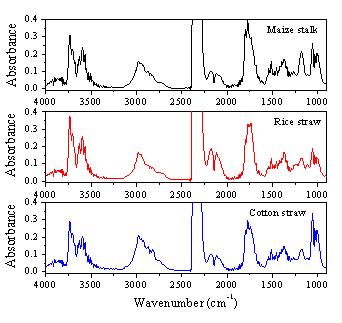
Fig. 1. FTIR spectra of gas products evolved at 300 oC for pyrolysis of three materials.
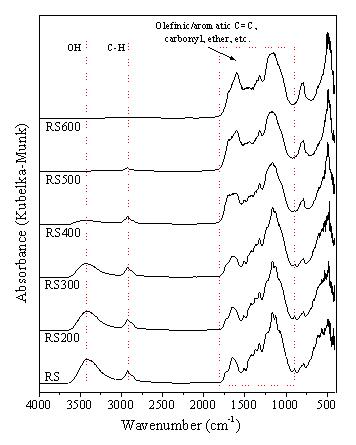
Fig. 2. DRIFT spectra of rice straw and chars formed at different temperatures.
See more of this Group/Topical: 2013 International Congress on Energy (ICE)