
 Google
 Yelp
 Facebook
 Twitter
 ChEnected
349656 Thermal Release Tape Method for Transfer and Characterization of Hexagonal Boron Nitride Grown By Metal Precipitation
Thermal Release Tape Method for Transfer and Characterization of Hexagonal Boron Nitride Grown by Metal Precipitation
Yichao Zhang, Timothy B. Hoffman, James H. Edgar
Kansas State University, Department of Chemical Engineering, Durland Hall, Manhattan, KS 66506
Abstract
Neutron detectors have shown an increasing importance in homeland security and nuclear non-proliferation, as they are capable of detecting nuclear weapons material. [1]. He-3 is currently the most widely used neutron detector material, however, due to the shortage of He-3 gas, as well as difficulty in inconvenience of transporting the device and high voltage operation requirement, there is a need for better alternatives [2]. Hexagonal boron nitride (hBN) is a compound semiconductor material that has shown potential in several applications, including use as a neutron detector, as. B-10, an isotope of boron, reacts strongly with thermal neutrons, making it a possible choice for solid state neutron detector material [3].
Several methods have been developed to produce hBN single crystal for neutron detector devices, including both CVD and bulk growth techniques. The goal of this research is to develop a method to transfer hBN produced from metal flux growth using a Ni-Cr solvent, thus allowing for material characterization free of the metal substrate. This research has implemented two ways of transferring hBN crystal, one of which is using thermal release tape to transfer thick layers of hBN crystal for fabrication of hBN detector devices. The other method is mechanical exfoliation via scotch tape, which yields much thinner layers of hBN crystal. Microscopy techniques, such as scanning electron microscopy (SEM), atomic force microscopy (AFM) and optical microscopy are used in characterizing these crystals.
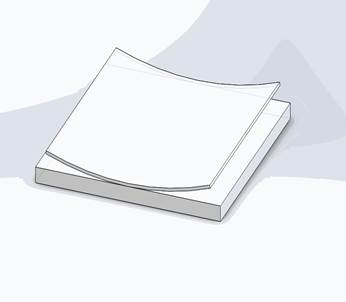
Thermal release tape has the unique property that it has adhesion that can be deactivated through the application of heat. The tape used in this research has a release temperature of 150 ° C. The transfer process was as follows. First, the tape was cut into 1 cm by 1cm pieces for use. The handle substrate for the crystal (glass or sapphire) was cleaned by three successive five-minute cycles of sonication using with trichloroethylene (TCE) followed by acetone and then methanol, followed by drying in air. The thermal release tape piece was pressed onto the hBN crystal for ten seconds then carefully removed, extracting the crystal from the metal substrate onto the tape. Then the tape was manually pressed onto the clean handle substrate, contacting the hBN with the handle substrate. The substrate-tape complex was then soaked in acetone for five seconds, and placed tape-side up onto a hot plate heated to the tape release temperature (150 °C) After a few minutes, the tape began to release and peel back from the substrate, as can be seen in Figure 1. At this time, the tape could then be carefully removed, leaving the hBN crystals on the handle substrate, completing the transfer process.
Second transfer method, mechanical exfoliation, was first developed for the production of graphene, but can be applied to hBN due to their structural similarities. The mechanical exfoliation in graphene breaks the weak interlayer Van der Waals forces that hold the stacked layers of graphite together, causing the formation of monolayer graphene with each successive step of exfoliation [4]. This research has adopted the same method, but applied it to produce thin-layer hBN, not monolayer, for the measurement of crystal properties.
The crystal flakes which fail to transfer during the thermal release tape method are recollected used in the mechanical exfoliation process. An adequate amount (4 mm2) of crystal is off-centered on a length of 10 cm long strip of scotch tape, with. The tape is then folded in half and pulled apart 5 times, causing the crystal to be exfoliated and spread on the tape. After the exfoliating is completed, tape is pressed onto a handle substrate cleaned by the same method as described in the thermal release tape transferring method. The substrate is left in contact overnight with the scotch tape to allow for crystal release. After 24 hours, the tape is removed from the substrate and soaked in acetone for two hours to remove the tape residue.
The key of this process is the selection of handle substrate and removal of the tape residue. hBN has been transferred onto several handle substrates for optical characterization and electrical characterization. Exfoliated hBN has very low optical contrast, making it difficult to observe under an optical microscope when on a transparent substrate [5]. Experiments have been performed on glass, quartz, SiO2 thermal oxide on Si, silicon carbide, and sapphire substrates to determine the substrate with high contrast and rate of transfer. Exfoliation was also performed on an aluminum substrate for measurement of electrical properties. Residual tape residue is a problem for characterization because it worsens surface roughness, affecting AFM measurement. Several methods have been explored to remove this residue, including soaking in TCE for 24 hours and thermal degradation of the residue under H2/Ar gas at 500 °C [6].Of these methods, thermal treatment of samples under H2/Ar gas at 500 °C has shown to be most successful in removing remaining tape residue.
References
[1] Uher, J., S. Pospisil, V. Linhart, and M. Schieber. Efficiency of Composite Boron Nitride Neutron Detectors in Comparison with Helium-3 Detectors. Applied Physics Letters 90.12 (2007): 124101. Print.
[2] J. Li, R. Dahal, S. Majety, J.Y. Lin, and H.X. Jiang, Hexagonal boron nitride epitaxial layers as neutron detector materials, Nucl Instrum Meth A 654 417 (2011)
[3]D.S. McGregor, T.C. Unruh, and W.J. McNeil, Thermal neutron detection with pyrolytic boron nitride, Nucl Instrum Meth A 591 530 (2008)
[4] Geim, A. K., and K. S. Novoselov. "The Rise of Graphene." Nature Materials 6.3 (2007): 183-91. Print.
[5] Gorbachev, R. V.; Riaz, I.; Nair, R. R.; Jalil, r.; Britnell, L.; Belle, B. D.; Hill, E. W.; Novoselov, K. S.; Watanabe, K.; Taniguchi, T.; Geim, A. K.; Blake, P. Hunting for monolayer boron nitride: optical and Raman signatures. Small 2011, 7, 465-468.
[6] Moore, A. W. "Characterization of Pyrolytic Boron Nitride for Semiconductor Materials Processing." Journal of Crystal Growth 6-15 106.1990 (n.d.): 6-15. Print.
Figures
Figure 1: Thermal Release Tape Model
See more of this Group/Topical: Student Poster Sessions