
 Google
 Yelp
 Facebook
 Twitter
 ChEnected
349673 Kinetics of 2,3-Butanediol Reaction with Cu-ZSM-5 (23)
The rising costs and harmful environmental impacts of fossil fuels has made developing renewable energies very important. Through bacterial fermentation, biomass can be converted into 2,3-butanediol (2,3-BDO). Using a bifunctional catalyst to catalyze both a hydrogenation and dehydration reaction, 2,3-BDO can be converted in butene, which can then be used as a jet additive.
In this study, the kinetics of the 2,3-BDO reaction with catalyst Cu-ZSM-5 (23) was investigated using a small-scale batch reactor. The reaction was run at various reaction times, temperatures, and with or without hydrogen gas present. The liquid products were analyzed using a gas chromatography mass spectrometer. The gas phase was studied using a thermal conductivity detector and flame ionization detector.
By identifying the types and amounts of products made, a new reaction mechanism was proposed for the conversion of 2,3-butanediol into butene. This mechanism is shown in Figure 1. The butadiene pathway seemed to be favored over the pathway involving the formation of propanol. Hydrogen was seen as a byproduct of the reaction. More tests should be done on this reaction to further modify the mechanism. Determining an accurate reaction mechanism is important to designing a catalyst that will best optimize the production of butene and make its production cost competitive with petroleum based butene.
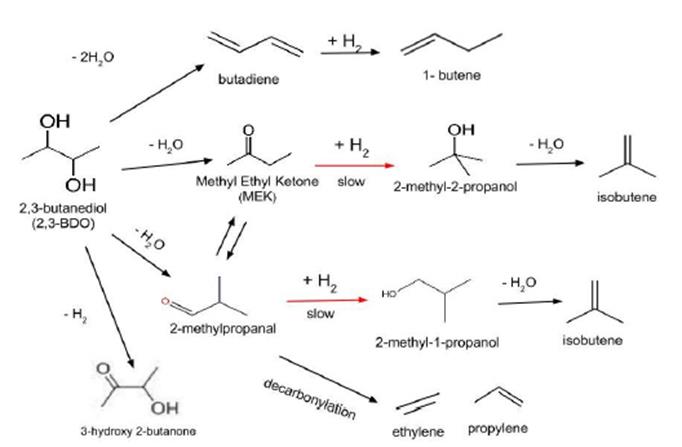
Figure 1. Proposed mechanism of 2,3-butanediol conversion to butene using Cu-ZSM-5 (23) catalyst.
See more of this Group/Topical: Student Poster Sessions