
 Google
 Yelp
 Facebook
 Twitter
 ChEnected
323655 Biodiesel Production Using Continuous Flow Ultrasonic Reactor
Biodiesel production using continuous flow ultrasonic reactor
Ajay Kumara*, D.V.Naika, Neeraj Atreya, S. Kaula
aIndian Institute of Petroleum, Dehradun, India 248005.
*Corresponding author. Tel.:+911352525949 Fax: +911352660202
E-mail address: ajaykr@iip.res.in
Abstract
The soaring prices of petroleum, depletion in the petroleum reserves and the growing environmental concerns to limit the exhaust emissions have led to the emergence of biodiesel as an alternative to diesel fuel. Biodiesel has attracted enormous attention because it is a biodegradable, renewable source, sustainable, non-toxic and safe alternative for meeting the world‘s energy needs that also reduces emission of carbon monoxide, carbondioxide, sulfur oxides, heavy metals, aromatic hydrocarbons and volatile compounds.
Biodiesel is traditionally obtained from vegetable oils or animal fats subjected to a chemical reaction called transesterification. In this reaction, the vegetable oil reacts in the presence of a catalyst and alcohol to produce the corresponding alkyl ester of the fatty acid mixture. Glycerol is produced as a by-product. Methanol and ethanol are the most commonly used alcohols because of their low cost. Both homogeneous and heterogeneous catalysts are used for biodiesel production.
It is understood that the transesterification of triglyceride with methanol is equilibrium reaction. The ratio of alcohol to triglyceride needs to be higher than stoichiometric to drive the equilibrium to a higher biodiesel yield. The transesterification reaction involves two immiscible phases. The less dense phase has the catalyst dissolve in the alcohol, where as the other contains the oil or fat. The reaction between these species can occur only in the interfacial region between the liquids, as alkaline catalysts are insoluble in the oil phase. Vigrous mixing is required to increase the area of contact between the two phases. Use of ultrasound reactor favors the reaction and propagation by way of enhanced mass transfer and interphase mixing between the phases and also can lower the requirement of the severity of the operating conditions in terms of temperature and pressure.
Ultrasound irradiation causes cavitation of bubbles near the phase boundary between the alcohol and oil phases. The asymmetric collapse of the cavitation bubbles disrupts the phase boundry. The cavitation may also lead to a localized increase in temperature at the phase boundary, enhancing the transesterification reaction. Neither additional agitation nor heating is required to produce biodiesel by ultrasound technique.
The present work aims at exploiting continuous production of biodiesel using ultrasonic energy with the aim of reducing the processing cost. Trans-esterification of non-edible jatropha vegetable oil with methanol in the presence of alkaline catalyst potassium hydroxide has been investigated under the influence of ultrasonic irradiation at 24 kHz frequency and 200 W as power input. The effect of different operating parameters such as ultrasonic power dissipation, catalyst concentration, methanol to oil molar ratio, flow rate of oil and residence time have been studied for process optimization. Excellent conversions of oil to biodiesel were obtained for all conditions studied in this work. Conversion levels of more than 95% have been observed with the use of continuous reactor in one pass using ultrasonic energy in less than 1 min residence time under ambient operating conditions.
Experimental
Materials and methods
In the present study non-edible jatropha oil was used containing about 14% free fatty acid (FFA). The alcohol and catalyst used in the present study were methanol and KOH. Methanol (99.8%) and KOH (98%) were purchased from Merck Specialities and Qualigens Fine Chemicals, respectively.
Experimental set-up
A Schematic diagram of the ultrasonic continuous flow cell reactor is shown in Figure 1. Vessel 1 was used for storage of vegetable oil and vessel 3 was used for storage of dissolved pottasium hydroxide in methanol. Both reactants were pumped through reciprocating pumps (2 and 4) into the ultrasonic flow cell reactor through a Y- joint at the bottom of reactor. Product mixture was continuously removed from the top of the reactor. The reactor consists of the ultrasonic generator having 24 kHz frequency with total supplied power input 200W. The ultrasound system has the facility to change the amplitude of the power ranging from 30-100%. The actual power dissipated in the system was computed through the software and system is assisted by computer for its monitoring and control. The volume of the reactor was 14 ml and diameter of the horn used was 14 mm. The flow cell reactor was equipped with a jacket, which permitted the recirculation ofchilled water from a constant-temperature bath and temperature of the reaction mixture was maintained within ± 1oC. The measurement of temperature of the reaction mixture was done at the exit of the reactor with the help of the thermocouple.
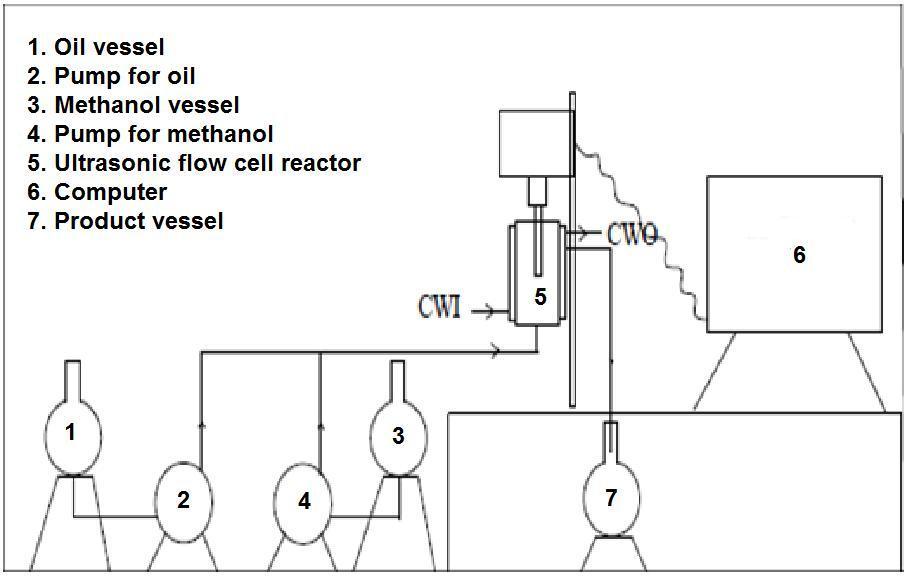
Fig. 1. A systematic diagram of experimental set-up of ultrasonic flow cell reactor
Experimental procedures
The two pumps of the reactants were adjusted at the desired flow rates to pass both the reactants into the flow cell reactor. Ultrasound generator was then switched on. Samples were collected for 2 minute after 1 minute, 3 minute and 5 minute time of start of ultrasound to study the steady state conditions of the system. Collected product was neutralized with acid and kept in the separating funnel for two hours to separate the phases. Bottom layer consists of glycerol rich phase and the upper layer consists of biodiesel rich phase. Bottom layer phase is separated with the help of gravity from the bottom of the separating funnel. The upper layer biodiesel rich phase was given a treatment of water washing, so that the catalyst and methanol present in this layer are separated. After the water washing, the sample was distilled in rotavapor to remove the trace amount of moisture present in the biodiesel. The samples were kept at 180C till further analysis.
Analysis
The compositional analysis of biodiesel product samples was done using a Gas Chromatograph of Chemito CERES 800 plus equipped with a flame ionization detector and a capillary column of VF 5 ht, 15m, 0.32mm, 0.10 micrometer. The GC oven was kept at 80oC for 5 min, heated at 10oC/min up to 450oC, where it was kept for 1 min, and a total analytical time was 40 min. The carrier gas was nitrogen. The analysis of a sample by GC was carried out by injecting 1 micro liter of the sample solution into the GC. The formed methyl ester was identified by comparing its retention time to the retention time of standard methyl ester of fatty acid.
Result and discussion
The continuous flow reactor using ultrasonic energy is efficient and time saving for transesterification of vegetable oil with alcohol to produce biodiesel. Source of sound energy proved suitable for large-scale processing in continuous way of vegetable oil to biodiesel. Ultrasound assisted cavitation mainly affects the mass transfer rates and ensures uniform distribution of reactants as well as release high energy to get maximum conversion at shorter residence time in the continuous reactor. As we have discussed in previous section that apart from the cost of vegetable oil for lowering the cost of biodiesel the other main factors that influence the cost of production of biodiesel are energy consumption, the amount of methanol and catalyst. During this study of the transesterificaton reaction, the effects of various parameters such as the dissipation of ultrasonic power, catalyst concentration, molar ratio of methanol to oil, flow rate/residence time on the conversion have been investigated. The reaction samples were collected after 1, 3 and 5 minute after start of ultrasound to study the steady state of the system and it was found that the conversion was same for each sample. Thus, it can be said that the steady state was attained within one minute operation of the system. The optimum operating parameter for around 100% conversion in the present work were observed to be 6:1 mole ratio of methanol to oil, 1.25 wt% catalyst concentration and temperature 30oC and residence time less than one minute. The present work has clearly demonstrated the key role of continuous reactor using ultrasonic energy for biodiesel synthesis process.
Conclusion
The present work has clearly demonstrated the key role of continuous reactor using ultrasonic energy for biodiesel synthesis process. The continuous flow reactor using ultrasonic energy is efficient and time saving for transesterification of vegetable oil with alcohol to produce biodiesel.
See more of this Group/Topical: Energy and Transport Processes