
 Google
 Yelp
 Facebook
 Twitter
 ChEnected
326011 Direct Cracking of Raw Oil Sands Bitumen - A New Approach
Abstract
The objective of this study is to determine the viability of direct fluid catalytic cracking (FCC) of the resids-free portion of the raw Athabasca oil sands bitumen in the presence of the easily-cracked synthetic crude oil (SCO) after removing its light 343°C– fraction. A 343–525°C cut heavy gas oil (HGO) was prepared by distilling a vacuum topped bitumen from the vacuum distillation unit at Syncrude commercial upgrading plant1 (Figure 1) in northern Alberta, Canada. It was then blended with various amounts of 343°C+ fraction of commercial SCO, called Syncrude Sweet Premium (SSP). Five HGO blends were prepared containing 100, 75, 64, 61, and 48v% of SCO HGO. The two blends with 64 and 48v% were referred to here the synsynbit and synbit HGOs, respectively. An earlier marketability study2 on oil sands products in Asian countries predicted that (1) synsynbit, blended to approximate the quality of Middle East light sour crudes, would have the largest exporting volume and diversity of marketability, compared with those for the sweet SCO, and (2) Asian refineries would be able to accept synsynbit without any major modifications of the plant structure.
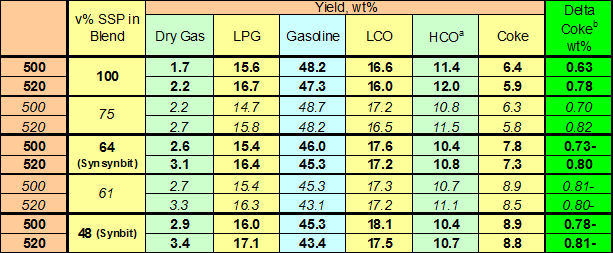
Each HGO blend was catalytically cracked at 500 and 520°C using a bench-scale Advanced Cracking Evaluation (ACE) unit. The results showed the acceptable performance of bitumen HGO when adequate amount of SCO HGO was added. The conversion, defined as the summation of dry gas (H2, H2S, C1–C2), liquefied petroleum gas (LPG, i.e., C3+C4), gasoline (C5–221°C), and coke, and selectivities of gasoline, light cycle oil (LCO, a diesel pool component, 221–343°C), and coke were either improved or little affected, in comparison with those of 100% SCO HGO used as a bench mark (Table 1). In-house analyses supported by those reported in the literature3 showed that the bitumen HGO, which accounted for 40.6wt% vacuum topped bitumen, actually contained less nitrogen than its counterpart and had relatively low Ni+V and CCR. These imposed no serious threat to the cracking catalysts which were vulnerable to these poisons. Perhaps, the major challenge was the mild increase in the dry gas yield notably due to the augmentation of H2S, and higher sulfur levels in gasoline and diesel which might need desulfurization prior to being sent to gasoline and diesel pools. As sulfur species in bitumen HGO exist mostly as sulfides, mercaptans, and small thiophenes, they should be easily removed by mild hydrotreating or other low cost process.
In summary, the proposed route provided an interesting and promising option to directly crack the raw bitumen leading to a substantial saving in energy and reduction in green house gases by eliminating the costly upgrading of the bitumen HGO.
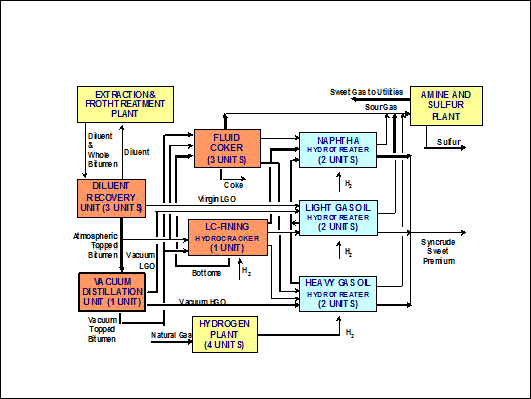
Figure 1. Syncrude upgrading process flow
Table 1. Product distributions at 72 wt% conversion for HGO blends
a heavy cycle oil, sometimes
used as heavy fuel oil b the amount of coke on catalyst
[1]
Yui, S., Chung, K. “Syncrude Upgrader Revamp Improves Product Quality”, Oil & Gas Journal, December 17, 2007, pp. 52–59. [2] du Plessis, D., Wu, N. “Marketability of Oil Sands Products
in Asian Countries”, presentation to HUTF, June 20, 2007. [3]
Chung, K.H., Xu, C.M., Hu, Y., Wang, R. “Supercritical Fluid Extraction
Reveals Resid Properties”, Oil & Gas Journal, January 20, 1999, pp.
66–69.
See more of this Group/Topical: Fuels and Petrochemicals Division