
 Google
 Yelp
 Facebook
 Twitter
 ChEnected
331759 Synthesis of Nanostructured Flower-Like Zinc Oxide Through a Membrane Dispersion Micro-Structured Reactor
With the development of nanotechnology, Nanostructured ZnO has attracted extensive research attentions over the past decades in view of its numerous applications, such as gas sensors, desulfurizing sorbents and semiconductors. Many methods for synthesizing nanostructured ZnO have been proposed, including the chemical precipitation method, hydrothermal method, solgel techniques and so on4. The direct chemical precipition method is one of the most promising ways to fabricate nanostructured ZnO for its low cost, simple process and high purity. However, the mass transfer process is seriously limited in the typical precipitation process in which one feedstock is slowly added to another one dropwise, high supersaturation ratio is not available in whole, finally lead to the wide distribution of particle diameter. Consequently, it's significative to develop a micro-structured membrane dispersion reactor with high mass transfer efficiency. Figure 1 shows the membrane reactor experimental setup and the principle of membrane dispersion. NH4HCO3 and Zn(AC)22H2O were used in the reaction as precipitant and zinc salt respectively. Microporous tubular ceramic membrane with pore size of 50nm took the role of dispersion medium. Under the pressure of 0.4 MPa, NH4HCO3 solution was dispersed into tiny drops. The drops diffused rapidly under stirring and reacted with zinc salt, white precursor could be generated theno. Fllowing the process, the white precursor was washed by distilled water three times to remove foreign ions, and then it was dried at 70℃ for 6h and calcined at 300℃ for 1.5h.
Nanostructured flower-like zinc oxide with controlled size was successfully prepared though a novel membrane dispersion micro-structured reactor combined with the direct precipitation method. Figure 2 is the X-ray diffraction pattern. The white precursor obtained by the precipitation reaction is crystallized Zn5(CO3)2(OH)6 (No.19-1458). After the heat treatment, it matches well to the standard diffraction pattern of wurtzite ZnO (No.36-1451). Figure 3 is the SEM of Zn5(CO3)2(OH)6 and ZnO at different magnifications. Zn5(CO3)2(OH)6 precipitate demonstrates an interesting nanostructured flower-like morphology at micrometer size, which is assembled by nanoflakes. After the calcine process, similar morphology can be obtained but the nanoflake break into nanopaticles due to the heat treatment. The average crystallite size of ZnO is approximately 18.5 nm calculated by the Scherrer's formula.
|
|
Figure 1. Schematic diagram of membrane dispersion microstructured reactor |
Figure 2.X-ray diffraction pattern of precousor and ZnO after calcination |
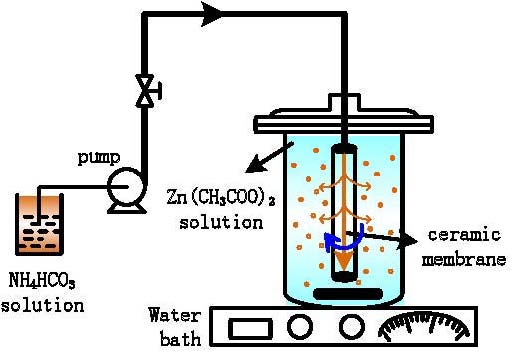
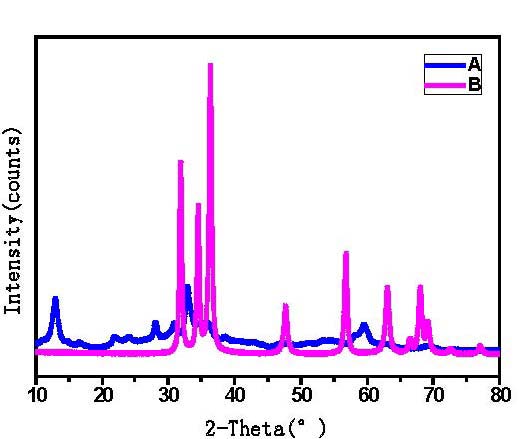
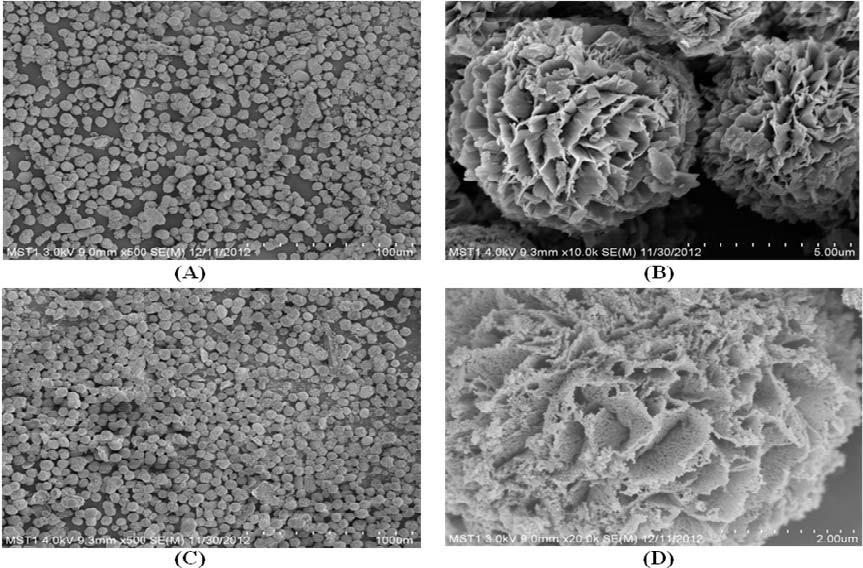
Figure 3.SEM micrographs of (A), (B) Zn5(CO3)2(OH)6 precursor (C), (D) ZnO at different magnifications
References
1.Chen M, Wang ZH, Han DM, Gu FB, Guo GS. High-sensitivity NO2 gas sensors based on flower-like and tube-like ZnO nanomaterials. Sensor Actuat B-Chem. 2011,157(2):565-574.
2.Garces HF, Espinal AE, Suib SL. Tunable Shape Microwave Synthesis of Zinc Oxide Nanospheres and Their Desulfurization Performance Compared with Nanorods and Platelet-Like Morphologies for the Removal of Hydrogen Sulfid. The Journal of Physical Chemistry C. 2012,116(15):8465-8474.
3.Kripal R, Gupta AK, Srivastava RK, Mishra SK. Photoconductivity and photoluminescence of ZnO nanoparticles synthesized via co-precipitation method. Spectrochimica acta. Part A, Molecular and biomolecular spectroscopy. 2011,79(5):1605-1612.
4.Tiwari JN, Tiwari RN, Kim KS. Zero-dimensional, one-dimensional, two-dimensional and three-dimensional nanostructured materials for advanced electrochemical energy devices. Prog Mater Sci. 2012,57(4):724-803.
5. Medina A, Bejar L, Borjas SE, et al. Characterization of ZnO nanoparticles with short-bar shape pro-duced by chemical precipitation. Mater Lett. 2012,71:81-83.
Acknowledgements
Financial supports from the National Natural Science Foundation of China (No. 21125629), the National Basic Research Program (No.2009CB623406), the National High-Tech Research and Development Program of China (2012AA03A606)