
 Google
 Yelp
 Facebook
 Twitter
 ChEnected
332242 A Novel Method of Making Stamps in Soft Lithography Via Compressed Carbon Dioxide
A novel method of making stamps in soft lithography via compressed carbon dioxide
Yu Cang, Rui Zhang*, Lixiao Liu, Jianchao Zhang, Tao Yang, Xuhong Guo*
State Key Laboratory of Chemical Engineering, East China University of Science and Technology, 130 Meilong Road, Shanghai 200237, China
*Corresponding authors. Tel.: +86-21-64253491; E-mail: r.zhang@ecust.edu.cn
guoxuhong@ecust.edu.cn
Abstract: Soft lithography (SL) is one newly developed and high precise microfabrication technology which can fabricate various microstructures of materials costless with the help of medium pattern-transfer element or elastomeric stamp. Polydimethylsiloxane(PDMS) owns excellent viscoelasticity that become widely used in making different-microstructure stamps. PDMS stamps are produced by casting and curing PDMS precursors on the Si master by photolithography or swelled by some organic solvent traditionally. However, these preparation methods are expensive and may distort microstructures which limited their applications. We propose a new method of making stamp that imprint microstructure on PDMS with compressed carbon dioxide due to the good solubility of PDMS in compressed carbon dioxide. The patterns are sandwiched between two PDMS moldings under certain pressure and temperature. We use gauze, silica gel particle and nanometer-size chip as patterns. In the whole process, the reaction pressure is up to 5MPa and temperature is 318.15K, which can soft PDMS well. However, after the reaction the quench temperature should be decreased obviously under constant pressure to prevent the collapse of stamp. The patterns of different dimensions from micro-meters to nano-meters can be imprinted perfectly after about 4 hours. The simply and precise way of making stamp can expand the use of SL in chemistry, biology, physics, semiconductor fields and so on.
Keywords: soft lithography, polydimethylsiloxane, carbon dioxide
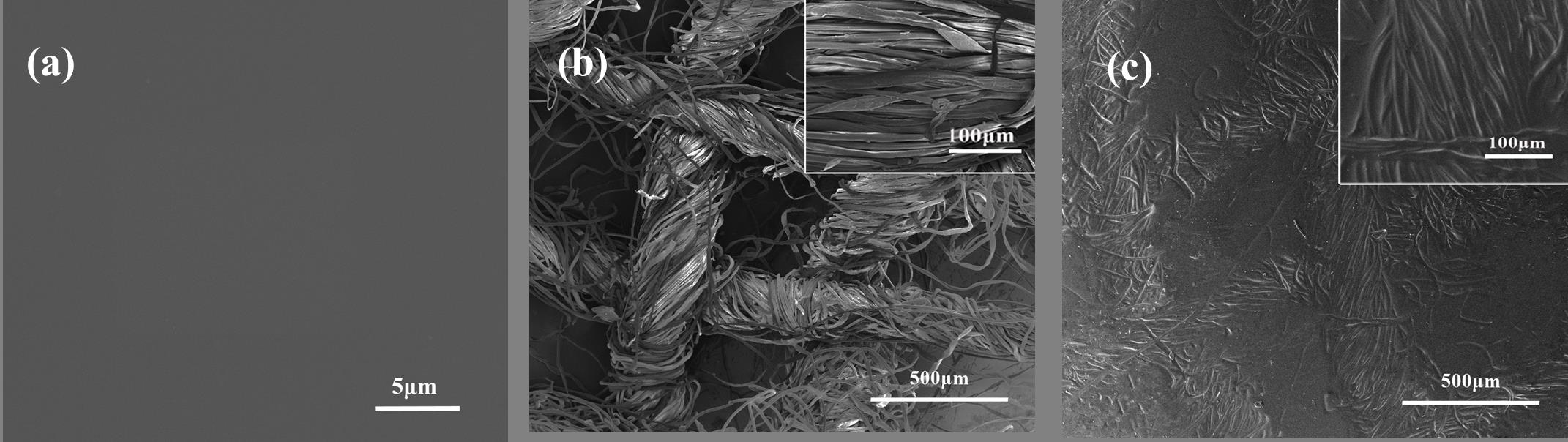
Figure. (a) SEM image of PDMS before imprinted (b) SEM image of gauze pattern (c) SEM image of PDMS after imprinted gauze pattern
See more of this Group/Topical: Engineering Sciences and Fundamentals