
 Google
 Yelp
 Facebook
 Twitter
 ChEnected
332734 Porous Cleas of β-Mannanase Prepared By Macromolecular Cross-Linker
Cross-linked enzyme aggregates (CLEAs), a carrier-free enzyme immobilization approach, prepared by precipitation and subsequent cross-linking using glutaraldehyde, have attracted increasing attentions in recent years because of its advantages of high stability and enzyme activity due to the exclusion of carrier and the excellent property of repeated utilization.1, 2 However, mass transfer limitation was considered as the main shortcoming for the application of CLEAs because of its conglomeration structure formed by glutaraldehyde.
Therefore, in this paper, the multi-aldehyde macromolecule of linear dextran polyaldehyde (2000 kD) as well as branched dialdehyde starch (350-750 kD), Fig. A, were introduced as cross-linker to construct the porous structure and enhance the mass transfer property of beta-mannanase CLEAs.
Scanning electron microscope revealed the inner structure of CLEAs prepared by different cross-linker. For the CLEAs cross-linked by glutaraldehyde (Fig. B-a), the SEM image exhibited a smooth surface with few pores. It was estimated that this structure had the seriously steric hindrance effect on macro-substrates, which limited the substrates to enter into the inner CLEAs. Thus, beta-mannanase CLEAs showed the low activity (4.68%). When using the linearly macromolecular dextran polyaldehyde (2000 kD) as a cross-linker, beta-mannanases were bonded along its long chain, which not only prevented the lump of enzyme molecules but also formed a porous structure of CLEAs for macro-substrates to get into the inner CLEAs (Fig. B-b). These pores decreased the steric hindrance and obviously increased the activity of CLEAs (32.01%). Unlike the linear macromolecule, dialdehyde starch (350-750 kD) is dendritic. It bonded enzyme molecules along its interlaced branch, which also led to the congestion of enzyme and the steric hindrance of CLEAs (Fig. B-c). Even then, the activity of CLEAs prepared with dialdehyde starch (20.98%) was still higher than that cross-linked by glutaraldehyde due to the flexibility of enzyme.
This research was supported by the NSF of China (20976125, 31071509, 51173128, 21206113) and Tianjin (10JCYBJC05100), the Ministry of Science and Technology of China (Nos. 2012YQ090194, 2013AA102204, 2012BAD29B05), the Program for New Century Excellent Talents in Chinese University (NCET-08-0386), and Beiyang Young Scholar Program (2012).
References
[1] U. Roessl, J. Nahalka and B. Nidetzky, Biotechnol. Lett., 2010, 32, 341-350.
[2] L. Cao, F. van Rantwijk and R. A. Sheldon, Organic Letters, 2000, 2, 1361-1364.
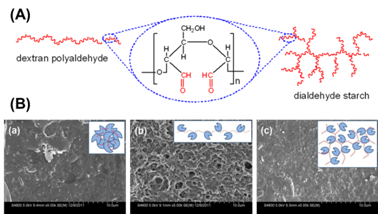
Figure (A) The molecular structure of dialdehyde starch and dextran polyaldehyde; (B) The morphology of beta-mannanase CLEAs cross-linked by (a) glutaraldehyde, (b) dextran (2000 kDa) and (c) dialdehyde starch (magnified 5 k times).
See more of this Group/Topical: Food, Pharmaceutical & Bioengineering Division