
 Google
 Yelp
 Facebook
 Twitter
 ChEnected
341635 Detailed Kinetic Modeling and Simulation of Coal/Corn Stover Mixtures in a Moving Bed Gasifier
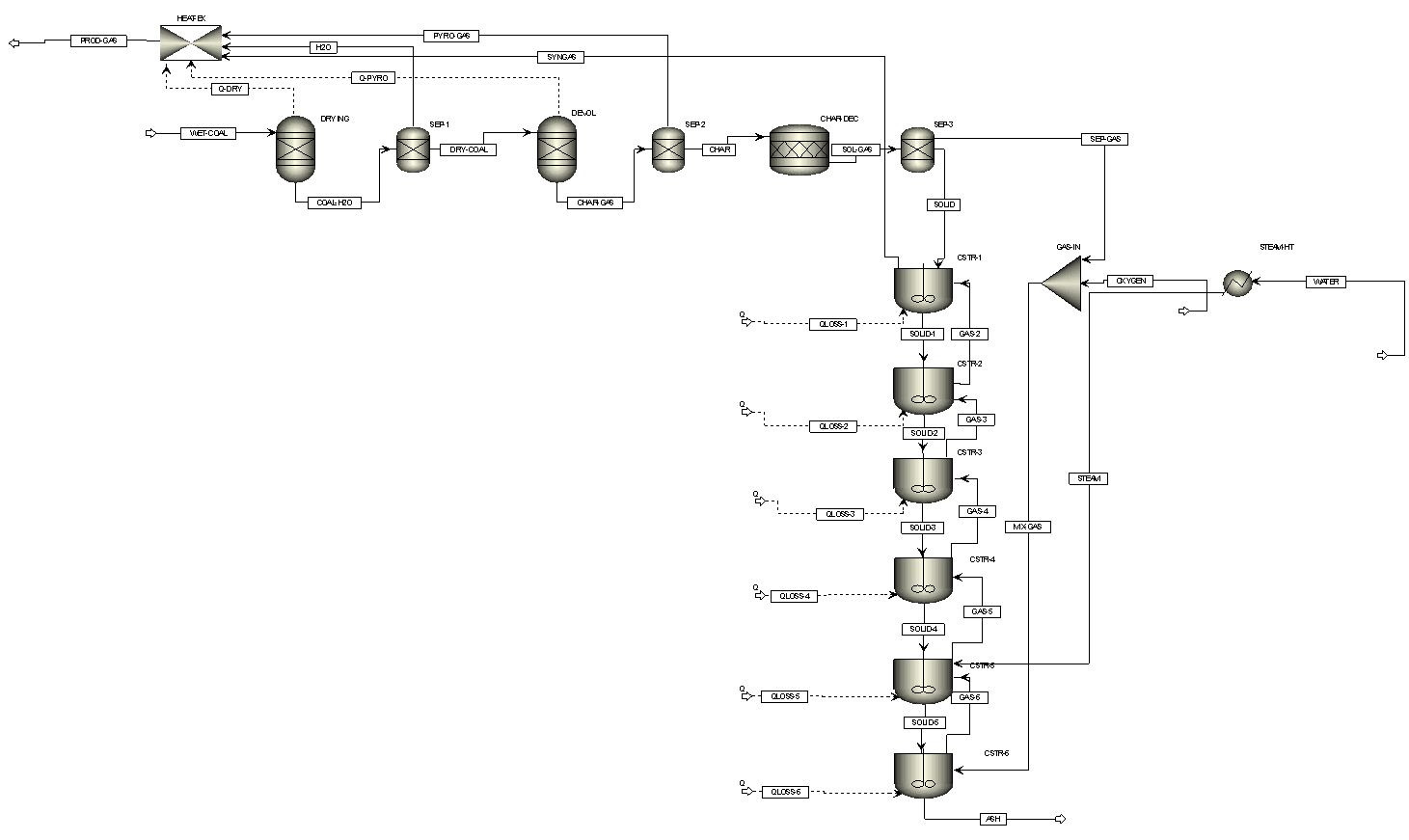
This paper presents the process simulation and modeling of a moving bed gasifier using two Montana coals (DECS-38 sub-bituminous coal and DECS-25 Lignite coal), one biomass sample (corn stover) and their blends (10% and 30% by weight of corn stover). All the processes occurring in a moving bed gasifier, drying, devolatilization, gasification, and combustion, are included in this model.
The model, developed in Aspen Plus using external FORTRAN subroutines, is used to predict the effect of various operating parameters including pressure, oxygen to coal, and steam to coal ratio on the product gas composition. Developing Aspen Plus model requires knowledge of reaction stoichiometry, reaction rates, kinetics, mass, and heat transfer. The model was used to predict the composition of product gas, temperature profile, and effect of process variables on the syngas composition.
Assumptions in the model are as follows:
(1) The model is in steady state.
(2) Coal and gas flow as plug flow. Plug flow assumes constant velocity across the cross section of the gasifier with no back-mixing.
(3) Residence time of the coal in drying and pyrolysis section is assumed to be negligible as compared to combustion-gasification section.
(4) The pressure drop in the gasifier is neglected.
(5) Volumetric reaction represents all gas-solid reactions except char combustion which is according to shrinking core model.
(6) Gas temperature is the same as solid temperature at every point in the gasifier.
The results obtained from the simulation were compared with experimental data obtained for the same feedstocks using a laboratory scale moving bed gasifier. The predicted composition of the product gases was in general agreement with the established results. Carbon conversion increased with increasing oxygen-coal ratio and decreased with increasing steam-coal ratio. Steam to coal ratio and oxygen to coal ratios impacted produced syngas composition, while pressure did not have a large impact on the product syngas composition.
All the feedstock materials have been gasified in a moving bed reactor running in a completely auto-thermal batch mode using several air/oxygen/steam ratios. A laboratory-scale gasification system has been designed and constructed. The main components are schematically represented in Figure 1. Coal/biomass is fed at the top of the gasifier by means of a quick-open flange while air/oxygen and steam are fed simultaneously upwards through the bottom of the gasifier. The product gas from the gasifier contains mainly hydrogen, carbon monoxide, carbon dioxide and small amounts of methane.
The gasifier is a cylindrical stainless steel modular flange assembly having an internal diameter of 1.37 inches with quartz/stainless steel tubing of 0.075 inches on the inside and a height of about 10 inches from the grate. The internal tubing is fitted with a stainless steel grate with holes large enough to let the ash pass through but small enough to hold the feed material. The grate is connected to a mechanical rotary linear feed-through to periodically remove ash. The bottom zone, under the grate, has another cylindrical stainless steel flange with a height of about 5 inches to collect and then discharge the ash produced in the process.
The energy content of the gas produced through gasification depends on numerous factors, such as the oxidizing agent, reactor type, fuel type and form, etc. The oxidizing agent can be chosen as air, oxygen, steam, or a mixture of these. When air is used, the resulting gas has a low calorific value. This can be increased by using oxygen or steam but in the latter case sufficient heat should be provided because steam gasification is an endothermic process.
|
See more of this Group/Topical: Catalysis and Reaction Engineering Division