
 Google
 Yelp
 Facebook
 Twitter
 ChEnected
343668 Brownain Dynamics Simulation of Discrete Red Blood Cell Model Based On Kinetic Theory With Constraints
The progression of disease is oftentimes accelerated by the changes in the mechanical behavior of cells. The rheological material properties of biological cells such as red blood cells are important factors in the occurrence and onset development of diseases. A better fundamental understanding of flow and its rheological properties will help rational approach to prevention of serious conditions and its costs, and development of new treatments as well.
The empirical data of the human blood, for example, has non-Newtonian behavior and its elastic properties have been measured. The viscosity drops as the shear rate increases instead of remaining constant as in the Newtonian fluids. Often times the pure mathematical Casson model has been used to model the behavior of the blood since it gives the characteristic of power-law slope of the viscosity similar to that of experimental data. However, the model neither predicts the time-dependent behavior nor fit all the range of shear rate empirical data where the viscosity tends to have nearly constant viscosity at the low and high shear limits. More importantly, the Casson model gives us no insight into the dynamics of cells in complex flows.
The Brownian Dynamic simulation will allow predicting the movement of biological cell in methodological way with the consideration of all the forces such as hyodrodynamic, the Brownian, intermolecular, and constraint forces. Instead of considering blood as continuum fluid or using an empirical constitutive equation, we can use kinetic theory where the stress tensor and a stochastic differential equation (SDE) of motion depend on the configuration of the microstructure of the fluid. Blood is considered as a suspension of deformable red blood cells (RBC) in a dilute solution of Newtonian fluid. Our approach is to construct a discrete model of bead-spring RBC based on kinetic theory with a holonomic constraints using Lagrange multiplier method. The constraints such as total area, cell volume, and local curvature describe the effect of the biological cell conserving its overall size throughout the motion of flow while allowing the shape to deform. We present our method and demonstrate its applicability to study rheology of biological cells and further study of blood flow. To validate the capability of the method, the minimalist bead-spring-ring model to represent the RBC was simulated. A simple linear Hookean spring is used to give flexibility to deform. The two geometrical constraints were set to have constant area and constant total length of the connected springs. The two-constraint model gives more restriction to deformation than one-constraint method where the constraint is only an area, and yet still has some degree of flexibility. The model is tested under shear and shear free flow. An assumption was made that the friction tensor is isotropic. Averaged rheological material properties of the fluid can be calculated with the components of stress tensor. The rheological material properties obtained are qualitatively in agreement clearly showing shear-thinning effect of viscosity in shear flow. We can also observe Fahraeus-Lindqvist effect in the capillary flow with this study where the viscosity drops as the vessel diameter decreases.
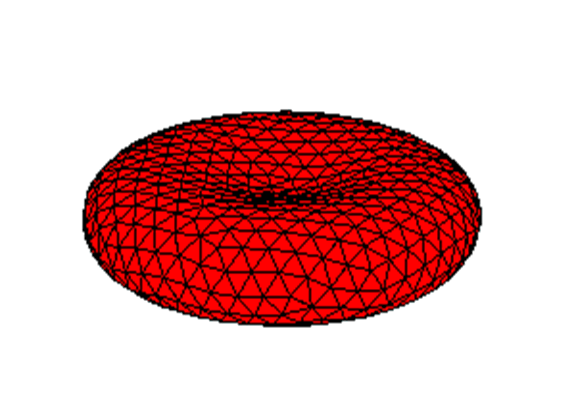
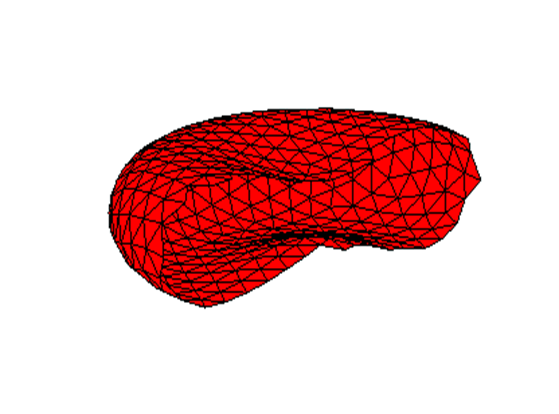
Figure. Biconcave shape of RBC using mathematical expression from Kuchel (1999) in Cartesian coordinate. 3D surface meshing of 558 particles is generated using distance functions and Delaunay triangulation algorithm.
Further study on more complicated geometric modeling of microstructures can be done with hydrodynamic interaction.
See more of this Group/Topical: Food, Pharmaceutical & Bioengineering Division