
 Google
 Yelp
 Facebook
 Twitter
 ChEnected
344500 CFD Simulation of Rayleigh Benard Convection in Annular Cylinder System: Heat Transfer Mechanism and Vortex Pattern
Title: CFD simulation of Rayleigh Benard convection in annular cylinder system: Heat transfer mechanism and vortex pattern
Authors: Vedantam, S1*., Dhotre, M.T.2
Affiliation: 1Industrial Flow Modeling Group (iFMg), CEPD Division, National Chemical Laboratory (NCL), Pune, INDIA
2Institute of Chemical Technology, Matunga, Mumbai, INDIA
*corresponding author: spriya.vedantam@gmail.com
ABSTRACT
Introduction:
Thermal convection is an important phenomenon in nature and coming in extreme use in technology. Rayleigh- Benard convection refers to the instability which occurs in a viscous fluid layer subjected to a vertical negative temperature gradient, in the same direction as gravity. A key question is the dependence of the heat transfer rate as measured by the Nusselt number (Nu) for a given temperature difference between the hot bottom and the cold top plates (measure termed as dimensionless Rayleigh number (Ra)), a given fluid (properties termed as dimensionless Prandtl number (Pr)), and a given aspect ratio of the container. Since over the last two decades there has been tremendous progress on this and related questions by experiment, theory, and numerical simulation (Ahlers et al., 2009). However, most of the work reported focused on the RB convection for single-phase flow. Various situations in the process and the energy industries, involve liquid convection in the presence of boiling: vapor generators in nuclear and conventional electric power plants, reboilers, distillers, water purification systems, cooling applications and many others ranging from material processing to nuclear systems to atmospheric sciences.
Boiling as a heat transfer mechanism has been a subject of interest for centuries and the process has formed the object of a very large number of studies (Dhir, 1998). Most of the focus has been on the process by which the high thermal resistance opposed by the visco-thermal layer adjacent to the hot surface is decreased by the vapor bubbles; the two main mechanisms are believed to be micro-convection and latent heat transport. Another significant effect of the bubbles, however, is to promote strong convective currents in the liquid, thus helping to remove the heated layer near the hot wall (Oresta, 2009). With this backdrop, it is of interest to gain deeper understanding of the possible outcomes of such thermal instability. It is realized important to venture on the hydrodynamic modeling of thermal instability in combination with centrifugal instability (Taylor-Couette flow, measure given by a dimensionless Taylor number (Ta)) and with certain variations in the geometry of the domains of interest.
As an initial step, single phase simulations have been carried out in concentric cylinder system, including the heat transfer, in the presence of centrifugal instability. The standard single-phase RBC under the Boussinesq approximation is controlled by Rayleigh number and Centrifugal instability has been introduced into the system, using Taylor number. Commercial software Ansys Fluent has been used for all simulations. 2D axi-symmetric model with a swirl component has been used to solve the flow equations. Turbulence has been incorporated using the RSM model. It was assumed that density is the only property that gets affected by the change in the temperature between both the boundaries, and hence Boussinesq approximation has been used. Mercury has been used as working fluid for the single phase simulations. Model has been validated with the experimental data of Rossby (1969) as shown in the figure 1:
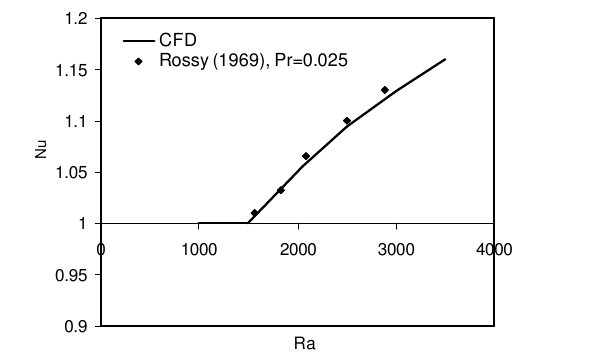
CFD simulations in the annulus of coaxial cylinders (with no eccentricity) revealed the formation of contra-rotative cells along the length for an established temperature difference and rotational speed. The cell formation is in agreement with experimental as well as theoretical observation.
It is of interest to arrange the system with an eccentricity to see the impact on the heat transfer mechanism in the annulus and the vortex patterns formed therein. Hence two such co-axial systems have been simulated, in the initial case without a rotation, which have been validated with the established data; and with rotation such that these studies form a proof of concept for two-phase studies. An annular gap width of 28.5 mm is used, for three different annulus lengths of 10, 20 and 40 cm respectively. The two cases simulated are i) concentric co-axial cylinders placed horizontally ii) non-concentric annular cylinders with an eccentricity of -0.623. The effect on heat transfer mechanism and vortex patterns along the length of the annulus are studied. Air as well as low-Pr fluids are considered as the fluid systems in the domain of interest. For all these simulations, commercial software Ansys FLUENT has been used. Heat flux from the surface of the cylinders has been estimated and compared for the two cases.
References
Ahlers, G., Grossmann, S., and Lohse, D., 2009, Rev. Mod. Phys. 81, 503.
Dhir, V., 1998, Annu. Rev. Fluid Mech., 30, 365.
Oresta, P., Verzicco, R, Lohse, D, Prosperretti, A, Physical Review E., 80, 026304 (1-11) (2009).
Rossby, T., J. geophys. Res., 74, 5542-5545 (1969).
See more of this Group/Topical: Nuclear Engineering Division - See also ICE