
 Google
 Yelp
 Facebook
 Twitter
 ChEnected
377143 Construction and Degradation Properties of Fusion Enzymes Composed of Bacterial Expansin and Endoglucanase
Construction and Degradation Properties of Fusion Enzymes Composed of Bacterial Expansin and Endoglucanase
Kazunori Nakashima, Koji Endo, Naomi Shibasaki-Kitakawa, Toshikuni Yonemoto
Department of Chemical Engineering, Tohoku University, Sendai, Japan
1. Introduction
Lignocellulosic biomass, composed of cellulose, hemicellulose, and lignin, is the most abundant and renewable resource with great potential in biorefinery process. Cellulose in biomass can be degraded into fermentable sugars such as glucose by the action of cellulase. One of the most serious obstacles in the utilization of cellulose lies on the low digestibility by cellulase, mainly because of highly crystalline structure of cellulose. Therefore, the pretreatment of biomass is necessary to enhance its digestibility by breaking high crystallinity of cellulose. However, the pretreatment often involves chemicals such as acids and alkaline, which should be removed before enzymatic hydrolysis, and also requires high energy consumption for treatment at high temperature and pressure, causing process complication and the increase of pretreatment cost. If cellulases acquire the ability to break high crystallinity of cellulose, pretreatment process could be potentially omitted, leading to the construction of innovative biorefinery process.
Expansin is a plant protein that is known to be capable of loosening the packaging of the plant cell wall and disrupting cellulose crystal, without showing hydrolytic activity. Expansin-like proteins have also been found in bacteria such as Bacillus subtilis. This bacterial expansin could be substantially expressed in an active form in Escherichia coli. In the present study, we have constructed a novel fusion enzyme composed of expansin and endoglucanase (cellulase). The degradation properties of the fusion enzymes were evaluated using cellulose substrates with different crystallinity.
2. Materials and Methods
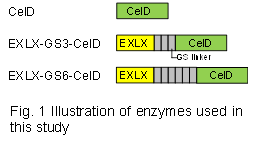 Bacillus subtilis expansin (EXLX) and Clostridium thermocellum
endoglucanase (CelD) were cloned from each genome DNA by PCR. We
constructed different types of fusion enzyme composed of EXLX and CelD which is
connected by a flexible GS linker with different length, that is, EXLX-GS3-CelD
and EXLX-GS6-CelD (Fig. 1). The enzymes were overexpressed in E. coli
BL21 (DE3) as a his-tagged protein and purified by Ni-nitrilotriacetic acid
affinity column.
We prepared cellulose substrate with different crystallinity by treating crystalline cellulose (Avicel) with different concentration of phosphoric acid, and obtained cellulose with the crystallinity index (CrI) of 13.7, 57.6, 74.0.
Enzymatic hydrolysis of cellulose was performed by shaking a reaction mixture (5 ml) containing the cellulose (5.0 g/l) and enzymes (1.0 µmol/l) at 100 rpm and 40°C. The concentration of oligosaccharides generated was measured by HPLC equipped with evaporative light scattering (ELS) detector.
3. Results and Discussion
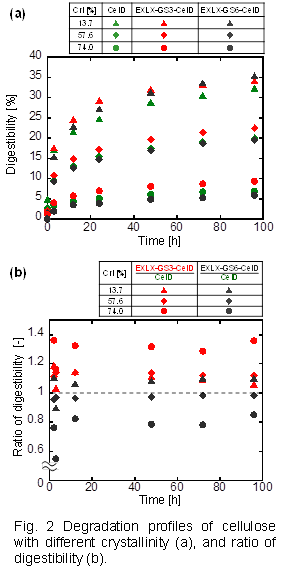 Figure 2(a) shows the degradation profiles
of three different celluloses by the three kinds of enzymes, CelD, EXLX-GS3-CelD,
and EXLX-GS6-CelD. In all of the enzymes examined, cellulose with higher
crystallinity was shown to be less degradable than that with lower
crystallinity. As for the activity of each enzyme, EXLX-GS3-CelD
exhibited higher activity compared to CelD for all cellulose substrates, while EXLX-GS6-CelD
expressed variable activity depending on the crystallinity of cellulose; that
is, EXLX-GS6-CelD showed higher activity than CelD for the cellulose of CrI
13.7, but similar activity for the cellulose of CrI 57.6, and lower activity
for the cellulose of CrI 74.0.
To evaluate the effectiveness of fusion of EXLX, the digestibility of fusion enzymes (EXLX-GS3-CelD and EXLX-GS6-CelD) were divided by that of CelD to calculate the ratio of digestibility in each reaction system (Fig. 2(b)). The ratio of EXLX-GS3-CelD/CelD became higher with the increase of CrI. In contrast, inverse tendency was observed for EXLX-GS6-CelD/CelD. These results suggested that the activity and the property of fusion enzymes were altered depending on the length of linker between EXLX and CelD, and fusion enzyme EXLX-GS3-CelD would act more effectively than EXLX-GS6-CelD for highly crystalline cellulose.
See more of this Group/Topical: Food, Pharmaceutical & Bioengineering Division