Tuesday, November 10, 2015: 9:54 AM
Salon H (Salt Lake Marriott Downtown at City Creek)
Flare stacks are key system in the petrochemical
process industries, where off gases containing hydrocarbons are combusted before
sending it to atmosphere. This study
discuses a molecular seal gas leak upstream of a flare stack in a commercial scale
petrochemical plant. This leak is
difficult to fix during the continuous plant operation, so it had to wait until
next turndown time. To continue
operation, risk analysis requires the calculations of the distribution of the
leaked gas in the proximity of the flare to rule out potential fire/explosion. Flammability limits (LEL: Lower explosive
limit / UEL: Upper explosive limit for each individual species are identified. The
diffusivity coefficient of each species in air is determined from available empirical
correlations. The combustible hydrocarbon
dispersion in the atmosphere from the flare line is predicted
using CFD modeling. Computational domain
for CFD model consist of the atmosphere surrounding the flare stack near leak. Prevailing wind velocity and direction data is used for the atmospheric domain boundary conditions. A 2D model is used to
identify the extent of computational domain of interest for the 3D
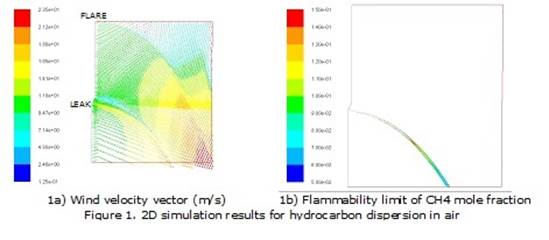
simulations. The preliminary 2D model results
are shown in Figure 1. The extent of the flammable zone for the Methane
gas is shown in Figure 1b. 3D simulations will also be
presented to capture the effects of the flare stack body on flow
turbulence and leak gas distribution including parametric study to assess wind
velocity/direction and flare gas composition.
Extended Abstract: File Not Uploaded

