

Nitrogen oxides (NOx) are pollutants generated during combustion in air. Catalytic oxidation of NO to NO2 is a critical component of all NOx remediation strategies. NO oxidation is catalyzed by supported Pt, and experiments reveal that turnover rates are highest on Pt single crystals [1]. Under catalytic conditions, the Pt surface is covered with O and NO. The binding energies of these species are coverage-dependent, and molecular models that properly capture this coverage dependence are necessary to capture experimentally observed rates, rate orders, and apparent activation energies.
Our group has used a cluster expansion (CE) approach to describe coverage-dependent O adsorption on Pt (111) [2] and, combined with Monte Carlo simulations and the observed Brønsted-Evans-Polanyi relationship between adsorption energy and surface reaction barriers, developed NO oxidation kinetic models that recover most observed behavior [3]. One of the basic assumptions of the models used so far was that NO coverage is negligible and oxygen is the only species that adsorbs on the catalyst surface. In this work, we use a density functional theory (DFT) based cluster expansion that incorporates co-adsorption of O and NO on Pt (111) to obtain kinetic parameters for NO oxidation conditions using Grand Canonical Monte Carlo (GCMC) simulations. We compare results to an oxygen-only model and to mean-field models that incorporate the coverage dependence approximately.
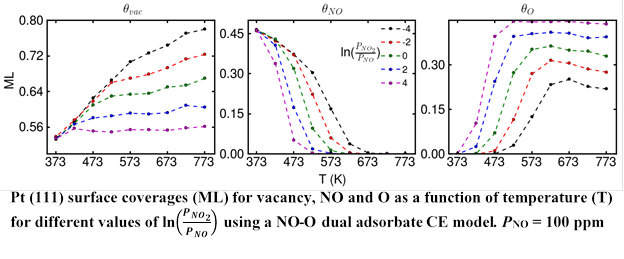
We find that the complexity of the model needed to simulate NO oxidation on Pt (111) depends on the temperature and the concentration of NO in the reaction system. At temperatures below ~ 523 K, we observe a presence of NO on the catalyst surface that affects the obtained kinetic parameters and therefore an oxygen only model does not capture this feature. For temperatures beyond 573 K, both, oxygen only and the NO-O dual adsorption model produce similar results.
References
1. A. D. Smeltz, W. N. Delgass, F. H. Ribeiro, Langmuir 26 (21), (2010) 16578-16588.
2. D. J. Schmidt, W. Chen, C. Wolverton, W. F. Schneider, J. Chem. Theory Comput. 8, (2012) 264-273.
3. C. Wu, D. J. Schmidt, C. Wolverton, W. F. Schneider, J. Catal. 286, (2012) 88-94.
See more of this Group/Topical: Catalysis and Reaction Engineering Division