

CORRESPONDING STATES THEORY OF ADSORBED FILMS: INFLUENCE OF WETTING AND WALL ROUGHNESS
Yun Longa, An Rongb, Małgorzata Śliwinska-Bartkowiakc, Matthias Thommesd and Keith E. Gubbinsb
a Department of Chemical& Biomolecular Engineering, National University of Singapore, Singapore 117585
b Department of Chemical& Biomolecular Engineering, North Carolina State University,
Raleigh, NC 27695, USA
c Faculty of Physics, Adam Mickiewicz University, Poznan 61-614, Poland
d
Quantachrome Instruments, 1900 Corporate Drive, Boynton Beach, FL 33426, USA
We illustrate the usefulness of this approach using examples
drawn from both experimental and molecular simulation studies of gas-liquid and
liquid-solid phase separations [3,4], and pressure enhancement in nanopores [5-7],
with emphasis on simple pore geometries. These examples illustrate the central
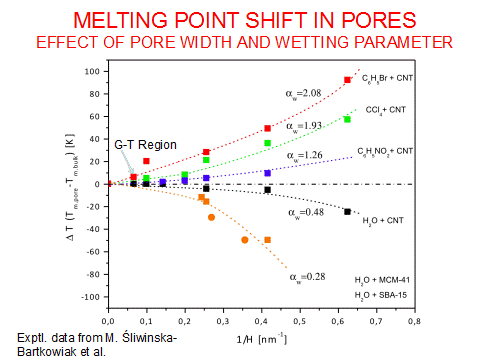
role played by wetting, and also the breakdown of some concepts and macroscopic
laws, such as the equations of Kelvin, Laplace and Gibbs-Thomson, for nano-phases
confined within small pores. They also suggest consistency tests for
experimental data that should be applied in the event of capillary condensation
or other phase changes in mesoporous materials.
The approach can be extended to account for geometric
or energetic wall roughness [8], and to adsorbate molecules that interact with
site-site potentials having both Lennard-Jones and point charge sites.
1.
R
.Radhakrishnan, K.E. Gubbins and M. Śliwinska-Bartkowiak, “Global Phase
Diagrams for Freezing in Porous Media”, Journal of Chemical Physics, 116,
1147-1155 (2002).
2.
Keith E.
Gubbins, Yun Long and Malgorzata Sliwinska-Bartkowiak, “Thermodynamics of
Confined Nano-Phases”, Journal of Chemical Thermodynamics, 74,
169-183 (2014).
3.
L.D. Gelb,
K.E. Gubbins, R. Radhakrishnan and M. Sliwinska-Bartkowiak, “Phase Separation
in Confined Systems”, Reports on Progress in Physics, 62,
1573-1659 (1999).
4.
C.
Alba-Simionesco, B. Coasne, G. Dosseh, G. Dudziak, K.E. Gubbins, R.
Radhakrishnan and M. Śliwinska-Bartkowiak, “Effects of Confinement on
Freezing and Melting”, Journal of Physics: Condensed Matter, 18,
R15-R68 (2006).
5.
Yun Long, Jeremy C. Palmer, Benoit
Coasne, Małgorzata Śliwinska-Bartkowiak and Keith E. Gubbins,
“Pressure enhancement in carbon nanopores: A major confinement effect”, Physical
Chemistry Chemical Physics, 13, 17163-17170 (2011).
6.
H. Drozdowski, M. Kempinski, M.
Śliwinska-Bartkowiak, M. Jazdzewska, Y. Long, J.C. Palmer and K.E.
Gubbins, „Structural Analysis of the Behavior of Water Adsorbed in Activated
Carbon Fibers”, Physical Chemistry Chemical Physics, 14,
7145-7153 (2012).
7.
Yun Long,
Jeremy C. Palmer, Benoit Coasne, Małgorzata Śliwinska-Bartkowiak,
George Jackson, Erich A. Müller and Keith E. Gubbins, “On the Molecular Origin
of High Pressure Effects in Nanoconfinement: Effects of Surface Chemistry and
Roughness”, Journal of Chemical Physics, 139, 144701 (2013).
8.
M.
Śliwinska-Bartkowiak, A. Sterczyńska, Y. Long and K.E. Gubbins,
“Influence of Microroughness on the Wetting Properties of Nano-Porous Silica
Matrices”, Molecular Physics, 112, 2365-2371 (2014).
See more of this Group/Topical: Separations Division