
 Google
 Yelp
 Facebook
 Twitter
 ChEnected
451359 Preparation and Photocatalytic Properties of g-C3N4/TiO2/BiVO4
Preparation and Photocatalytic Properties
of g-C3N4/TiO2/BiVO4
Shen Xinlin, Wang Youliang, Li Kebin, Wang Fengyun
The Institute of Industrial Chemistry, Nanjing University of Science & Technology, Nanjing 210094, P.R.China
Keyword: g-C3N4/TiO2/BiVO4; preparation; MB degradation
Over the last few decades, the semiconductor-based photocatalysis has emerged as an environmentally benign technology for wastewater treatment due to its destructive ability towards a wide range of inorganic and organic pollutants[1-3] . TiO2 is by far the most commonly being researched photocatalytic material owing to its many advantages for photocatalytic applications, e.g. high redox potentials, long-term thermodynamic stability, cost-effective and non-toxicity[1,4,5]. Whereas the bare TiO2 suffers from several disadvantages including the limit to ultraviolet (UV) light absorption due to its wide band gap, as well as low quantum efficiency resulting from the rapid recombination of photogenerated electron¨Chole pairs. To overcome these drawbacks and enhance the photocatalytic activity of TiO2, we constructed and prepared a ternary catalyst, i.e., mpg-C3N4/TiO2/BiVO4.
The mpg-C3N4 was obtained in a typical synthesis: dicyandiamide was used as raw material and SBA-15 as template agent and calcined under nitrogen atmospheres. The binary and ternary catalysts were prepared by hydrothermal.
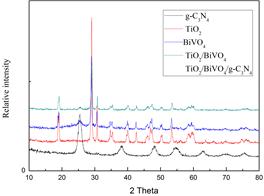
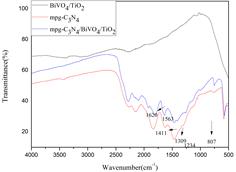
The XRD patterns of catalysts are shown in Figure 1. There are two peaks found in mpg-C3N4 sample at 12.28¡ãand 27.51¡ã, which can be indexed to (100) and (002) peak. The peaks at 25.5¡ã (101), 38.2¡ã (004), 48.2¡ã (200) and 54.9¡ã (105) indicate the existence of anatase TiO2 phase (JCPDS No. 21-1272). The other diffraction peaks are agreement with monoclinic BiVO4 phase (JCPDS No. 14-0688). No characteristic diffraction peaks of mpg-C3N4 can be observed for the ternary composite because of its low content and poor crystallization. But, its existence can be evidenced by FTIR spectra in figure 2. We have prepared the ternary mpg-C3N4/ BiVO4/TiO2 composite successfully.
|
|
Figure 1 : XRD patterns of mpg-C3N4; BiVO4; TiO2; BiVO4/TiO2; mpg-C3N4/ BiVO4/TiO2
| Figure 2 : FTIR spectra of mpg-C3N4; BiVO4/TiO2;mpg-C3N4/ BiVO4/TiO2
|
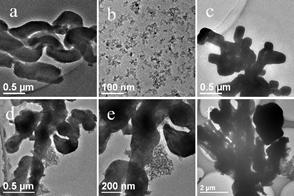
The TEM images of catalysts are shown in figure 3, we can see the binary and ternary catalysts are the formation of heterojunction. Although the size of the structure reach micron grade, the minimum structure of the hierarchical structure unit is still the nanoscale.
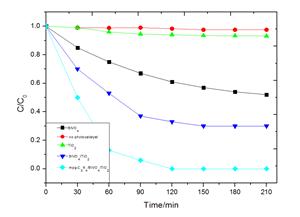
The effect of photocatalytic degradation for methylene blue (MB) under visible light radiation (¦Ë ¡Ý 420 nm) is shown in figure 4. It shows that the methylene blue is almost completely degraded by the ternary mpg-C3N4/ BiVO4/TiO2 composite after 2 h. It proves that the mpg-C3N4/ BiVO4/TiO2 composite is more efficiently than the binary and pure catalysts.
|
|
Figure 3 : The TEM image of catalysts : (a) mpg-C3N4 ; (b) TiO2 ; (c) BiVO4 ; (d-e)BiVO4/TiO2 ; (f)mpg-C3N4/ BiVO4/TiO2
| Figure 4 : The effect of photocatalytic degradation of methylene blue under visible radiation (¦Ë ¡Ý 420 nm)
|
The ternary mpg-C3N4/BiVO4/TiO2 catalysts have been prepared by calcination- hydrothermal successfully. It has been comfirmed of the formation of heterojunction by XRD, FTIR and TEM. The titled photocatalyst is efficiency for degradation of methylene blue under visible light radiation (¦Ë ¡Ý 420 nm).
References
See more of this Group/Topical: Materials Engineering and Sciences Division