
 Google
 Yelp
 Facebook
 Twitter
 ChEnected
453487 Microstructural Characterization of Gfrp Reinforcing Bars in Severe Environment
Microstructural Characterization of GFRP Reinforcing Bars in Severe Environment
Hilal El-Hassana,*, Abdelrahman Al-Sallamina, and Tamer El-Maaddawya
a Department of Civil and Environmental Engineering, United Arab Emirates University, Al Ain, United Arab Emirates, P.O. Box 15551
Abstract
Glass fiber-reinforced polymer (GFRP) bars are increasingly used as internal reinforcement in concrete structures because of their noncorrosive nature, lightweight, high strength, and ultraviolet resistance [1-5]. The microstructure and composition changes of GFRP bars exposed to severe environmental conditions are investigated in this paper. Test specimens were placed in moist seawater-contaminated concrete for up to 15 months at temperatures of 20, 40, and 60°C. Microstructural analysis was performed using differential scanning calorimetry (DSC), Fourier transform infrared (FTIR) spectroscopy, scanning electron microscopy (SEM), and matrix digestion using nitric acid. A decrease in glass transition temperature (Tg) of GFRP bars was recorded after conditioning as shown in Table 1. Conditioned GFRP bars exhibited matrix plasticization and chemical degradation. Findings from FTIR showed an increase in hydroxyl ions with conditioning at higher temperatures. Results of SEM indicated a separation at the fiber-matrix interface and matrix deterioration in conditioned specimens (Figure 1). Further microstructure examination showed a decrease in the matrix content because of conditioning.
Keywords: microstructure, GFRP; concrete; severe environment
* Corresponding author. Tel: +971(56)350-4110; Fax: +971(3)713-5156
E-mail address: helhassan@uaeu.edu
(Hilal El-Hassan)
References
1. Uomoto, T., et al., Use of fiber reinforced polymer composites as reinforcing material for concrete. Journal of Materials in Civil Engineering, 2002. 14(3): p. 191-209.
2. Debaiky, A.S., et al., Residual Tensile Properties of GFRP Reinforcing Bars after Loading in Severe Environments. Journal of Composites for Construction, 2006. 10(5): p. 370-380.
3. Robert, M., P. Cousin, and B. Benmokrane, Durability of GFRP Reinforcing Bars Embedded in Moist Concrete. Journal of Composites for Construction, 2009. 13(2): p. 66-73.
4. American Concrete Institute (ACI), Guide for the design and construction of concrete reinforced with FRP bars. 2006.
5. Chen, Y., J.F. Davalos, and I. Ray, Durability prediction for GFRP bars using short-term data of accelerated aging tests. Journal of Composites for Construction, 2006. 10(4): p. 279-286.
Table 1: Glass transition temperature of GFRP bars using DSC analysis
Conditioning | Tg (°C) | ||
Duration (months) | Temperature (°C) | 1st Scan | 2nd Scan |
Control | 120 | 125 | |
15 | 20 | 99 | 126 |
15 | 40 | 94 | 128 |
15 | 60 | 90 | 126 |
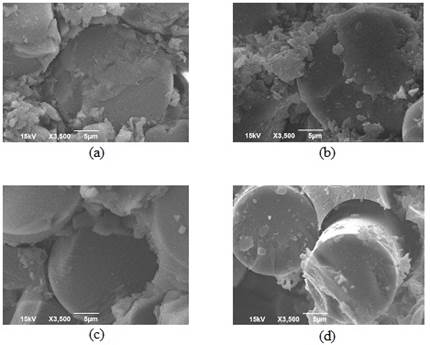
Figure 1: Cross-sectional micrograph of GFRP bars: (a) control (b) immersed for 15 months at 20°C (c) immersed for 15 months at 40°C (d) immersed for 15 months at 60°C
See more of this Group/Topical: Materials Engineering and Sciences Division