
 Google
 Yelp
 Facebook
 Twitter
 ChEnected
454263 Natural Organic Matter Fouling Behaviors on Superwetting Nanofiltration Membranes
Natural organic matter fouling behaviors on superwetting nanofiltration membranes
Linglong Shan, Hongwei Fan, Hongxia Guo, Shulan Ji and Guojun Zhang
Beijing Key Laboratory for Green Catalysis and Separation, College of Environmental and Energy Engineering, Beijing University of Technology, Beijing, China. Email: shanlinglong@126.com
In natural water, natural organic matter (NOM) components have been identified as precursors of disinfection by-products. Nanofiltration has been widely recognized as a promising technology to remove NOM from natural water. Currently, the most challenging aspect is the often inevitable occurrence of membrane fouling, which is caused by NOM accumulation on the membrane surface, as in NOM removal in drinking water treatment and production. NOM fouling is considered to be governed by the interface relationship between NOM and the membrane surface in aqueous solution. Much work has been carried out, but the effect of hydrophilicity/-phobicity of NOM and the membrane surface on fouling behavior is still a controversial issue. [1-7] The controversy originates from the unilateral consideration of membrane wettability or foulant hydrophilicity/-phobicity, when in fact both need to be considered. In our study, both superhydrophilic and superhydrophobic membranes with stable structure have been successfully obtained using two facile hybrid approaches (see Fig. 1). The fouling behavior of NOM on superwetting nanofiltration membranes has been extensively investigated using humic acid (HA: model foulant) and real natural water. The extended Derjaguin-Landau-Verwey-Overbeek (XDLVO) approach and nanoindentor scratch tests suggested that the superhydrophilic membrane had the strongest repulsion force to HA due to the highest positive ¦¤GTOT value and the lowest critical load. Excitation emission matrix analyses of natural water also indicated that the superhydrophilic membrane showed resistance to fouling by hydrophobic substances and therefore high removal thereof. Conversely, the superhydrophobic membrane showed resistance to fouling by hydrophilic substances and therefore high removal thereof (see Figs. 2 and 3). Long-term operation suggested that the superhydrophilic membrane had high stability due to its anti-NOM fouling capacity, which is crucial for practical application. Based on the different anti-fouling properties of the studied superwetting membranes, a combination of superhydrophilic and superhydrophobic membranes was examined to further improve the removal of both hydrophobic and hydrophilic pollutants. The RUV254 and RDOC could be increased to 83.6% and 73.3%, respectively, by a combination of superhydrophilic and superhydrophobic membranes. In view of the hydrophilic and hydrophobic NOM fouling behaviors on superwetting membrane surfaces, the superwetting strategy can be regarded as a very important approach for obtaining a membrane with both high NOM rejection and good anti-NOM fouling properties.
Keywords: Superhydrophilic, Superhydrophilic, Nanofiltration, NOM, Fouling
References
[1] L. Shan, H. Fan, H. Guo, S. Ji, G. Zhang, Natural organic matter fouling behaviors on superwetting nanofiltration membranes, Water res., 93 (2016) 121-132.
[2] L. Shan, H. Guo, Z. Qin, N. Wang, S. Ji, G. Zhang, Z. Zhang, Covalent crosslinked polyelectrolyte complex membrane with high negative charges towards anti-natural organic matter fouling nanofiltration, RSC Adv., 5 (2015) 11515-11523.
[3] M. Ng, S. Liu, C.W.K. Chow, M. Drikas, R. Amal, M. Lim, Understanding effects of water characteristics on natural organic matter treatability by PACI and a novel PACI-chitosan soagulants, J. Hazard. Mater., 263 (2013) 718-725.
[4] J.A. Nilson, F.A. DiGiano, Influence of NOM composition on nanofiltration, J. Am. Water Works Assoc., 88(5) (1996) 53-66.
[5] H. Yamamura, K. Okimoto, K. Kinura, W. Yoshimasa, Hydrophilic fraction of natural organic matter causing irreversible fouling of microfiltration and ultrafiltration membranes, Water Res., 54 (2014) 123-136.
[6] L. Zhang, G. Chowdhury, C. Feng, T. Matsuura, R. Narbaitz, Effect of surface-modifying macromolecules and membrane morphology on fouling of polyethersulfone ultrafiltration membranes, J. Appl. Polym. Sci., 88 (2003), 3132-3138.
[7] A. Tiraferri, Y. Kang, E.P. Giannelis, M. Elimelech, Superhydrophilic thin-film composite forward osmosis membranes for organic fouling control: fouling behavior and antifouling mechanisms, Environ. Sci. Technol., 46 (2012) 11135-11144.
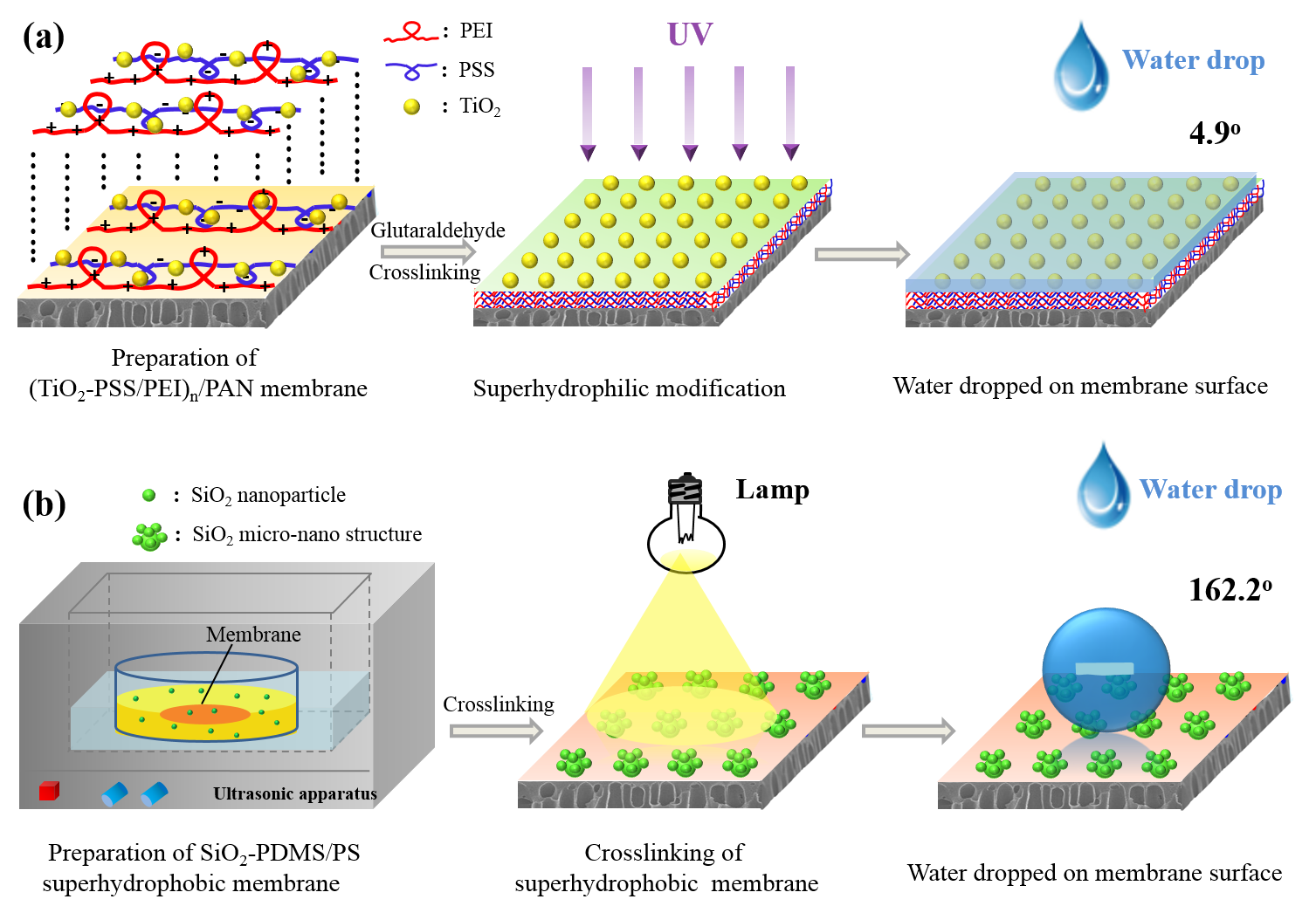
Figure 1. (a) Schematic illustration of the preparation of the superhydrophilic membrane and its surface wettability; (b) schematic illustration of the preparation of the superhydrophobic membrane and its surface wettability.
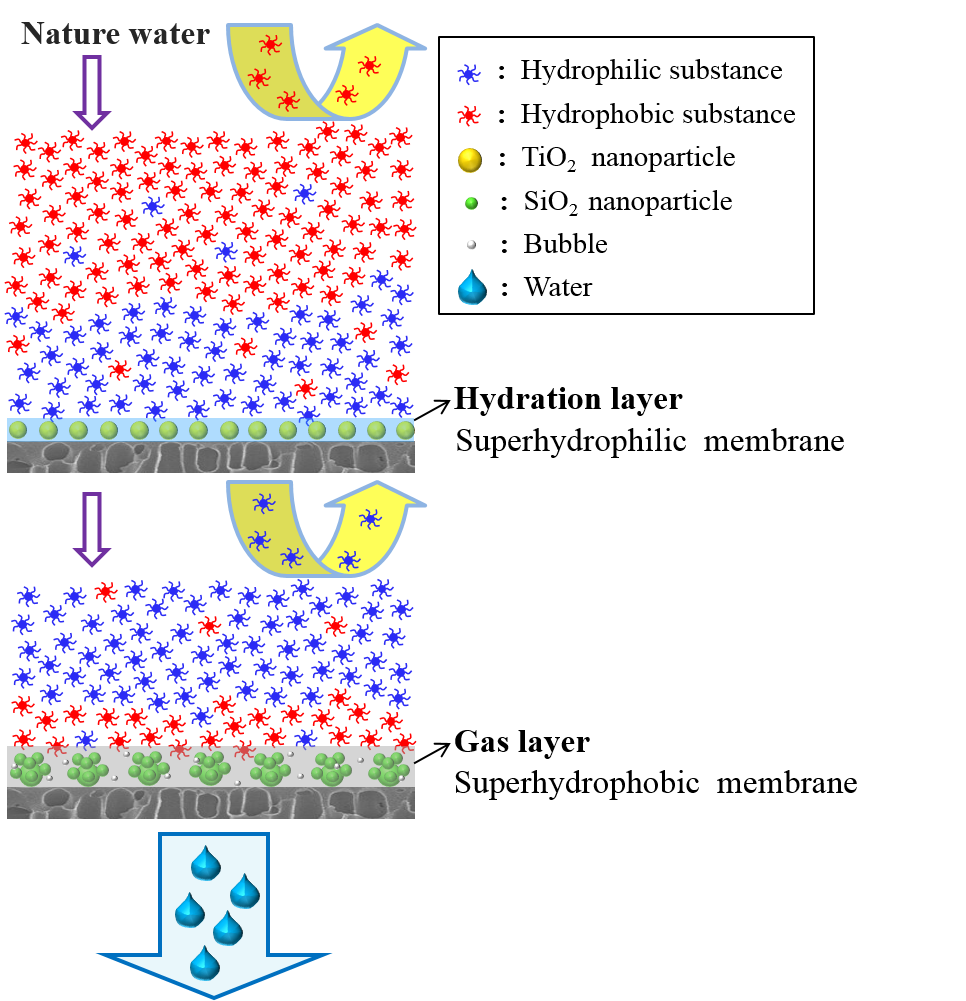
Figure 2. Schematic illustration of different anti-fouling properties of the studied superwetting membranes. Superhydrophilic membrane showed resistance to fouling by hydrophobic substances, while the superhydrophobic membrane showed resistance to fouling by hydrophilic substances.
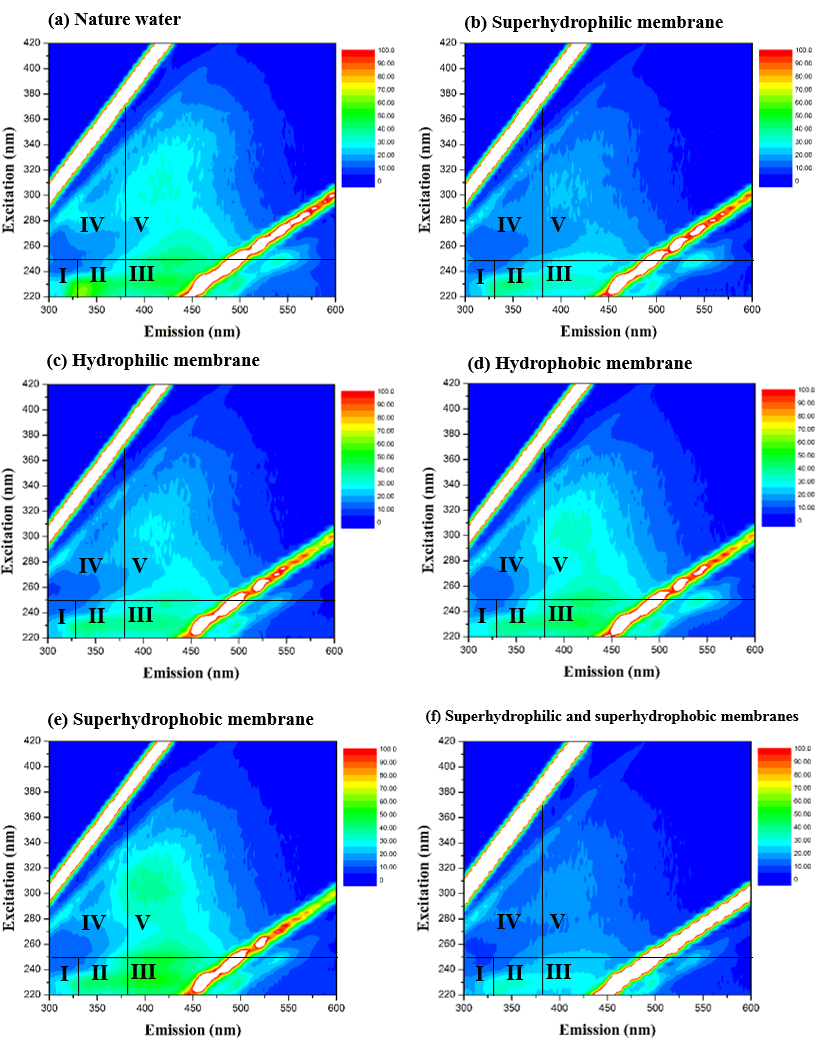
Figure 3. EEMs for (a) natural water; (b) natural water nanofiltrated by superhydrophilic membrane; (c) natural water nanofiltrated by hydrophilic membrane; (d) natural water nanofiltrated by hydrophobic membrane; (e) natural water nanofiltrated by superhydrophobic membrane; (f) natural water nanofiltrated by superhydrophilic membrane-superhydrophobic membrane.
See more of this Group/Topical: Environmental Division