
 Google
 Yelp
 Facebook
 Twitter
 ChEnected
457288 Semi-Empirical Drag Correlation for a Gas Solid Vortex Reactor Starting from the Radial Momentum Balances
Practical Information
All fields are compulsory
Last name | Friedle |
First name | Maximilian |
Email address | |
Keywords (3) | Fluidization, Particle Technology |
Abstract title | Semi-empirical drag correlation for a Gas Solid Vortex Reactor starting from the radial momentum balances |
Authors | Friedle, M; Niyogi, K; Torregrosa Galindo, M.M.; Heynderickx, G.J., Marin, G.B. |
Preferred presentation method | Oral presentation |
Division/Forum | Particle Technology Forum |
Session | 03B06 Fundamentals of Fluidization I |
Semi-empirical drag correlation for a Gas Solid Vortex Reactor starting from the radial momentum balances
Friedle, M; Niyogi, K; Torregrosa Galindo, M.M.; Heynderickx*, G.J., Marin, G.B.
Laboratory for Chemical Technology, Department of Chemical Engineering, Ghent University, Technologiepark 914, B-9052 Gent, Belgium
*Corresponding author: Geraldine.Heynderickx@UGent.be
The Gas Solid Vortex Reactor (GSVR) is a novel rotating fluidized bed reactor with a stationary geometry, in which the gravitational force in conventional fluidized bed is replaced by a centrifugal force resulting in process intensification1. In a GSVR a stable solids bed can be obtained for high gas flow rates thereby increasing the slip velocity between the phases. Consequently, the overall heat and mass transfer increases as to compared to a gravitational fluidized bed2, 3. The GSVR is a disc-like chamber where the process gas is introduced through a series of azimuthally inclined injection slots, uniformly distributed along the circumferential chamber wall. Inside the chamber the gas swirls towards the unidirectional central gas exhaust. When particles are fed inside this swirling flow field the gas transfers part of its momentum to the particles. The particles start to rotate in the chamber and form a stable, dense, rotating bed at the circumferential wall (Fig. 1). The rotational motion generates a radially outward directed centrifugal force on the particles. The injected gas flowing through the solid bed towards the unidirectional central gas exhaust generates a counteracting radially inward directed drag force on the particles. The GSVR compiles a unique set of characteristics typical for reactor technologies that combine high gas-solid slip velocities, good particle mixing and continuous operation under dense bed conditions4. As such, the GSVR technology has already been considered for different applications, like drying of biomass5, biomass pyrolysis1, SO2-NOx adsorption from flue gases6 or nuclear rocket fuel propulsion7.
As no universal understanding of the in-depth hydrodynamics of the GSVR technology is readily available, scaling and design of industrially-sized GSVRs are difficult up-to-date. An in-depth understanding of a technology often comes from a first principles approach. A first step in understanding of the multiphase hydrodynamics in the GSVR based on the radial momentum balances is aimed at in the present study.
An extensive set of experimental data has been collected by different researchers2, 3, 8, 9 over the past years in an experimental semi-batch GSVR setup at the Laboratory for Chemical Technology. The investigated range of operations spans a wide range of gas flow rates, particle sizes, particle densities and bed masses. The experimental data is used to verify the assumptions made and to determine the model parameters of the semi-empirical drag formulation.
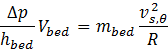
Following some simplifying assumptions, like neglecting the weight of the gas, the wall force and particle-particle interaction, the radial solids and gas momentum balances are combined to:
| (1) |
The resulting one-dimensional,
averaged equation shows that the pressure drop over the bed height balances the
centrifugal force of the bed. Here  describes the
radial height of the bed,
 the overall
volume of the bed,
 the mass of the
bed and
 the outer
radius of the unit. The azimuthal solids velocity
 is averaged
over the height of the bed.
Pressure drop over a conventional fluidized bed is usually estimated using semi-empirical correlations for the drag force10, 11. In the present work a semi-empirical correlation for the radial drag force on the GSVR bed is developed, starting from the well-known correlations for single-particle drag12. The resulting correlation is:
| (2) |

Here  is the void
fraction,
 the particle
diameter,
 is the gas
density and
 the radial
superficial gas velocity in the unit. Equations 1 and 2 are combined and
written in dimensionless form :
| (3) |

The correlation parameters are
obtained through linear regression of the available experimental data sets. The
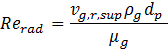
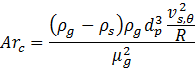
parity plot for equation 3 is shown in Figure 3. The radial Reynolds number and
the centrifugal Archimedes number are calculated from equations 4 and 5, where  is the gas
viscosity.
| (4) |
| (5) |
Using this modeling approach a more fundamental understanding of the interaction between gas and particles in a dense rotating bed is obtained. The absence of the void fraction as a classic modeling parameter, states that the gas interacts with every particle in the same way and that particle-particle interaction is minimal. In this respect the GSVR differs from conventional fluidization technologies operating in the dense bed regime, confirming the appropriateness of the GSVR for innovative industrial applications.
Acknowledgments
This work was supported by the European Research Council under the European Union’s Seventh Framework Program (FP7/2007-2013) / ERC grant agreement n° 290793.
References
1. Ashcraft RW, Heynderickx GJ, Marin GB, 2012. Modeling fast biomass pyrolysis in a gas-solid vortex reactor. Chemical Engineering Journal 207, 195-208.
2. Ekatpure RP, Suryawanshi VU, Heynderickx GJ, de Broqueville A, Marin GB, 2011. Experimental investigation of a gas–solid rotating bed reactor with static geometry. Chemical Engineering and Processing: Process Intensification 50, 77-84.
3. Kovacevic JZ, Pantzali MN, Heynderickx GJ, Marin GB, 2014. Bed stability and maximum solids capacity in a Gas-Solid Vortex Reactor: Experimental study. Chemical Engineering Science 106, 293-303.
4. De Wilde J, 2014. Gas–solid fluidized beds in vortex chambers. Chemical Engineering and Processing: Process Intensification 85, 256-90.
5. Eliaers P, De Wilde J, 2013. Drying of Biomass Particles: Experimental Study and Comparison of the Performance of a Conventional Fluidized Bed and a Rotating Fluidized Bed in a Static Geometry. Drying Technology 31, 236-45.
6. Ashcraft RW, Kovacevic J, Heynderickx GJ, Marin GB, 2013. Assessment of a Gas-Solid Vortex Reactor for SO2/NOx Adsorption from Flue Gas. Ind Eng Chem Res 52, 861-75.
7. Lewellen W. A study of fluid dynamics of gaseous nuclear rocketsQuarterly Progress Report, July 1-September 30, 1968. Massachusetts Inst. of Tech., Cambridge, 1968.
8. Pantzali MN, Kovacevic JZ, Heynderickx GJ, Marin GB, 2015. Radial Pressure Profiles in a Cold-Flow Gas-Solid Vortex Reactor. AIChE Journal 61, 4114-25.
9. Kovacevic JZ, Pantzali MN, Niyogi K, Deen NG, Heynderickx GJ, Marin GB, 2015. Solids velocity fields in a cold-flow Gas–Solid Vortex Reactor. Chemical Engineering Science 123, 220-30.
10. Gibilaro LG, Di Felice R, Waldram SP, Foscolo PU, 1985. Generalized friction factor and drag coefficient correlations for fluid-particle interactions. Chemical Engineering Science 40, 1817-23.
11. Ergun S, 1952. Fluid flow through packed columns. Chem Eng Prog 48, 89-94.
12. Gidaspow D, 1994. Multiphase Flow and Fluidization. Academic Press, Boston.
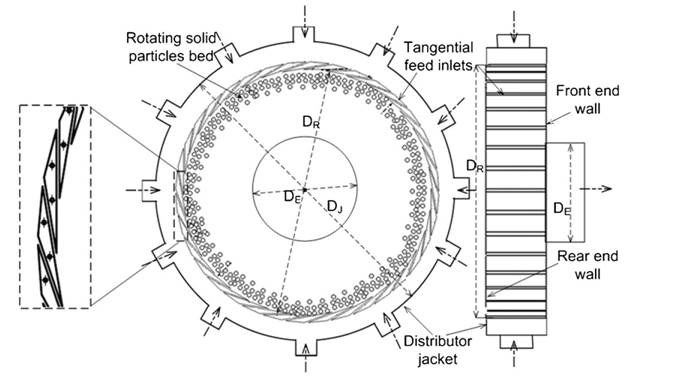
Fig. 1. A schematic representation of the Gas-Solid Vortex Reactor2
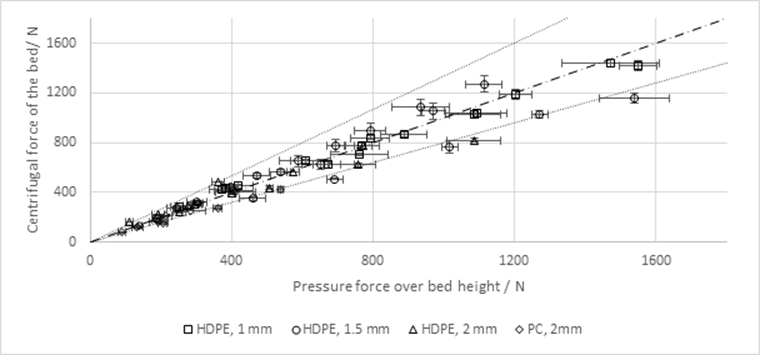
Fig. 2. Plot for the centrifugal force of the bed and the force exerted by the pressure on the bed (Equation 1).
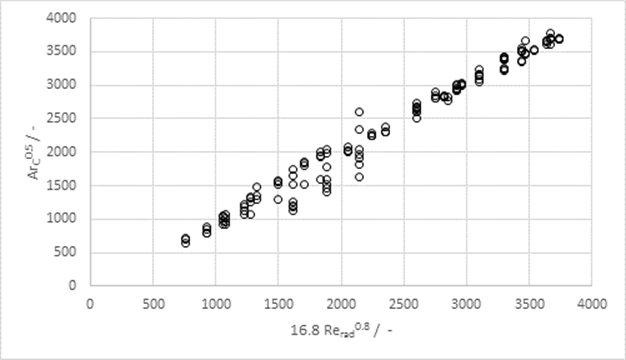
Fig. 3. Parity plot for the semi-empirical correlation for the particle-gas interaction in the GSVR (Equation 3).
See more of this Group/Topical: Particle Technology Forum