
 Google
 Yelp
 Facebook
 Twitter
 ChEnected
457344 Modelling of Diffusion-Reaction Interaction inside the Co-Based Catalyst Particles for the Fischer-Tropsch Synthesis
1. Introduction
Fischer-Tropsch synthesis (FTS) is a heterogeneous reaction used to convert synthesis gas into a range of hydrocarbon products. This reaction is a pivotal part of the Gas-to-Liquid (GTL) process in which natural gas is converted into liquid fuels and value-added chemicals. As such, FTS is often conducted inside of multi-tubular fixed bed reactors filled with cobalt-based catalyst particles. In order to avoid high pressure drops inside of the catalyst bed, relatively large particles (1-3 mm) are typically applied [1,2]. This may lead to intraparticle diffusional limitations for highly active catalysts. This means that the particle size, shape and operating process conditions may have a profound influence on the catalyst effectiveness and FTS selectivity. Several literature studies modelled diffusion with chemical reaction with Co based FTS catalysts [3,4], but focused mainly on spherical geometry and utilized rate equations based on experiments with a low activity catalyst [5].
In recent years Velocys [6] developed micro-channel reactors for FTS. These reactors utilize “super-active” Co catalysts compared to fixed-bed reactors in order to improve reactor volumetric productivity. It is expected that transport resistances could play a significant role with these reactors as well. Models of diffusion-reaction interaction are helpful in determining an optimal layer thickness that maximizes catalyst effectiveness and improves FTS product selectivity.
Here we present results from simulations utilizing one-dimensional particle models for Co-based FTS catalysts. Several critical parameters, such as the effects of shape (sphere, hollow cylinder and slab), diffusion length, temperature distribution inside the particle, diffusivity coefficients (gas- and wax-filled) and catalyst activity, and their influence on catalyst effectiveness and selectivity have been examined.
2. Diffusion-reaction model
FTS reaction can be simplified using the following stoichiometric relation:

Our model assumes that the average hydrocarbon product is n-hexane (i.e. n = 6). Therefore, the components considered in the model are: carbon-monoxide, hydrogen, water and n-hexane.
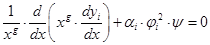
The equation describing diffusion with chemical reaction inside FTS catalyst particle can be expressed as:
where
x is the dimensionless distance,
superscript g stands for geometry (g
= 2, 1 and 0 for sphere, cylinder and slab, respectively), yi is dimensionless
concentration (i
= CO, H2, H2O and n-hexane), stoichiometric coefficient
(αi = 1, 13/6, 1 and 1/6 for CO, H2,
H2O and n-hexane, respectively), Ψ
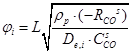
is the dimensionless CO consumption rate and φi is the
dimensionless parameter (

Reaction rate was described using the Yates-Satterfield expression [5]:
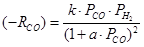
The parameters k and a in Eq. (3) were estimated from experimental data with 0.48%Re–25%Co/Al2O3 catalyst [7]. Rates of H2 disappearance and H2O and n-hexane formation are calculated based on Eq. (3) and stoichiometry of Eq. (1). It is worth noting that this catalyst is approximately an order of magnitude more active under typical FTS operating conditions compared to the original Yates-Satterfield catalyst [8], and as such is more representative of modern Co catalysts used in industrial applications.
Two approaches to effective diffusion calculations were used, one assuming wax-filled and the other gas-filled catalyst pores. The former used correlations for diffusivity in FTS wax developed by Akgerman et al. [9], which is a representative of the porous catalyst transport environment over a significant portion of the reactor bed. For gas-filled particle we used multi-component diffusion approach, adjusted with Knudsen diffusion, and this is an extreme representation of segments of the reactor bed in which catalyst pores are not entirely filled with wax.
The key aspect of FTS catalyst selectivity is methane selectivity. Methane formation rate was calculated using Ma et al. [10] expression:
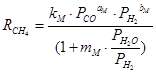
where numerical values of kinetic parameters were estimated from the same set of data as those in Eq. (3), i.e. with 0.48%Re–25%Co/Al2O3 catalyst [7]. Solution of Eq. (2) provides partial pressures needed to evaluate methane formation rate and calculate methane selectivity as:
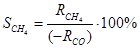
which is valid for Co-catalysts due to their low WGS activity, i.e. low CO2 formation.
3. Results and discussion
Our simulations show that with very small spherical particles (< 150 μm) diffusional resistance is small, even with highly active Co catalyst used in our study. This is consistent with literature results [2-4]. However, with larger particle sizes (e.g. 2 mm) diffusion resistances are present both with the highly active Co catalyst and low activity catalyst used in previous studies [3,4]. Figure 1 shows model results for a 2 mm diameter spherical pellet, filled with wax, with kinetic parameters obtained with 0.48%Re–25%Co/Al2O3 catalyst. Reaction rate results show that FTS follows “abnormal” kinetics (increase in rate with conversion followed by decrease at high CO conversions). Ratio of H2 to CO diffusivity is higher than the corresponding consumption ratio. This means that the ratio of H2 and CO concentrations is increasing inside the particle. Because of this, as well as the positive reaction order in H2 and negative order in CO, we get that the reaction rates inside the particle initially increase starting from the particle surface. However, for large particles, reactants are consumed relatively fast and reaction rate drops to zero leaving a large fraction of the particle unutilized (Figure 1). The calculated effectiveness factor for such a particle is only 0.52. Even more interesting is the behaviour of selectivity inside the spherical particle (Figure 1). Because methane selectivity follows the trend of H2/CO ratio, S(CH4) increases rapidly inside the particle. As concentration of CO goes to zero, H2/CO ratio becomes so high that methane selectivity at a certain point inside the particle becomes 100%. Additional insights were obtained from simulations with a lower activity catalyst, different size particles and assumption of gas-filled pores. Results strongly suggest that the eggshell catalyst distribution is the only viable option for large catalyst particles utilized in multi-tubular fixed bed reactors.
Similar simulations were performed for a slab geometry present in wall-coated micro-channel reactors with various slab thickness and reaction rates. Figure 2 shows results obtained with 300 μm thickness layer. Catalyst effectiveness for this thickness is 0.65, suggesting that lower thickness should be used in order to fully utilize the coated catalyst. Also, methane selectivity is extremely high. This is contrary to the goal of increasing the reactor productivity by adding more catalyst (i.e. using thicker layers). Therefore, an optimal solution between high catalyst effectiveness and reactor productivity has to be found. Selectivity has to be taken into account also. Our simulation show that, similar to spherical particles, methane selectivity rises almost exponentially inside of 300 μm catalyst slab and reaches 100% well before FTS rate drops to zero. Thus, selectivity has to be considered in selection of the optimal slab thickness.
4. Conclusions
A one-dimensional model of diffusion-reaction interaction inside the FTS cobalt catalyst was developed. A number of simulations for sphere and slab geometry were performed. Results show that intraparticle diffusional limitations are severe with a highly active cobalt-based catalyst. Results suggest that large 2 mm spherical particles should utilize eggshell design in order to minimize the negative impact of pore diffusion on activity and selectivity. Also, pore diffusional limitations were found to be significant for a thin layer of catalyst (300 mm). Good understanding of diffusion-reaction interplay inside FTS catalyst is required in order to optimize reactor productivity, catalyst effectiveness and product selectivity.
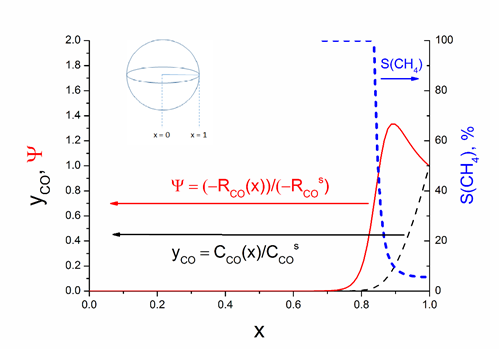
Figure SEQ Figure \* ARABIC 1 – Distribution of dimensionless CO concentration (yCO), dimensionless CO consumption rate (Ψ) and methane selectivity (S(CH4)) within a spherical particle (dp = 2 mm, T = 473 K, P = 25 bar, bulk H2/CO = 2).
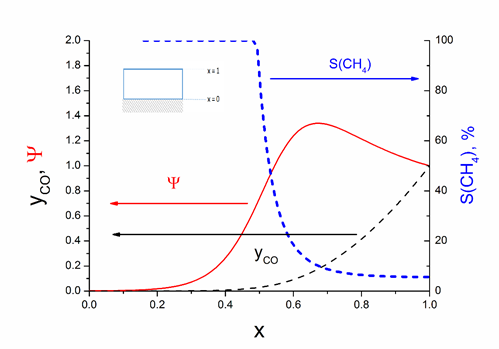
Figure 2 – Distribution of dimensionless CO concentration (yCO), dimensionless CO consumption rate (Ψ) and methane selectivity (S(CH4)) within a slab geometry (slab thickness = 300 mm, T = 473 K, P = 25 bar, bulk H2/CO = 2).
Acknowledgements
This publication was made possible by NPRP grant 7-559-2-211 from the Qatar National Research Fund (a member of Qatar Foundation). The statements made herein are solely the responsibility of the authors.
References
[1] A.P. Steynberg, M.E. Dry, B.H. Davis and B.B. Breman, Stud. Surf. Sci. Catal., 152 (2004) 64.
[2] E. Rytter, N.E. Tsakoumis, A. Holmen, Catal. Today, 261 (2016) 3.
[3] D. Vervloet, F. Kapteijn, J. Nijenhuis, J.R. van Ommen, Catal. Sci. Technol., 2 (2012) 1221.
[4] S.A. Gardezi, B. Joseph, Ind. Eng. Chem. Res., 54 (2015) 8080.
[5] I.C. Yates, C.N. Satterfield, Energy Fuels, 5 (1991) 168.
[6] H.J. Robota, L.A. Richard, S. Deshmukh, S. LeViness, D. Leonarduzzi, D. Roberts, Catal. Surv. Asia, 18 (2014) 177.
[7] B. Todic, T. Bhatelia, G.F. Froment, W. Ma, G. Jacobs, B.H. Davis, D.B. Bukur, Ind. Eng. Chem. Res., 52 (2013) 669.
[8] C. Maretto, R. Krishna, Catal. Today, 52 (1999) 279.
[9] Akgerman, Final Report DOE AC22-84PC70032, (1984).
[10] W. Ma, G. Jacobs, T.K. Das, C.M. Masuku, J. Kang, V.R.R. Pendyala, B.H. Davis, J.L.S. Klettlinger, C.H. Yen, Ind. Eng. Chem. Res., 53 (2014) 2157.
See more of this Group/Topical: Catalysis and Reaction Engineering Division