
 Google
 Yelp
 Facebook
 Twitter
 ChEnected
460978 Continuous Hydrodeoxygenation of Liquid Phase Pyrolysis Oil
Continuous Hydrodeoxygenation of Liquid Phase Pyrolysis Oil
Liquid phase pyrolysis
Non-renewable energy resources such as oil and coal will not suffice the increasing demand of energy in the future. To fill the upcoming gap a biomass liquefaction concept has been developed. This concept consists of two main process steps. In the first step lignocellulosic biomass is converted into pyrolysis oil and pyrolysis char through the bioCRACK process1. In the second step the intermediate products are upgraded. Two upgrading technologies were investigated: hydrodeoxygenation (HDO) of pyrolysis oil2 and hydrogenation of pyrolysis char. The bioCRACK process was successfully operated in pilot scale (100 kg/h lignocellulosic feed) over two years.
Continuous HDO of liquid phase pyrolysis oil
Liquid phase pyrolysis oil was upgraded by continuous hydrodeoxygenation in lab scale. Hydrotreatment was performed catalytically in a plugflow reactor. Operation parameters were 400°C and 121 bar hydrogen pressure. Lab scale results showed a carbon yield of 38% in the fuel phase with a carbon content of 86,15% and a hydrogen content of 13.35%. Fuel boiling range is shown in figure 1. The boiling range is between diesel and gasoline.
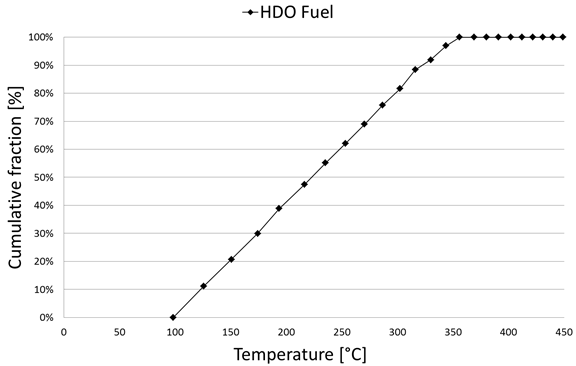
Figure SEQ Figure \* ARABIC 1: boiling range of HDO fuel from liquid phase pyrolysis oil
Direct liquefaction of pyrolysis char was carried out in lab scale catalytically and non-catalytically. Non-catalytic biochar liquefaction showed a conversion of 84% and an oil yield of 72%3, catalytic biochar liquefaction resulted in 100% conversion and 95% oil yield.
The design parameters for pilot scale of the hydrodeoxygenation technology as well as the hydrogenation technology (upgrade of pyrolysis oil as well as biochar) are under evaluation.
ADDIN Mendeley Bibliography CSL_BIBLIOGRAPHY (1) Schwaiger, N.; Elliott, D. C.; Ritzberger, J.; Wang, H.; Pucher, P.; Siebenhofer, M. Green Chem. 2015, 17, 2487–2494.
(2) Pucher, H.; Schwaiger, N.; Feiner, R.; Ellmaier, L.; Pucher, P.; Chernev, B.; Siebenhofer, M. Green Chem. 2015, 17, 1291–1298.
(3) Feiner, R.; Schwaiger, N.; Pucher, H. RSC Adv. 2013, 3, 17898–17903.
See more of this Group/Topical: Fuels and Petrochemicals Division