
 Google
 Yelp
 Facebook
 Twitter
 ChEnected
461144 Lewis Acid Catalyzed Pyrolysis of Polystyrene in Low-Temperature Molten Salts: Experiment and Simulation
Waste polystyrene is a potential energy and chemicals resource that is a major component of the plastics that are abundant in municipal solid waste. To valorize polystyrene waste, a major challenge is obtaining high yield and selectivity of the styrene monomer. Various reactor designs and catalysts have been reported previously. In our work, we have studied pyrolysis of polystyrene in ternary salt mixtures at or near their eutectic temperatures. Specifically, we have focused our attention on ternary mixtures of chlorides, with at least one component being ZnCl2, as these mixtures have melting temperatures comparable to those used for polystyrene unzipping, i.e., 300 °C and greater. Molten salt mixtures have several important advantages for polystyrene de-polymerization, notably excellent heat transfer as well as potential for dispersion of acid and/or base co-catalysts. To improve performance further, we used an inert sweep gas that removed volatile decomposition products as they were formed.
First, we examined the benefits of polystyrene pyrolysis in a 60/20/20 ZnCl2/NaCl/KCl molten salt mixture compared to thermal pyrolysis, finding that styrene yield and selectivity improved in the presence of the salt. The benefit was most pronounced at lower temperatures, with appreciable liquid yields (>60%) being achieved even at modest temperatures of 350 °C where thermal pyrolysis was much less effective. We then sought to examine the effects of polystyrene loading, ZnCl2 addition, and composition of the supporting electrolytes (e.g., ratio of NaCl and KCl and/or addition of LiCl). This work revealed that polystyrene pyrolysis in a 40/30/30 ZnCl2/NaCl/LiCl mixture could achieve an overall liquid yield of over 90% and a styrene yield of 75%. The molten salt pyrolysis performance compares favorably to yields reported in the literature, for example in the presence of an Fe-based catalyst or with microwave enhancement. Brønsted acids and bases were examined as catalysts. ZSM-5 and phosphotungstic acid greatly reduced the liquid yield, instead producing char. Thermal conditions converted Ni(OH)2 into NiO which was removed by the inert sweep gas as green particulate material.
We then sought to understand the chemical role of the molten salt using density functional theory (DFT) simulations. In particular, we investigated the potential for the metal cations present in the molten salt acting as Lewis acids via aromatic-cationic interactions. We focused on Zn+2, as this is the strongest Lewis acid in our systems. Using DFT, we calculated bonding energies of Zn+2 to a styrene trimer for a series of geometries. These calculations showed that the most stable arrangement was for the Zn+2 to intercalate between adjacent aromatic rings. The Figure is the stable geometry calculated for the intercalated configuration. However, the intercalated geometry does not result in substantial changes in carbon-carbon bonding, with only a modest changes (1-2%) in the bond lengths of several carbon-carbon bonds being observed. A second geometry, in which the Zn+2 positions directly on the aliphatic backbone, results in a substantial increase in the length of the carbon-carbon bond connecting a-methyl styrene to the remainder of the trimer. The backbone position is less thermodynamically stable than the intercalated configuration and we hypothesize that the intercalated configuration is first fully populated in the salt solvated polymer, followed by population of the backbone configuration. This hypothesis also may explain the benefits of the Li salt. Li+ has a higher charge-to-surface-area ratio than either Na+ or K+, which allows Li+ to participate more strongly in cation-aromatic interactions. Moreover, optimal Lewis acid loading is required to maintain high styrene yields without co-producing a-methyl styrene that reduce selectivity to the monomer. Brønsted acids, when combined with Lewis acids, catalyze carbon-carbon bond breaking and bond formation with low selectivity, leading to char production. These results form the basis for designing industrial recycling processes for obtaining high monomer yields from polystyrene pyrolysis.
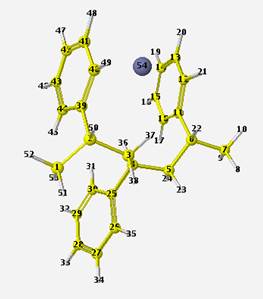
Figure 1. Optimized geometry of the styrene trimer participating in a Lewis acid/base interaction with Zn+2. Carbon atoms (yellow), hydrogen (white), zinc (blue) are color labeled for clarity.
See more of this Group/Topical: Catalysis and Reaction Engineering Division