
 Google
 Yelp
 Facebook
 Twitter
 ChEnected
461460 Highly Permeable Artificial Water Channels in Block Copolymer Membranes
Highly permeable artificial water channels in block copolymer membranes
Yue-xiao Shen, Tingwei Ren, Manish Kumar*
Department of Chemical Engineering, Pennsylvania State University, University Park, PA, 16802
*Corresponding author: 155 Fenske Laboratory, Pennsylvania State University, University Park, PA, 16802, (814) 865-7519, manish.kumar@psu.edu
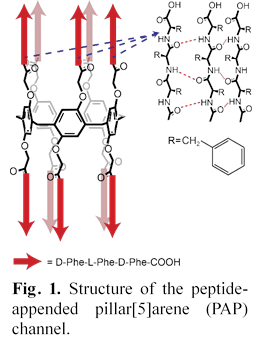 We have reported that peptide-appended
pillar[5]arene (PAP) artificial water channels (Fig. 1) combine the advantages
of biological water channels Aquaporins (AQPs) and carbon nanotubes (CNTs).1 It can be
synthesized using simple chemistry at gram scale in the lab and provide stable
structure and good solvent compatibility. The water conductance of PAP is in
the range of AQPs. It can also be vertically aligned in lipid membranes, with much
higher packing density than current synthetic CNTs-based membranes.
Although the initial testing of the PAP channels was conducted in lipid systems, this is not an ideal format for commercial separation materials. We continue to investigate the functionality of these channels in block copolymer (BCP) membranes. BCPs, with lipid-like structures, are most commonly synthesized for biomimetic applications because of the advantages of BCPs membranes including high mechanical and chemical stability,2,3 low water and gas permeability4 and customizable properties (e.g., a larger range of membrane thickness2 and end groups5). We are testing a series of poly(butadiene)-b-poly(ethylene oxide) (PB-PEO) diblock copolymers with different block length. These BCPs have different hydrophobicities and thicknesses compared to lipids, and been shown to functionally incorporate water channel proteins aquaporin 0,6 potassium channel7 and ¦Á-hemolysin.8
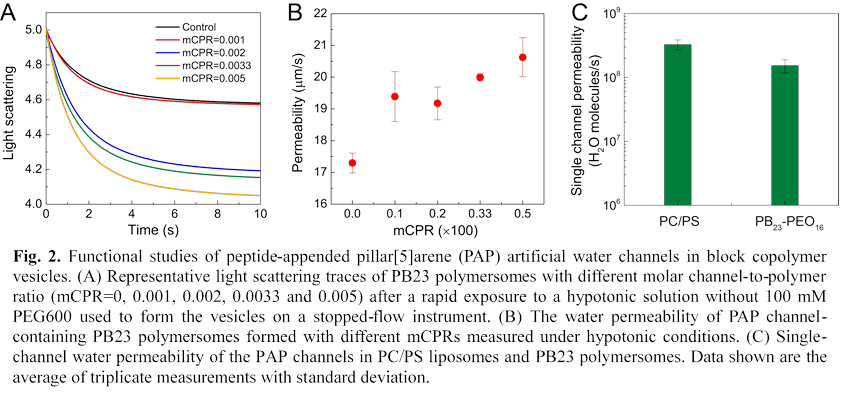
The PAP channels can be incorporated into PB-PEO BCP membranes using the film rehydration method. The number of channels per vesicle was measured based on a fluorescence correlation spectroscopy (FCS) technique.9 We combined the channel number data and permeability data using stopped-flow light scattering technique (Fig. 2A and 2B) and obtained the single channel water permeability in PB23-PEO16 vesicles (1.5¡À0.4´108 H2O molecules per second). This value is close to that in lipid system (3.7¡À0.6´108 H2O molecules per second, Fig. 2C).1 In the future, we will systematically test the PAP channels in different BCPs systems, visually confirm the incorporation in giant unilamellar vesicles and discuss the interaction of different BCPs and the PAP channels. We will also plan to use fluorescence recovery after photobleaching (FRAP) technique to determine the diffusion coefficient of the PAP channels in lipid and BCPs bilayers and expect these results can provide insights into to maximizing the channel¡¯s packing density in BCP membranes.
Reference
2 Discher, D. E. & Eisenberg, A. Polymer Vesicles. Science 297, 967-973, (2002).
See more of this Group/Topical: Separations Division